

To the average American or European eye, the word "starling" immediately conjures the image of the common European Starling (Sturnus vulgaris): a medium-sized, iridescent black bird known for its aggressive flocking behavior, remarkable mimicry, and, in the U.S., its reputation as a highly successful invasive species. Introduced to North America in the late 19th century—specifically, 60 pairs released in Central Park, New York, in the early 1890s as part of a misguided attempt to bring all the birds mentioned in Shakespeare to the continent—this bird's population exploded to over 200 million individuals, often to the detriment of native cavity-nesting birds.
Yet, this plain, though still beautiful in the right light, immigrant represents only one small, highly successful twig on a massive, globally distributed family tree. The Sturnidae family encompasses over 120 species, and many of the European Starling's lesser-known cousins—found predominantly in Africa, Asia, and the islands of the Pacific—are among the most exotically colored and visually striking birds on the planet. These species shatter the perception of the starling as a dull, aggressive pest, showcasing brilliant metallic sheens, intricate feather structures, and vivid, contrasting plumage.
These are the starlings that birders dream of seeing abroad, living proof that the family is a showcase of evolutionary artistry.
The Jewels of the Forest: Glossy Starlings (Lamprotornis Genus)
Perhaps the most famous group of visually stunning starlings are the Glossy Starlings, a genus concentrated primarily in sub-Saharan Africa. Their plumage features intense, structural iridescence, where the color is not a pigment but created by the microscopic structure of the feathers, causing light to split and reflect brilliant metallic hues.
1. The Superb Starling (Lamprotornis superbus)
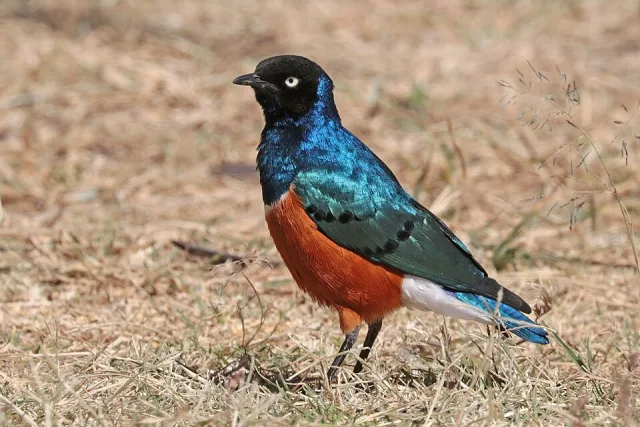
As its name suggests, the Superb Starling is arguably the crown jewel of the group and one of the most recognizable birds in East Africa.
- Appearance: This bird looks like a walking color swatch. It features a metallic blue-green head and back, a striking metallic violet-blue throat and chest, and a brilliant rust-colored belly. A thin white band separates the iridescent chest from the rusty abdomen, providing a crisp, clean border.
- Behavior and Distribution: It is common, bold, and adaptable, often found in open woodlands, savannas, and even gardens and campsites across Ethiopia, Somalia, Uganda, and Kenya. Unlike many rainforest species, its visibility makes it a favorite among tourists and birders, frequently foraging on the ground in small, social groups.
2. The Golden-breasted Starling (Lamprotornis regius)

The Golden-breasted Starling is a slightly larger, less common relative, offering a blend of warm and cool tones that is simply breathtaking.
- Appearance: This bird is defined by its metallic violet-blue tail and back contrasting with a dazzling golden-yellow breast and belly. The head is a shimmering emerald green. Like the Superb Starling, its colors shift dramatically depending on the angle of the sunlight.
- Distribution: Found in the dry thornscrub and acacia woodlands of East Africa, typically in drier, more remote habitats than its Superb cousin, making it a slightly tougher bird to locate.
3. The Purple Glossy Starling (Lamprotornis purpureus)

One of the more widespread glossy species, the Purple Glossy Starling is a feast for the eyes, often appearing almost black until the light catches it.
- Appearance: Its entire body is covered in a deep, dark structural sheen, primarily reflecting metallic purple and violet, with patches of blue and green on the wings and tail. Its eyes are a striking, piercing yellow.
- Distribution: Widespread across West and Central Africa in wooded savannas, often seen foraging socially or mobbing larger birds.
4. Metallic Starling (Aplonis metallica)
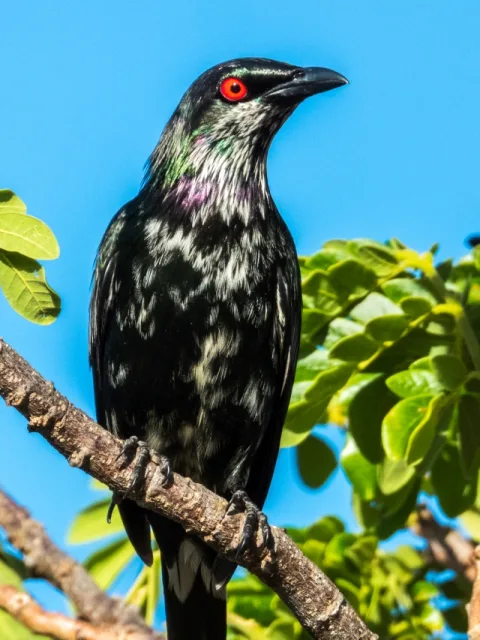
Moving away from Africa, the Metallic Starling of Australasia and Indonesia offers a unique aesthetic defined not only by color but by structural complexity, particularly its long, graduated tail feathers.
- Appearance: The male is entirely covered in a rich, glossy metallic dark green and purple-black iridescence that glows intensely in the sunlight. Its most distinctive feature is its bright red eye and its incredibly long, pointed, and graduated tail. This long tail gives it an elegant, streamlined silhouette far removed from the compact shape of the European Starling.
- Behavior and Distribution: Found across eastern Indonesia, New Guinea, and northeastern Australia. These starlings are highly social, forming massive, dense breeding colonies that can look like enormous, noisy woven baskets high in the canopy. Their social nature and preference for tall, open trees make them a spectacular sight in their native habitats.
The Wacky and Wonderful: Crests, Wattle, and Bare Faces
Moving beyond the iridescent sheen, other starling genera boast bizarre structural ornaments and unique color patterns that set them apart from the European Starling.
5. The Bali Myna (Leucopsar rothschildi)
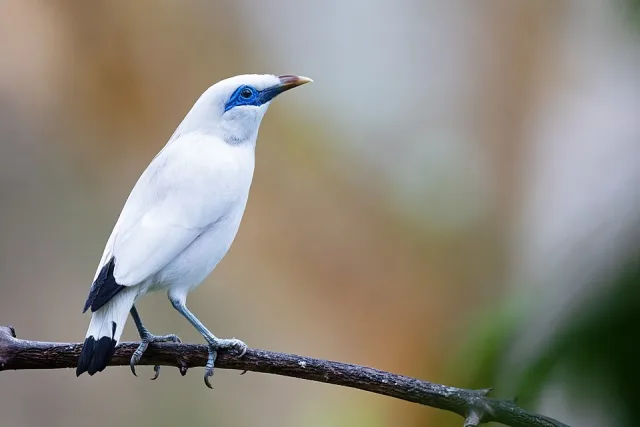
Though often called a myna (a starling subgroup), the Bali Myna is an iconic, critically endangered species endemic to the island of Bali, Indonesia.
- Appearance: This is a starling defined by its brilliant pure white plumage, contrasting with vivid blue bare skin around the eyes (a wattle). The bird sports a prominent, shaggy white crest, giving it a regal, almost punk-rock appearance.
- Conservation Status: The Bali Myna is one of the world's most endangered birds. Its wild population dropped drastically due to habitat loss and illegal pet trade collecting. Conservationists have launched intensive captive breeding and reintroduction programs to save the species, making every sighting a conservation victory. Its rarity underscores how vulnerable island endemics are compared to continental generalists like the European Starling.
6. The Wattled Starling (Creatophora cinerea)
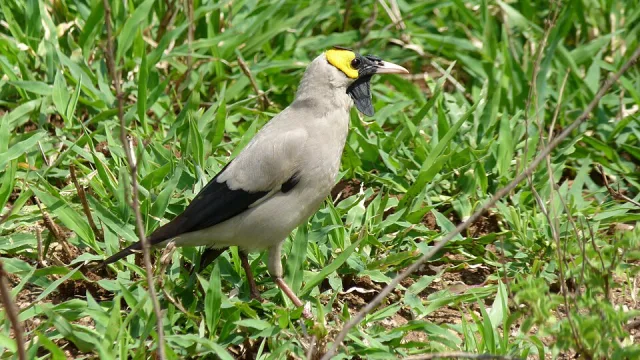
This Southern African species is unique for its dramatic, cyclical changes in appearance tied to the breeding season, making it a starling chameleon.
- Appearance: Non-breeding adults are fairly plain, gray-brown starlings. However, the breeding male undergoes a spectacular transformation: it loses most of the feathers on its head, revealing striking patches of yellow and black bare skin and developing unique, dangling black fleshy wattles or flaps of skin hanging from the back of the neck and crown.
- Behavior and Distribution: They are highly nomadic, moving in massive, often unpredictable flocks across South Africa and surrounding nations to exploit insect irruptions (like locust swarms), behaving much like a migratory pest but with a spectacular breeding-season twist.
The Asian Rainbow: Mynas and Asian Starlings
The Asian starlings, which include the well-known Mynas, show yet another array of colors and patterns, often favoring complex feather structures and bold contrasts over simple iridescence.
7. The Asian Pied Starling (Gracupica contra)
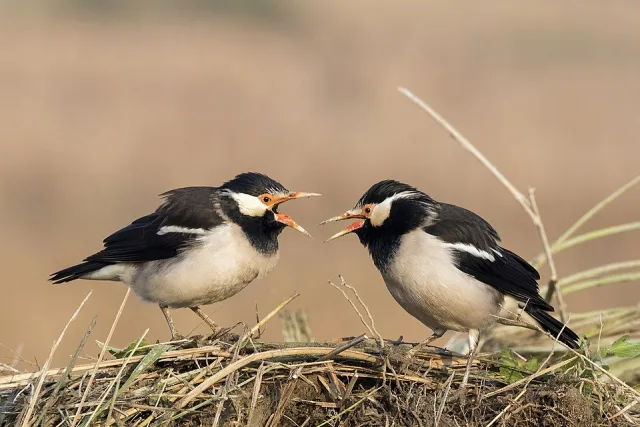
Found across the Indian subcontinent and Southeast Asia, this starling is a beautiful example of bold, contrasting feather work.
- Appearance: This starling is predominantly black and white, featuring a clean white patch on the breast, contrasting with glossy black feathers on the head and back. The skin around its eye is an eye-catching orange or red. It replaces the subtle iridescence of its African cousins with a clean, graphic pattern.
- Behavior: Like many starlings, it is a highly successful urban species, adapting well to human habitation, gardens, and agricultural lands, feeding on insects, fruit, and garbage.
8. The Golden-crested Myna (Ampeliceps coronatus)
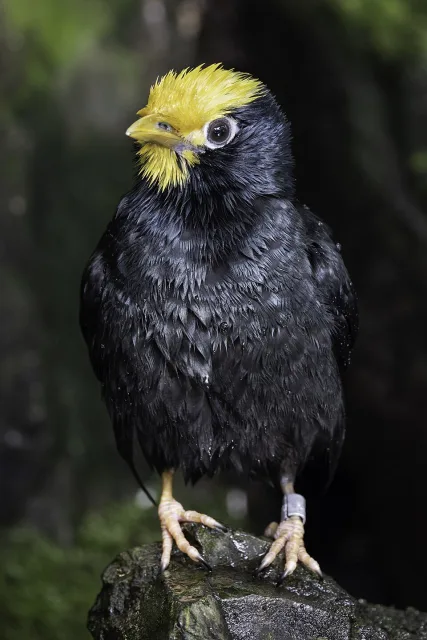
This myna species, found in Southeast Asia, highlights the use of vivid yellow and orange crests.
- Appearance: A large, glossy black myna with extensive, vibrant golden-yellow patches on its crown and nape that form a kind of feathered helmet or crest. It often has yellow fleshy wattles at the side of its head. The contrast between the jet black body and the bright yellow head is quite dramatic.
- Behavior: It is generally found high in the canopy of wet, evergreen forests, where it forages for fruit, though it is often captive-bred for its intelligence and mimicry skills.
Conclusion: Reframing the Starling Identity
The study of these exotic species forces a reframing of the "starling" identity. Far from the mundane gray-and-black bird that dominates American parklands, the Sturnidae family represents a spectacular triumph of avian evolution. Whether the adaptation is the intense, chromatic iridescence of the Glossy Starlings, the dramatic wattles of the Wattled Starling, or the monochromatic elegance of the Bali Myna, each species is a highly specialized product of its local environment.
While the European Starling’s invasion story remains a cautionary tale about introducing non-native species, its global relatives demonstrate the magnificent genetic potential hidden within the family. They serve as a constant reminder that for every common bird we see, there are dozens of brilliant, intricate, and often endangered cousins waiting to be discovered across the planet.
