

Identifying the pure white egrets of the United States can be a rewarding challenge for birders. While their dazzling white plumage makes them conspicuous against the backdrop of a marsh or shoreline, separating the species often comes down to minute details—specifically, the color of their bills, legs, and feet. The USA hosts three common species of egrets—the Great Egret, the Snowy Egret, and the less common Cattle Egret—all of which share a striking white appearance but possess distinct structural and behavioral traits.
Mastering the identification of these three primary white waders is essential for birding across North America, as they occupy habitats ranging from saltwater estuaries to inland cattle pastures.
1. The Great Egret (Ardea alba)
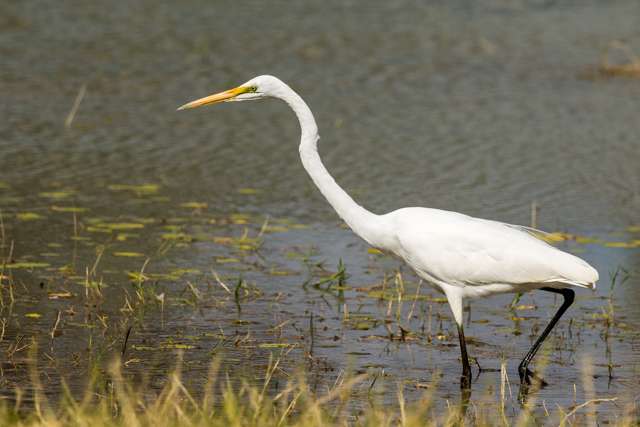
The Great Egret is the undisputed giant of the group. Its size alone is often the most reliable field mark. It is a stately, elegant bird found across all suitable wetland habitats in the lower 48 states, though it is more common in the south and along the coasts.
Key Identification Features
| Feature | Description | Importance |
| Size & Stature | Large and tall (up to 3.3 ft. tall; 4.5 ft. wingspan). Almost as tall as a Great Blue Heron. | Distinguishes it immediately from the smaller Snowy and Cattle Egrets. |
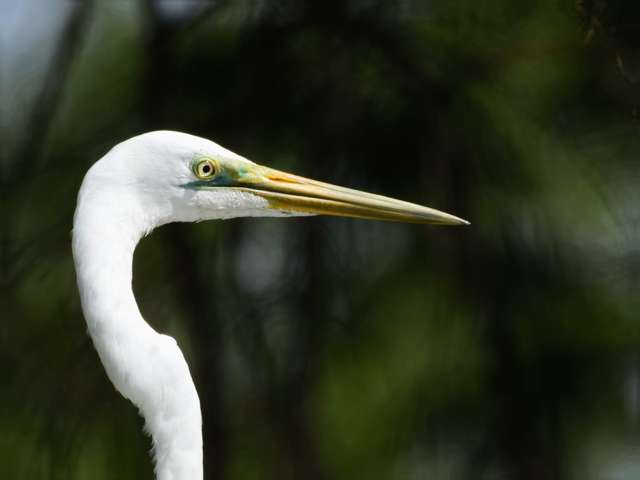
| Bill Color | Yellow and thick. | The most crucial field mark. The bill is long and dagger-like. |
| Leg & Foot Color | Black legs and black feet. | Uniformly dark legs and feet provide a contrast to its white body. |
| Neck | Long and S-curved. The neck is often longer than its body when stretched out. | |
| Breeding Plumage | Develops beautiful, long, lace-like plumes (aigrettes) on its back. The lores (skin between the eye and bill) turn a vibrant neon green. | The green lores are temporary but a definitive breeding sign. |
| Behavior | Slow, deliberate, and patient hunter. Often stands motionless, waiting for fish to come within striking range before striking with a rapid thrust. |
When to Look Closely
The Great Egret is typically a stand-alone observation, but confusion can arise with the smaller egrets when they are perched high up and their true size is difficult to gauge. If you see a pure white egret with a yellow bill and black legs, you have a Great Egret.
2. The Snowy Egret (Egretta thula)
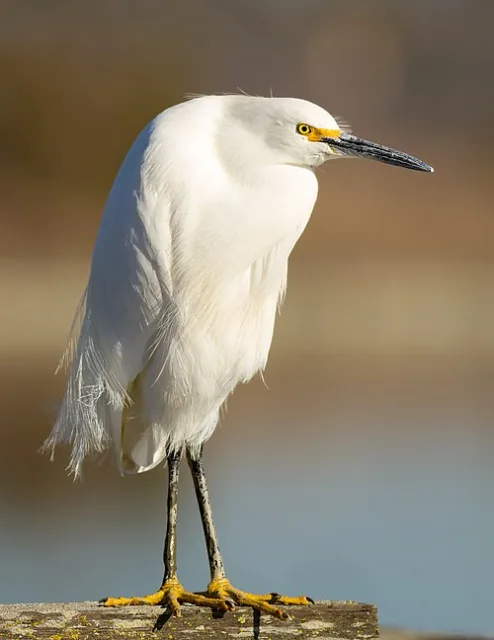
In stark contrast to the Great Egret’s statue-like poise, the Snowy Egret is a highly active and energetic hunter. It is a medium-sized bird, roughly half the size of the Great Egret, and almost exclusively associated with shallow water and mudflats.
Key Identification Features
| Feature | Description | Importance |
| Size & Stature | Medium-small (about 2 ft. tall). Smaller than the Great Egret but larger than the Cattle Egret. | Helps rule out the Great Egret immediately. |
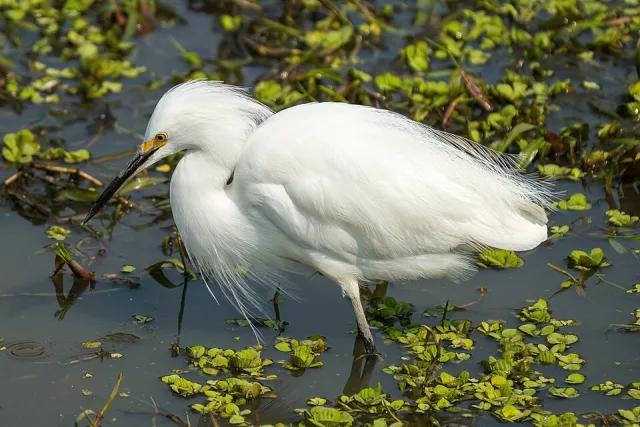
| Bill Color | Black and thin. | A dark bill immediately separates it from the Great Egret. |
| Leg & Foot Color | Black legs and bright yellow feet (often called "golden slippers"). | This is the single most defining feature of the species. |
| Breeding Plumage | Develops bushy plumes on its head, neck, and back. The skin at the base of the bill (lores) turns red or orange. | |
| Behavior | Very active forager. Uses its bright yellow feet to shuffle or stir up the mud and dislodge prey, then rapidly snaps them up. This behavior is diagnostic. |
When to Look Closely
The Snowy Egret’s yellow feet are its trademark. Even when the bird is wading in the water, the contrasting yellow feet are often visible, setting it apart from all other white egrets. If a white egret is aggressively shuffling its feet in the mud or running through the water, it is almost certainly a Snowy.
3. The Cattle Egret (Bubulcus ibis)
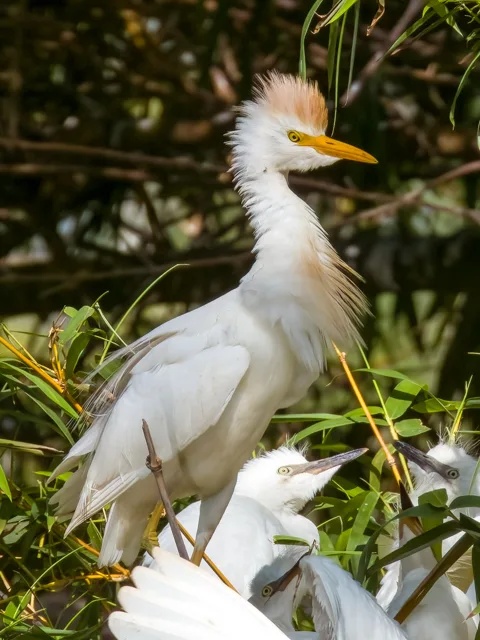
The Cattle Egret is the smallest and arguably the most unique of the three common egrets. As its name implies, it has a close association with cattle and other large grazing animals, following them to feast on insects disturbed by their movement. Its presence is often inland, far from the coastal marshes preferred by the Great and Snowy Egrets.
Key Identification Features
| Feature | Description | Importance |
| Size & Stature | Small and compact (smallest of the three, about 1.6 ft. tall). It has a thick neck and a hunched posture. | Stocky appearance is distinct from the slender look of the Great and Snowy Egrets. |
| Bill Color | Yellow and shorter, appearing thicker or stubbier than the Great Egret’s bill. | The bill changes to a deep orange or pink during breeding season. |
| Leg & Foot Color | Dull yellowish-green or grayish-yellow, changing to pink or reddish during breeding. | Never the vibrant black/yellow of the Snowy or the uniform black of the Great Egret. |
| Non-White Plumage | Develops buff or rusty-orange patches on its crown, chest, and back during breeding season. | This rusty wash is diagnostic and usually seen from spring through summer. |
| Habitat & Behavior | Found in dry pastures, fields, and roadsides, rarely in deep water. Always associated with cattle, horses, or agricultural equipment. | Habitat is the primary clue for this species. |
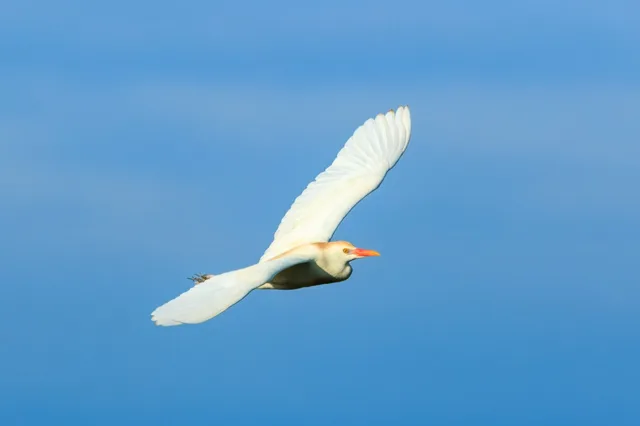
| In Flight | Flies with a more rapid wingbeat and appears more "front-heavy" than the other two species. |
When to Look Closely
If you see a small white heron far from a major body of water, feeding in a field next to livestock, you are likely looking at a Cattle Egret. During the non-breeding season, when the orange patches are absent and the bill is yellow, its size and stocky appearance are the best identifiers against the much taller Great Egret.
Comparison Cheat Sheet: The Three Common Egrets
| Feature | Great Egret | Snowy Egret | Cattle Egret |
| Relative Size | Largest (Crane-like) | Medium-Small | Smallest (Stocky) |
| Bill Color | Yellow (long, dagger-like) | Black (thin) | Yellow (short, stubby) |
| Leg/Foot Color | Black / Black | Black / Yellow | Dull Yellow-Green |
| Breeding Color | Green lores | Red/Orange lores | Buff/Rusty plumes |
| Foraging Style | Patient, stand-and-wait | Active, foot-shuffling | Follows large animals on dry land |
Tips for Egrets and Herons Identification
While the three egrets are the most common white waders, birders must also be aware of other species that can appear similar.
- Check Droppings: Look for white birds perched in trees near water. If the tree and ground are covered in white droppings (guano), it's a heron or egret rookery (nesting colony).
- Beware of Juvenile Herons: Juvenile Little Blue Herons are entirely white for their first year. If a white heron has dark legs but a dark bill, it could be a juvenile Little Blue. However, the bill on a juvenile Little Blue Heron usually shows a blue base—a feature that is completely absent on the three common egrets.
- Wading Depth: Observe where the bird is standing. The towering Great Egret can wade in the deepest water, while the Cattle Egret often avoids water altogether.
- Lighting is Key: In poor light or at a distance, the subtle colors of the bill and feet can be obscured. Wait for the bird to move into direct sunlight or use a spotting scope to confirm those critical identifying colors.
By systematically evaluating size, bill color, and leg/foot combination, birders can confidently distinguish between the elegant Great Egret, the dancing Snowy Egret, and the pasture-dwelling Cattle Egret, unlocking the secrets of these dazzling white masters of the American wetlands.
Are Penguins Really Birds? The Surprising Answer Is Hiding in Plain Sight
