
While once considered a single species, the Eastern Towhee (Pipilo erythrophthalmus) and the Spotted Towhee (Pipilo maculatus) were officially split into two distinct species based on genetic and vocal differences, though their habits remain strikingly similar. Both are large, ground-dwelling sparrows that rely on dense underbrush and employ the famous "double-scratch" technique to forage. Their differences, however, are immediate and geographical, relying on simple plumage contrasts that separate the East from the West.
Plumage and Range Differences
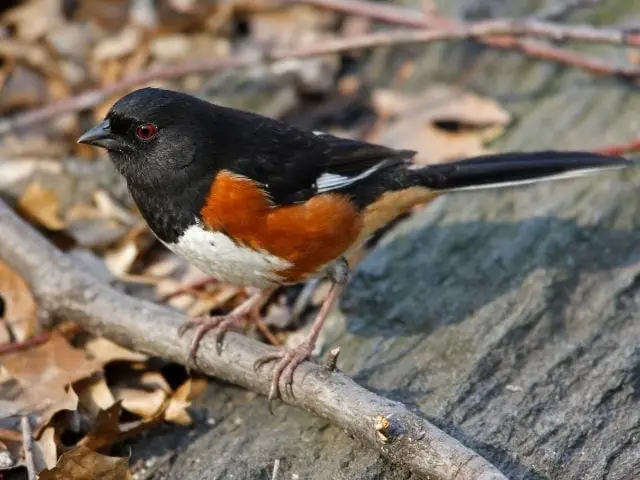
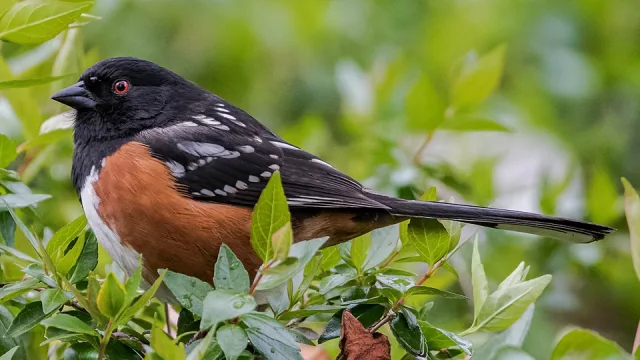
The most reliable way to tell the two species apart is by looking at the color of the back and the presence or absence of white spotting.
| Feature | Eastern Towhee (P. erythrophthalmus) | Spotted Towhee (P. maculatus) |
| Back Color | Uniformly black (male) or brown (female). | Spotted with white on the wings and back. |
| Head/Hood | Solid black (male) or brown (female). | Solid black (male) or gray-brown (female). |
| Flanks (Sides) | Bright, uniform rusty-red or rufous. | Bright rusty-red or rufous (similar to Eastern). |
| Range | East of the Great Plains, primarily found in the Eastern and Southeastern US. | West of the Great Plains, found from the Pacific Coast to the Rocky Mountains. |
| Hybridization Zone | Minimal overlap, though a narrow hybrid zone exists in the Great Plains, particularly where riparian corridors connect suitable habitat. |
Vocal Differences
The songs and calls are distinct enough to be used as primary identification tools, especially in the overlapping Great Plains region:
Eastern Towhee Song: The song is famous for its simple mnemonic: "Drink-your-tea!" It is loud, clear, and easy to recognize.
Spotted Towhee Song: The song is a faster, more complex trill that accelerates and usually lacks the clear, drawn-out syllables of the Eastern song. It's often described as a sputtering, metallic sound.
Call: Both use a distinctive chewink or tow-hee call, but the Eastern Towhee's call tends to be a bit smoother and more liquid, while the Spotted Towhee's call is often sharper and more aggressive.
In areas where they might co-occur, the rule of thumb is: if it has spots, it's a Spotted Towhee; if its back is a solid color, it's an Eastern Towhee.
