

Concealed in the deep shadows of North American woodlands and backyards, the Eastern Screech-Owl (Megascops asio) is a quintessential symbol of the nocturnal world. Despite its wide distribution and relative abundance, this small, enigmatic raptor often goes unnoticed by human neighbors. It is far more often heard than seen, its quavering, descending call serving as the soft soundtrack to many a dark night. The Eastern Screech-Owl is a marvel of camouflage and adaptability, thriving in environments ranging from deep forests to bustling urban parks.
A Master of Camouflage: The Color Morphs
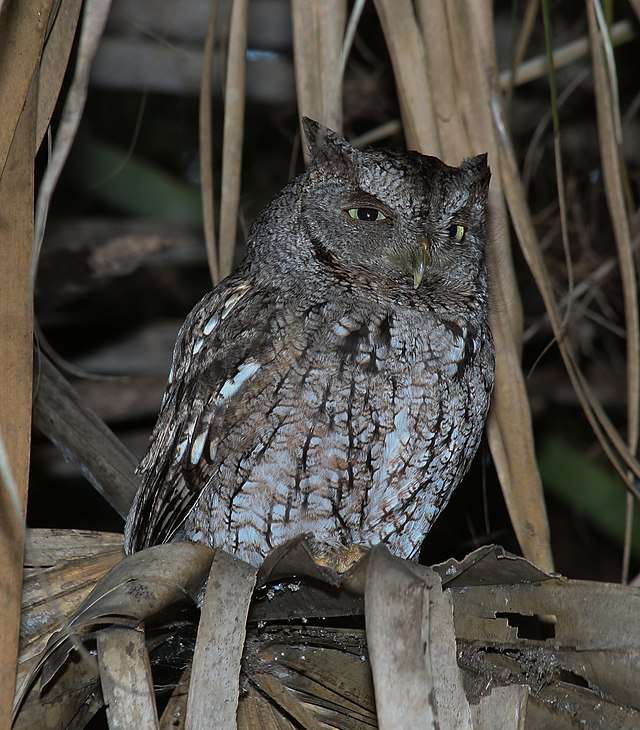
The Eastern Screech-Owl is a small, compact bird, roughly the size of a robin but appearing bulkier due to its large head and short tail. Its most defining characteristic is the presence of prominent ear tufts (feather structures, not actual ears) and bright, piercing lemon-yellow eyes.
However, what truly distinguishes this species is its unique color polymorphism, a feature not commonly seen in other North American owls. Individuals occur in two distinct color phases, or morphs:
Gray Morph: Predominant in the northern and western parts of the range, this plumage offers exceptional camouflage against the bark of deciduous trees like oak and maple.
Rufous (Red) Morph: More common in the southern and eastern parts of the range, this reddish-brown plumage blends seamlessly with pine trees or the colorful leaves of autumn.

Eastern Screech-Owl

An owl's color morph is permanent, determined genetically, and can even result in both gray and rufous offspring in the same nest. When threatened during the day, the owl employs a remarkable defense mechanism: it compresses its feathers, elongates its body, and tightens its eyes into slits, perfectly mimicking a broken tree snag or branch stub to avoid detection—a tactic often referred to as the "broken stick" posture.
The Voice of the Night
Despite its common name, the Eastern Screech-Owl rarely, if ever, makes a true "screech." Its vocalizations are much softer, tremulous, and musical, leading to folk names like the "whickering owl."
The species has two main calls:
The Descending Whinny: The primary territorial and advertising song, this call is a quavering, horse-like whinny that descends dramatically in pitch.
The Monotonic Trill: A prolonged, soft, quavering trill (a single, low-pitched note repeated quickly) that is used for contact between mates.

Eastern Screech-Owl

These calls are vital for identifying the owl, as it is strictly nocturnal, rarely beginning its hunting activity until after dusk.
Protecting the Prairie Miner: Burrowing Owl Conservation Programs
Habitat and Ecological Niche
The Eastern Screech-Owl boasts one of the broadest ecological niches of any owl in its range. It is a permanent, non-migratory resident found throughout Eastern North America, from southern Canada down to northeastern Mexico, generally stopping just east of the Rocky Mountains.
Its habitat requirement is simple: trees. It readily inhabits virtually any wooded environment, including:
Old-growth deciduous and evergreen forests.
Riparian zones (woodlands along rivers and streams).
Orchards and farm groves.
Suburban and Urban Parks: The species is highly adaptable and is often the most common avian predator in tree-filled suburban neighborhoods and city parks, frequently living within earshot of human homes.
As a cavity nester, the owl is dependent on existing tree holes—either natural hollows or, more commonly, abandoned holes excavated by large woodpeckers like the Northern Flicker. This reliance means that the provision of properly sized nest boxes is a successful conservation measure, particularly in areas where natural snags are scarce.
A Voracious and Varied Diet

The Eastern Screech-Owl is a fierce and opportunistic hunter, with a diet that varies widely depending on the season and locale. It hunts mostly from a low perch, swooping down with silent flight to capture prey with its powerful talons, relying heavily on both exceptional night vision and its asymmetrical ear openings to triangulate sound.
Its menu includes a startling variety of small animals:
Mammals: Mice, shrews, voles, and occasionally bats.
Birds: Small songbirds (often taken directly from roosting spots).
Invertebrates: Large insects, spiders, earthworms, and crayfish.
Other Vertebrates: Small snakes, lizards, frogs, and even small fish taken from shallow water.
In a curious symbiotic behavior, adults have sometimes been observed bringing live, non-venomous blind snakes back to the nest. The snakes burrow into the nest debris, where they feed on insect larvae and parasites, effectively acting as tiny "housekeepers" that may improve the health of the young owlets.
Monogamy and Parental Care
Eastern Screech-Owls are generally monogamous, forming pair bonds that may last for life. The breeding season begins in late winter, with the male advertising potential nest cavities. The female lays a clutch of three to five white eggs, which she primarily incubates for about 26 to 30 days.
Crucially, biparental care is maintained. The male diligently provides all food for the incubating female and, initially, for the newly hatched young. The young fledge (leave the nest) after about four weeks but remain dependent on their parents for food and protection for an additional eight to ten weeks, often staying close to the nest site.
Given its broad habitat tolerance and ability to adapt to human-altered landscapes, the Eastern Screech-Owl is currently classified as a species of Least Concern by the IUCN. Its silent flight and musical calls ensure that this tenacious little owl remains a vibrant, hidden component of the Eastern North American ecosystem.
