

The United States, with its extensive coastline, vast wetlands, and countless lakes and rivers, supports a tremendous variety of waterfowl. Birdwatchers can encounter over 40 distinct duck species across the 50 states, representing a spectacular array of feeding styles, breeding habitats, and plumages. These species fall primarily into two groups: Dabbling Ducks (which feed by tipping forward in shallow water) and Diving Ducks (which submerge entirely to catch food).
Here is a list of the ducks regularly seen in the US, along with identifying information and their primary ecological niche.
Dabbling Ducks (Genus Anas and Allies)
Dabbling ducks feed mainly on vegetation, seeds, and insects in shallow water. They take off almost vertically from the water.
| Common Name | Scientific Name | Key Identification & US Range |
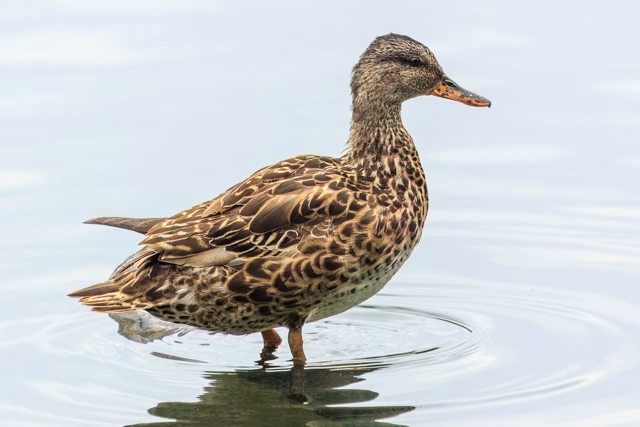
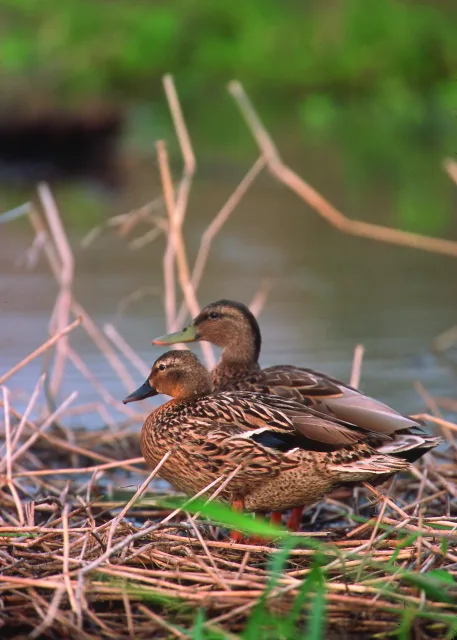
| Mallard | Anas platyrhynchos | Ubiquitous in all 50 states. Green head (male), mottled brown (female), blue speculum (wing patch). Ancestor of most domestic ducks. |
| American Black Duck | Anas rubripes | Eastern US. Dark blackish-brown body, light head, violet speculum. Closely related to the Mallard. |
| Mottled Duck | Anas fulvigula | Southeast US (Florida, Gulf Coast). Uniformly dark brown body, similar to Black Duck but lacking contrast; yellow bill. |
| Gadwall | Mareca strepera | Widespread. Subtle gray-brown plumage; male has black rear end and a white speculum (key ID). |
| Green-winged Teal | Anas crecca | Widespread. Smallest US dabbling duck. Male has cinnamon head with a green eye-patch; green speculum. |
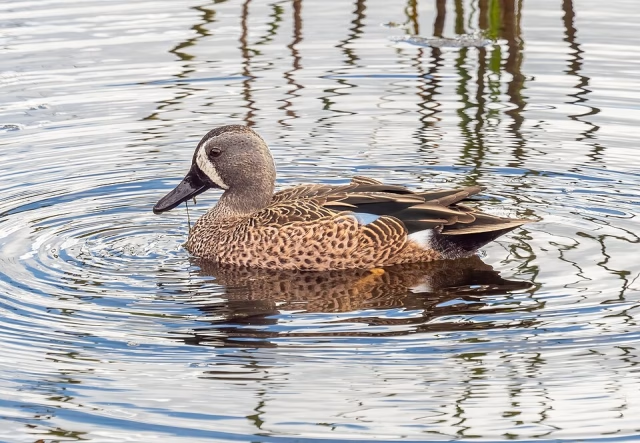
| Blue-winged Teal | Spatula discors | Widespread. Male has blue-gray head with a bold white crescent; large blue patch on forewing. Migrates south early. |
| Cinnamon Teal | Spatula cyanoptera | Western US. Male is entirely deep, rusty-cinnamon red; large blue patch on forewing (like Blue-winged Teal). |
| Northern Pintail | Anas acuta | Widespread. Male has a long, elegant neck and a long, pointed central tail feather (pin-tail); chocolate brown head. |
| Northern Shoveler | Spatula clypeata | Widespread. Distinguished by its enormous, spatula-shaped bill used for filtering invertebrates. Male has green head, white chest, chestnut flanks. |
| American Wigeon | Mareca americana | Widespread. Male has a white crown ("bald" patch) and a green patch behind the eye; often grazes on land. |
| Wood Duck | Aix sponsa | Widespread, especially East/West Coasts. Highly distinctive; male has an iridescent, crested green and purple head and red eyes. Nests in tree cavities. |
| Falcated Duck | Mareca falcata | Rare vagrant. Primarily seen in Alaska/Aleutians, sometimes lower 48. Male has a complex, crested green head and long sickle-shaped tertials. |
Diving Ducks (Subfamily Aythyinae, Merginae, etc.)
Diving ducks hunt underwater, propelling themselves with their feet. They need a running start to take flight.
A. Scaup, Ring-necks, and Canvasbacks (Aythya)
| Common Name | Scientific Name | Key Identification & US Range |
| Canvasback | Aythya valisineria | Widespread. Male has a red head and a distinct sloping forehead-bill profile. White body, black chest. |
| Redhead | Aythya americana | Widespread. Male has a rounded red head and a slate-gray body. Often confused with the Canvasback, but lacks the sloping profile. |
| Ring-necked Duck | Aythya collaris | Widespread. Male is black and white with a subtle chestnut ring on the neck (hard to see) and a white ring on the bill (easy to see). |
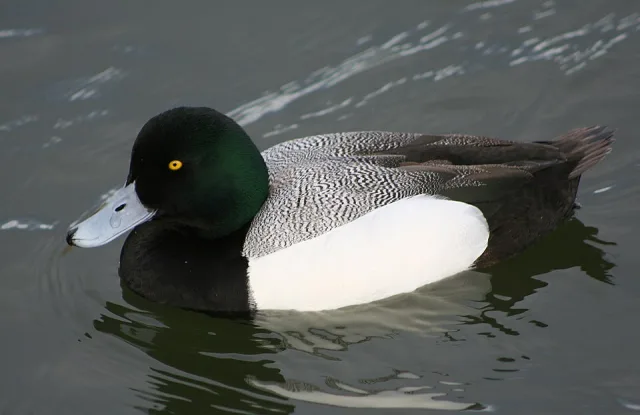
| Greater Scaup | Aythya marila | Coastal/Great Lakes. Male has a rounded, often green-iridescent head; large white patch on the wing primaries. |
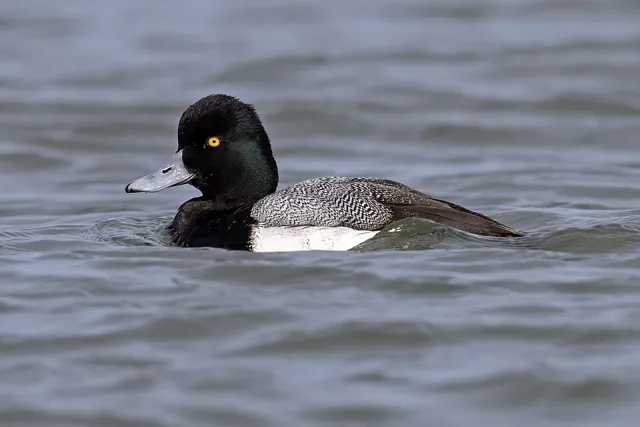
| Lesser Scaup | Aythya affinis | Widespread. Male has a more peaked, often purple-iridescent head; smaller white patch on the wing (less visible than Greater). |
B. Sea Ducks and Mergansers (Merginae and Allies)
These species are often found on large bodies of water, including the ocean, Great Lakes, and large rivers.
| Common Name | Scientific Name | Key Identification & US Range |
| Harlequin Duck | Histrionicus histrionicus | Coastal (rocky shores). Male is stunningly patterned with slate-blue, chestnut, and white crescent markings on the face and body. |
| Long-tailed Duck | Clangula hyemalis | Coastal/Great Lakes. Male has striking white and black winter plumage and a long, thin central tail feather. |
| Black Scoter | Melanitta americana | Coastal. Entirely black body; male has a knob at the base of the yellow bill. |
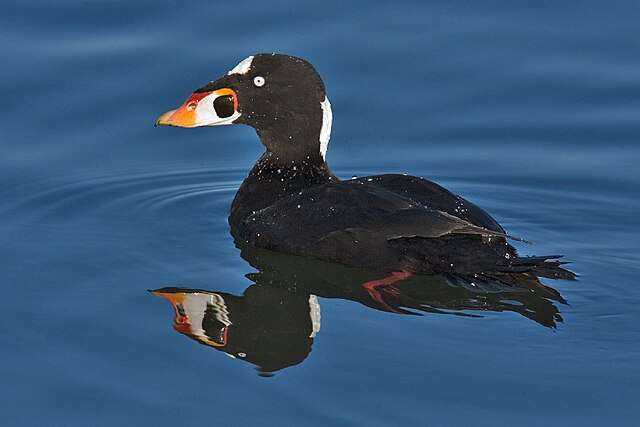
| Surf Scoter | Melanitta perspicillata | Coastal. Entirely black body; male has a bizarre, large white patch on the nape and forehead and a wildly colored bill (orange, white, black). |
| White-winged Scoter | Melanitta deglandi | Coastal/Great Lakes. Black body; white patch around the eye; key ID is the large white wing patch visible in flight or on water. |
| Bufflehead | Bucephala albeola | Widespread. Small, buoyant diving duck. Male has an iridescent black-green-purple head with a huge white patch on the back of the head. |
| Common Goldeneye | Bucephala clangula | Widespread. Male has a dark, green-iridescent head with a circular white spot between the bill and eye. |
| Barrow's Goldeneye | Bucephala islandica | Northwest/Rocky Mountains. Male has a dark, purple-iridescent head with a crescent-shaped white patch between the bill and eye. |
| Hooded Merganser | Lophodytes cucullatus | Widespread. Male has a large, striking white fan-shaped crest bordered in black. Smallest merganser. |
| Common Merganser | Mergus merganser | Widespread (lakes/rivers). Male has a smooth, dark green head and a large white body. Long, thin red bill. |
| Red-breasted Merganser | Mergus serrator | Coastal. Male has a shaggy, crested dark green head and a brown breast band; often found in saltwater. |

C. Other Ducks (Stiff-tails and others)
| Common Name | Scientific Name | Key Identification & US Range |
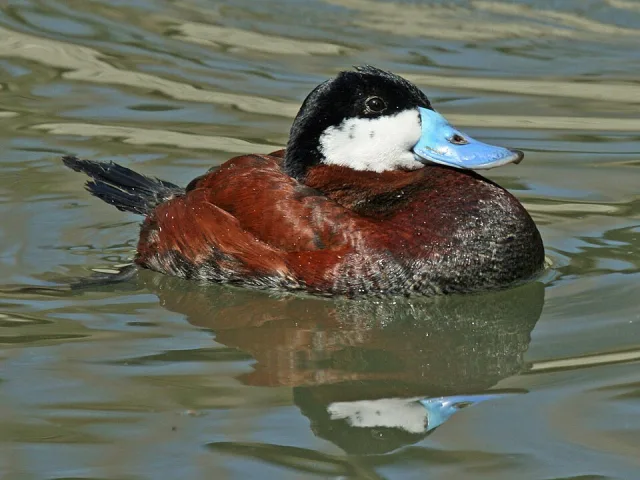
| Ruddy Duck | Oxyura jamaicensis | Widespread. Stiff-tailed duck; male has a bright blue bill and a rusty-red body in breeding plumage; often holds its stiff tail cocked up. |
| Hawaiian Duck | Anas wyvilliana | Endemic to Hawaii. Uniformly dark brown, similar to the Mottled Duck. Critically endangered. |
| Laysan Duck | Anas laysanensis | Endemic to Hawaii (Laysan Island). Small, dark brown with a prominent white eye-ring. Critically endangered. |
Rare Visitors and Vagrants (Selected Species)
These ducks are not part of the regular breeding or migratory population but are occasionally observed, primarily in Alaska or along the coasts.
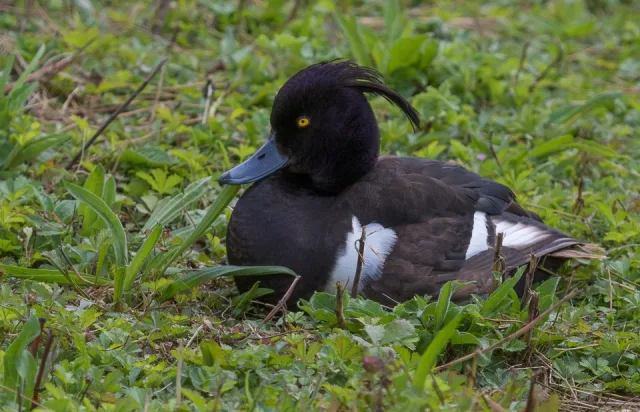
Tufted Duck (Aythya fuligula): Eurasian diving duck, occasionally seen on both coasts. Male has a distinctive droopy crest.
Garganey (Spatula querquedula): Eurasian dabbling duck, a rare visitor. Male has a broad white stripe over the eye.
Eurasian Wigeon (Mareca penelope): Widespread vagrant, often found with American Wigeon. Male has a cinnamon head and a creamy forehead.
Smew (Mergellus albellus): Rare Eurasian merganser, occasionally seen in Alaska or the Northeast. Striking black and white plumage (male).
Baikal Teal (Sibirionetta formosa): Asian dabbling duck, a rare but sought-after visitor, usually in Alaska or the West Coast. Male has a spectacularly patterned green, yellow, and black head.
Falcated Duck (Mareca falcata): An Asian dabbling duck seen occasionally, usually in Alaska. Male has a highly ornate crest and sickle-shaped tertials.
This immense diversity underscores the importance of the US waterways as crucial habitats, supporting both common species and numerous rare and endemic avian treasures.
10 Hidden U.S. Bird-Watching Hotspots You Won’t Believe Exist
