
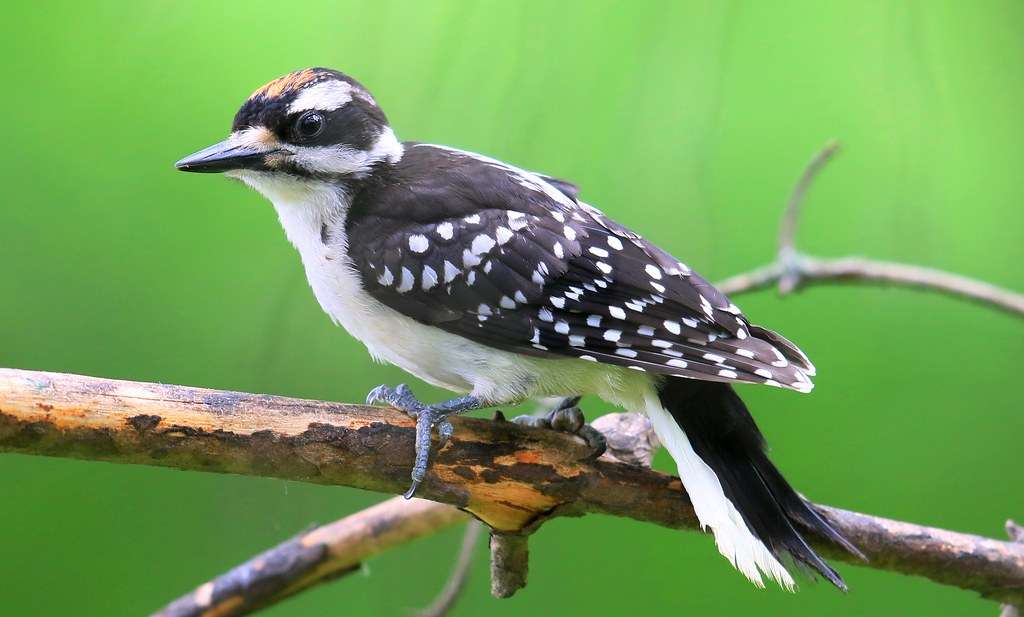
For countless North American birders, the challenge of reliably separating the Hairy Woodpecker (Dryobates villosus) and the Downy Woodpecker (Dryobates pubescens) is an enduring rite of passage. These two species are strikingly similar, featuring near-identical black-and-white patterns, including the prominent white stripe down the center of the back and the signature black mask and white eye-stripe. They even share similar foraging behaviors and vocalizations.
The difference between them, however, is a classic study in subtle field marks and behavioral ecology. While a definitive separation might seem daunting at first glance, focusing on just three key characteristics—size, bill length, and tail markings—makes distinguishing these birds straightforward and rewarding.
The Primary Clue: Size and Proportion
The most reliable, initial step in identifying the two species is assessing their overall size and proportions. Once you grasp the difference in their relative bulk, all other clues fall into place.
The Downy Woodpecker: The Miniature

The Downy Woodpecker is the smallest of all North American woodpeckers and is a study in compact design.
- Overall Size: At roughly 5.5 to 6.5 inches (14–17 cm) in length, the Downy is about the size of a House Sparrow or a Black-capped Chickadee. It is genuinely a tiny bird.
- Behavioral Cue: The Downy’s small stature allows it to forage where larger woodpeckers cannot. You will often find it hanging acrobatically on the thinnest terminal twigs and weed stalks, or exploring the finest branches of a tree. This habit is a great field indicator of its small size.
The Hairy Woodpecker: The Mid-sized Bird

The Hairy Woodpecker is substantially larger and possesses a noticeable degree of heft and power.
- Overall Size: Measuring between 8.5 and 10 inches (21–25 cm) in length, the Hairy is roughly the size of a Robin or a European Starling. This difference of 2 to 3 inches in length makes the Hairy look robust and powerful.
- Behavioral Cue: The Hairy prefers main trunks and large, sturdy branches. While it occasionally visits large limbs, it almost never hangs from thin twigs or weed stalks because its weight prevents this type of foraging.
The Secondary Clue: Bill Length and Head Structure
Once size is generally established, the proportions of the head and bill offer the next best confirmation. This distinction is so reliable that it is the single most important diagnostic feature when the birds are side-by-side or well-photographed.
Downy Woodpecker Bill
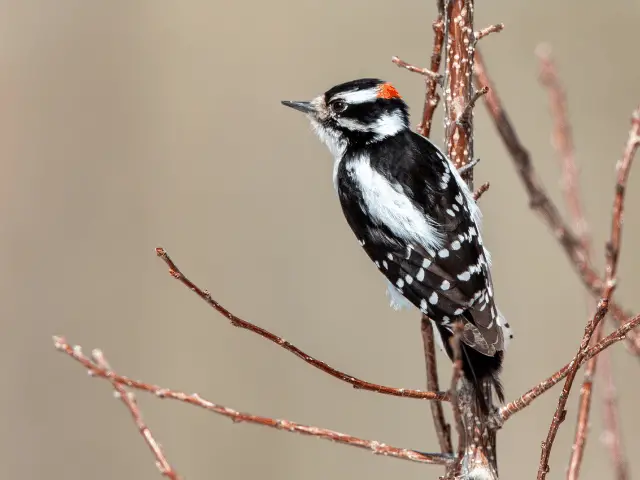
The Downy's bill is notably delicate and small relative to its head.
- Bill Length: The bill is always shorter than the length of the Downy's head (measured from the nape to the tip of the bill). It looks almost like a tiny little tack-hammer.
- Head Shape: The head appears large and rounded compared to the small, thin bill. This gives the Downy a gentle, almost comical appearance.
Hairy Woodpecker Bill

The Hairy's bill is a substantial, powerful weapon necessary for chiseling into solid wood.
- Bill Length: The bill is stout, thick, and is equal to or longer than the length of the Hairy’s head. It looks like a powerful ice-pick or chisel.
- Head Shape: The long bill makes the head look elongated and streamlined, giving the Hairy a much fiercer, more powerful appearance.
The proportional difference is key: even a small Hairy will have a long bill, and a large Downy will still have a short one. Compare the length of the bill to the length of the bird’s head, not its body.
The Tertiary Clue: Tail Feathers and Outer Markings
If size and bill proportions aren't clear—perhaps due to a lone bird in the distance or one obscured by foliage—the markings on the outer tail feathers provide an excellent confirmation point.
Downy Woodpecker Tail
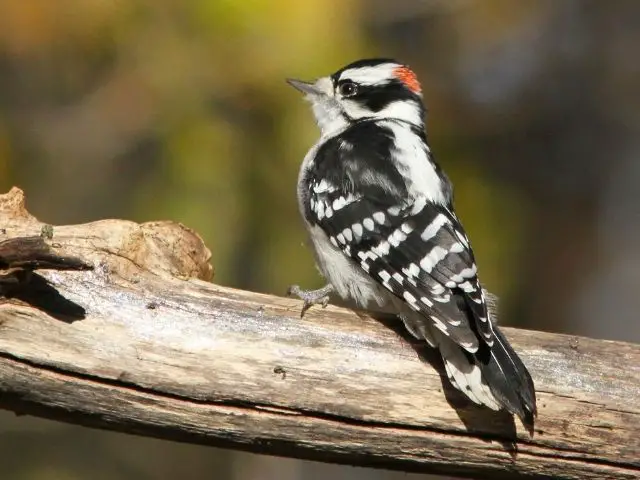
The outer white tail feathers of the Downy are almost always marked with small black bars or spots.
- When the Downy is clinging to a tree, you can often see these subtle black marks on the white outer tail feathers used for bracing. These marks are the origin of the Downy's scientific species name, pubescens, which translates to "downy, covered with soft short hairs," but are more easily seen as the black bars on the outer feathers.
Hairy Woodpecker Tail
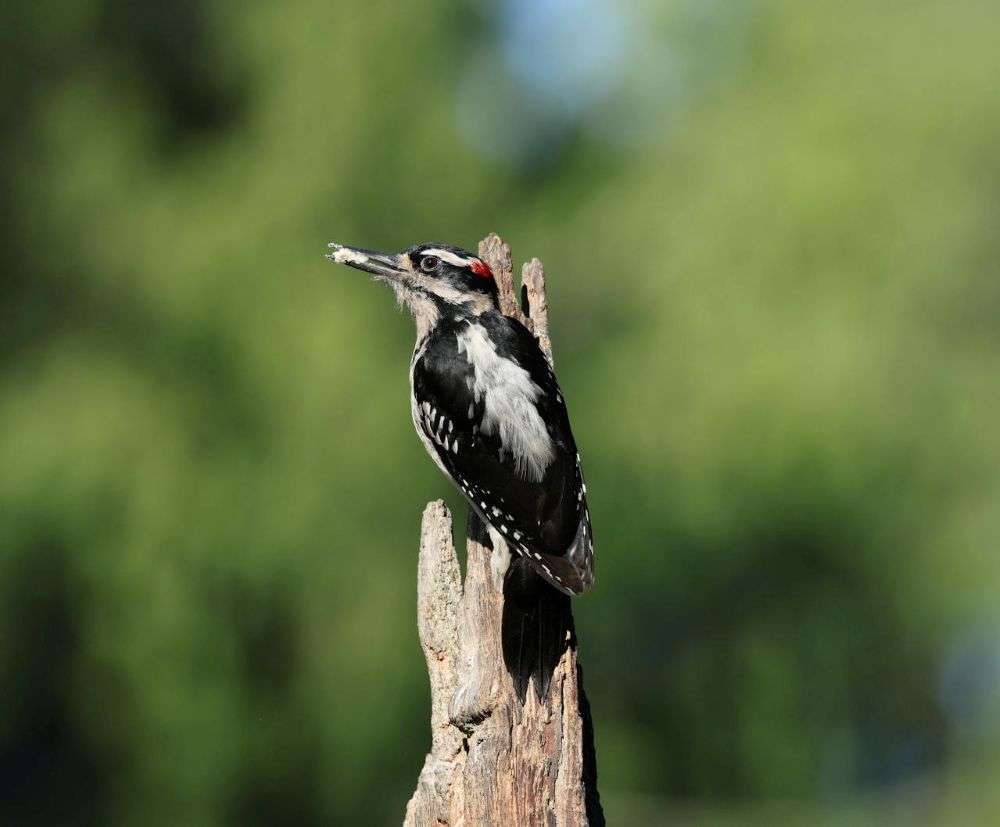
The outer white tail feathers of the Hairy Woodpecker are usually pure, unmarked white.
- When the Hairy is bracing against the bark, the white outer tail feathers appear as brilliant, clean white lines running up the sides of the tail. This "clean" look is a reliable identifier.
Other Subtle Plumage Differences
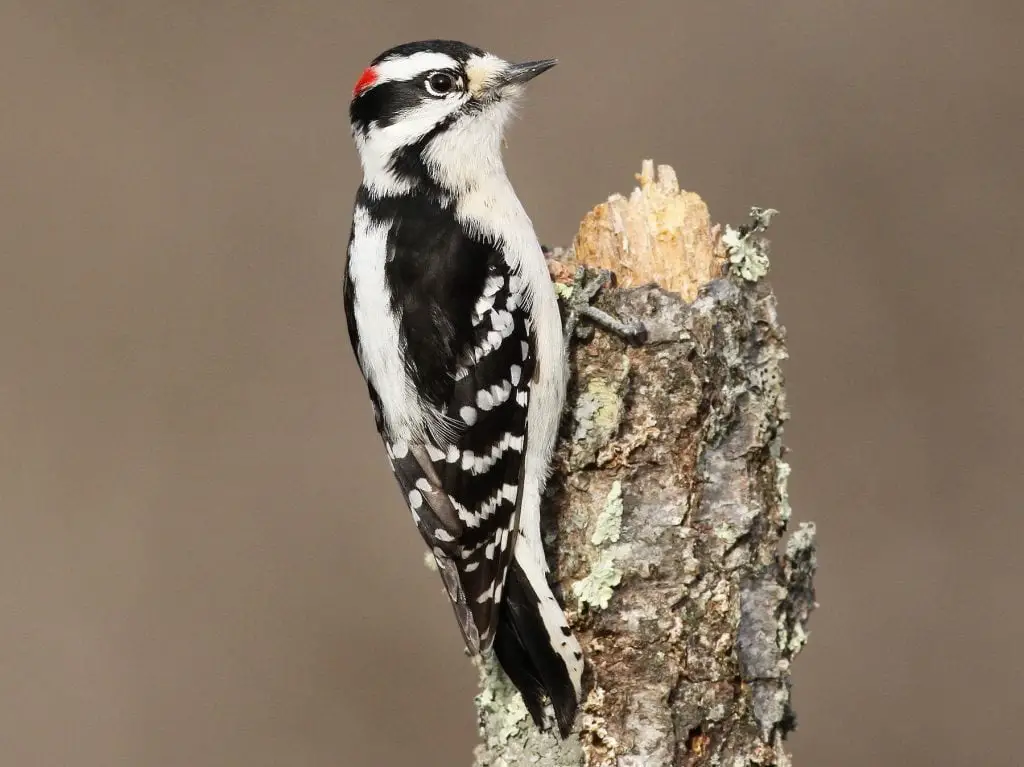
While relying on these can be risky due to individual variation, two other plumage marks can occasionally assist:
- Shoulder Spurs: The black stripes connecting the shoulder patch to the malar (cheek) stripe are usually separated in the Hairy, making the white shoulder patch appear to continue farther back. In the Downy, these black stripes are often broader and connect, somewhat isolating the white shoulder patch.
- White Back Stripe: The white stripe down the center of the Hairy's back often appears longer and more continuous than the Downy's, but this is highly subjective.

Beyond Sight: Vocalizations and Drumming
If you hear, but don't see, a black-and-white woodpecker, its calls and drumming patterns can be diagnostic.
Downy Woodpecker Vocalizations
- Call: The Downy’s call is a sharp, short, and relatively high-pitched "pik" or "chick." It is a quiet, less forceful sound.
- Drumming: Its drumming is a rapid, short burst that often decelerates slightly at the end. It is usually less than a second long.
Hairy Woodpecker Vocalizations
- Call: The Hairy’s call is a loud, ringing, and much more forceful "peek!" or "teek!" It is a commanding, sharp sound, easily distinguished from the Downy's softer call once heard a few times.
- Drumming: The Hairy produces a powerful, rapid drumming roll that is longer (often lasting over a second) and remains at a constant speed before abruptly stopping.
Summary of the Essential Identification Triad
To confidently separate these two common, yet confusing, woodpeckers, rely on this three-part diagnostic process, ideally in this order:
- Size and Bulk: Is it Chickadee-sized (Downy) or Robin-sized (Hairy)? Does it cling to fine twigs (Downy) or main trunks (Hairy)?
- Bill Proportion: Is the bill shorter than the head (Downy) or equal to/longer than the head (Hairy)? This is the definitive visual mark.
- Tail Markings: Are the outer white tail feathers marked with black bars (Downy) or pure, clean white (Hairy)?
Mastering these distinctions not only adds two reliable species to your life list but unlocks a deeper appreciation for the subtle brilliance of avian evolution, where two birds can share a virtually identical plumage yet occupy vastly different ecological niches based solely on size and the tools they carry.
Do Woodpeckers Migrate: Understanding Their Seasonal Movements
