
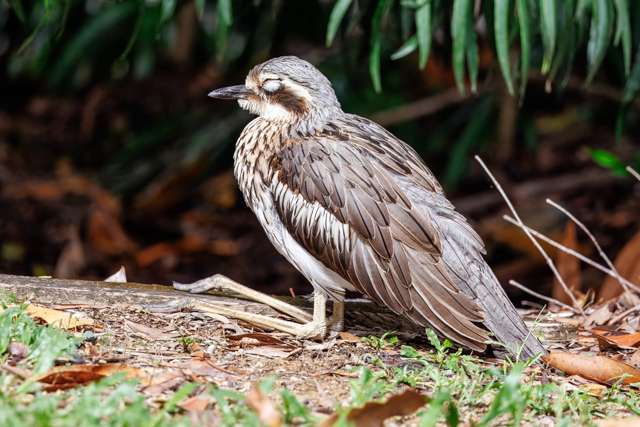
The common perception of a bird's leg is one of anatomical oddity: a leg that appears to bend backward at the knee. This widespread belief, however, is a fascinating and fundamental misconception. The joint that so many of us assume is a knee is, in fact, the bird's ankle joint. The true knee of a bird is located much higher up on the leg, tucked close to the body and often obscured by feathers. This anatomical reality is a key to understanding the remarkable diversity of avian locomotion, from the high-stepping gait of a heron to the powerful stoop of a falcon. The avian leg, with its hidden knee and exposed ankle, is a masterpiece of evolution, perfectly adapted for a life of flight, perching, and terrestrial movement.
The Real Knee: A Hidden Joint
To understand a bird's leg, we must first correct our visual assumptions. A bird’s leg has the same basic bone structure as a human's: a thigh, a shin, and a foot. However, the proportions are dramatically different. The thigh bone, or femur, is short and thick, connecting the hip to the knee joint. This joint, with its patella (kneecap), functions exactly like a human knee, bending forward. It is the joint between the femur and the large shin bone, the tibiotarsus. In most birds, this true knee is tucked up against the torso and is rarely visible, leading to the optical illusion of a backward-bending leg.

The bird's knee joint provides the primary flexion and extension for walking and running. Because the thigh is so short and positioned so close to the body's center of gravity, it gives the bird a very stable, upright posture. This is a critical adaptation for a bipedal animal that must land and take off with precision. A bird's real knee is an engine of locomotion, hidden from view but working tirelessly to power every step, jump, and landing.
The "Backward-Bending" Ankle: A Master of Deception
The joint that creates the illusion of a backward-bending knee is actually the ankle joint, or intertarsal joint. It connects the tibiotarsus (the shin bone) to the long, slender bone of the lower leg, the tarsometatarsus. This long "lower leg" is what we typically mistake for the shin, but it is actually an elongation of the bones of the mid-foot. The ankle joint itself bends in a way that appears backward to a human observer, but it is anatomically forward, just like our own. The illusion is created by the very long tarsometatarsus bone. This elongated structure raises the bird’s foot off the ground, giving it a longer stride and a higher vantage point while standing. This design provides birds with incredible agility and allows them to navigate complex terrain with ease.
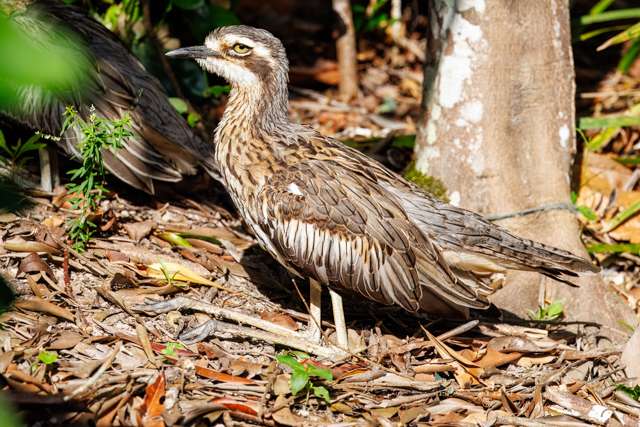
The ankle joint is also a critical component of the perching mechanism found in many songbirds. When a perching bird like an American Robin or a Northern Cardinal lands on a branch, its ankle joint bends. This action automatically tightens a tendon that runs down the back of the leg and into the toes, causing the toes to curl and lock tightly around the branch. This passive mechanism allows a bird to perch and even sleep without expending any muscular energy, a crucial adaptation for energy conservation.

Specialized Legs: Form Follows Function
The basic avian leg plan has been modified in countless ways to suit the specific needs of different bird species. The variations in the knee, ankle, and overall leg structure are a testament to the power of natural selection.
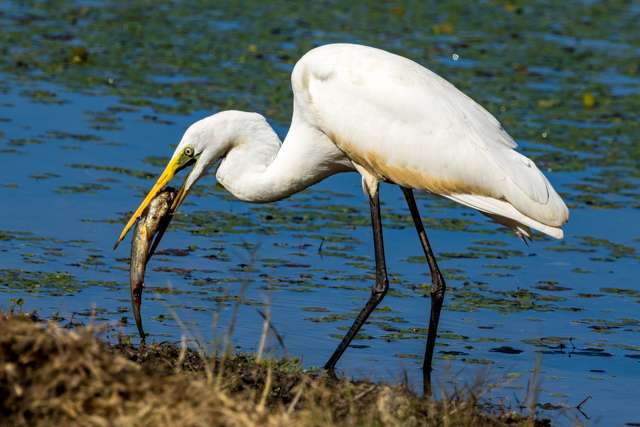
Wading Birds: Birds like the Great Blue Heron and the Great Egret have evolved extraordinarily long tibiotarsus and tarsometatarsus bones, which give them their distinctive stilty legs. The position of their knee, high on their body, combined with their long legs, allows them to wade through deep water while keeping their bodies and feathers completely dry. Their legs are not just long but also incredibly stable, with strong joints that allow them to stand motionless for long periods, patiently waiting to strike at prey.
Running Birds: For ground-dwelling birds like the Greater Roadrunner of the American Southwest and the Wild Turkey, legs are built for speed and power. Their knees are strong, and their femurs are positioned to maximize the leverage of their powerful leg muscles. This anatomy allows them to sprint away from predators or chase down prey with impressive speed and agility. Their toes are also positioned to provide maximum traction, enabling quick starts and stops on uneven terrain.
Birds of Prey: The legs and joints of birds of prey, such as the Bald Eagle and the Great Horned Owl, are designed for strength and shock absorption. When a Bald Eagle swoops down to snatch a fish from a lake or when an owl silently pounces on a mouse, their knees and ankles must be able to withstand the incredible force of the impact. Their knees are robust, and their ankle joints, while appearing delicate, are immensely powerful, allowing them to deliver a crushing grip with their talons.

Diving Birds: At the other end of the spectrum, birds like the Common Loon have their legs positioned far back on their bodies. This backward placement, which is a result of their long pelvis, makes them highly efficient swimmers and underwater divers. Their knees and ankles are adapted for a powerful forward thrust, using their webbed feet like paddles. However, this same adaptation makes them extremely clumsy on land, where their legs are unable to properly support their body weight.
Perching Birds: The perching mechanism is a key feature in the legs of over half of all bird species. The unique way their knee and ankle joints interact with tendons in their legs allows them to sleep soundly on a branch without falling. This automatic locking system, activated by the bird's weight, is a simple yet brilliant evolutionary solution to a fundamental problem of arboreal life.
An Evolutionary Masterpiece
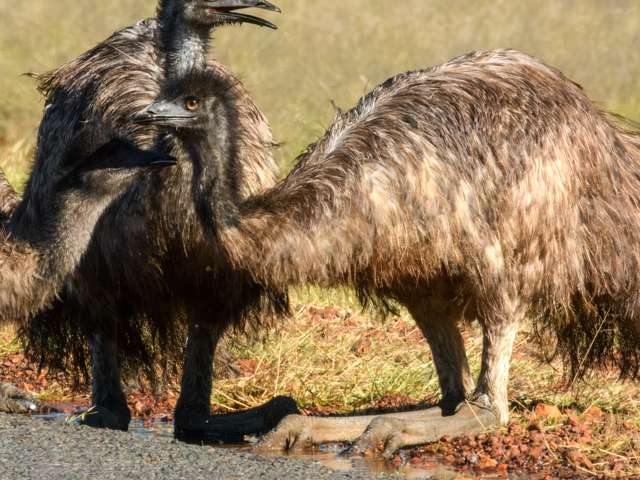
The avian leg, with its hidden knee and elongated ankle, is a direct evolutionary link to the dinosaurs. Birds are the living descendants of theropod dinosaurs, and their leg structure is a remnant of this lineage. This unique anatomical configuration provides several advantages: it shifts the center of mass forward, which is crucial for balancing flight, and it provides a biomechanically efficient way to walk and run on two legs.
Wrapping Up
So, the next time you see a bird strutting across the lawn or perched on a wire, take a moment to appreciate the elegant complexity of its leg. What appears to be a backward-bending knee is a beautiful illusion, concealing an ingenious and powerful system of bones and joints. This system has been perfected over millions of years to support a vast array of lifestyles, from the patient wait of a wading bird to the breathtaking speed of a falcon's dive. The avian knee may be hidden, but its function is at the very heart of what makes a bird a master of its world.
Find out why you sometimes see birds on one leg.
