

Delaware Bay, a vast, funnel-shaped estuary where the Delaware River meets the Atlantic Ocean, is the stage for one of the most spectacular and critical avian migration events on Earth: the Shorebird Supermass Migration. Every May, this relatively small stretch of coastline transforms into an indispensable fueling station for hundreds of thousands of shorebirds, particularly the Red Knot (Calidris canutus), as they pause their monumental journey from the tip of South America to the Arctic Circle.
The entire event hinges on a single, vital food source: the eggs of the ancient Horseshoe Crab (Limulus polyphemus). This ecological convergence—the precise timing of avian arrival coinciding with the crab's spawning frenzy—creates a biological phenomenon of unparalleled density and urgency. For the Red Knots and other shorebirds, the caloric bounty of the Delaware Bay is not just a snack; it is the difference between survival and starvation, ensuring they have the energy to complete the final, arduous leg of their migration to their distant Arctic breeding grounds.
The Convergence: Two Species, One Fate
The Delaware Bay ecosystem is built upon a finely tuned calendar that has persisted for millions of years.
1. The Horseshoe Crab Spawning

The foundation of the migration is the Horseshoe Crab, a marine arthropod that has remained virtually unchanged for over 450 million years—predating the dinosaurs. Every spring, coinciding precisely with the highest tides around the full and new moons in May and early June, millions of these crabs crawl ashore onto the sandy beaches of Delaware and New Jersey to lay their eggs.
Massive Egg Laying: A single female can lay between 80,000 and 100,000 tiny, pea-green eggs, burying them just beneath the sand surface.
Availability: The high tides and subsequent wave action frequently expose billions of these lipid-rich eggs along the high-tide line, creating a dense, calorie-packed food source.
2. The Shorebird Arrival
The timing of the migrating shorebirds is an evolutionary marvel, synchronized to this exact window of egg availability.

Red Knot: The Red Knot, the most iconic species of this migration, undertakes one of the longest migrations in the animal kingdom, traveling over 9,000 miles (14,500 km) from Tierra del Fuego in Argentina. They arrive in Delaware Bay utterly depleted, having lost a significant percentage of their body mass.
Urgency: The knots must consume enough Horseshoe Crab eggs to double their body weight in just 10 to 14 days. Without this rapid weight gain, they lack the fat reserves to power the final, non-stop flight to the Arctic.
Key Players in the Supermass Migration
While the Red Knot is the star of the show, the Delaware Bay feeds a complex community of shorebirds.
The Red Knot (Calidris canutus rufa)
The Red Knot is the symbol of this migration's vulnerability. Arriving in spectacular brick-red breeding plumage, they are the most numerous visitors, sometimes numbering over 100,000 individuals during peak years.
Weight Gain: The success of the Red Knot population is directly measured by their weight upon departure. A bird that leaves weighing less than 180 grams is statistically unlikely to survive the journey and successfully breed. The dense, high-fat content of the crab eggs is essential for meeting this metabolic deadline.
Conservation Status: The rufa subspecies of the Red Knot is listed as Threatened under the U.S. Endangered Species Act, largely due to historical overharvesting of the Horseshoe Crab.

Other Shorebirds
Several other species rely on the same ephemeral resource, though their dependency is generally less absolute than the Red Knot's.
Sanderling (Calidris alba): A slightly smaller sandpiper, often seen chasing waves. Sanderlings also gorge themselves on crab eggs and are abundant during the May staging.

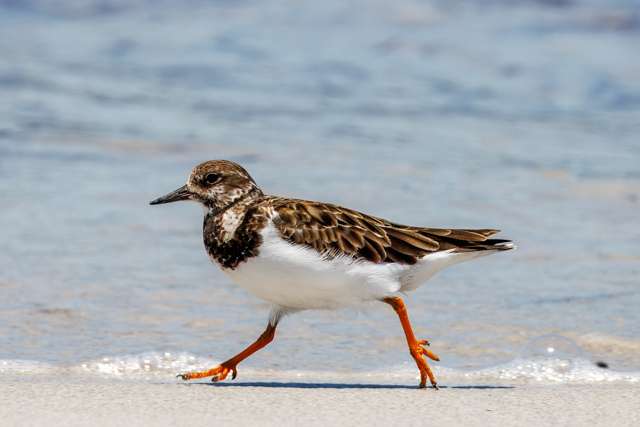
Sanderling Ruddy Turnstone (Arenaria interpres): Named for its habit of turning over stones and debris, this bird uses its wedge-shaped bill to flip over masses of beach wrack and seaweed, seeking out the buried crab eggs. Their colorful, harlequin-patterned breeding plumage makes them a favorite among birders.
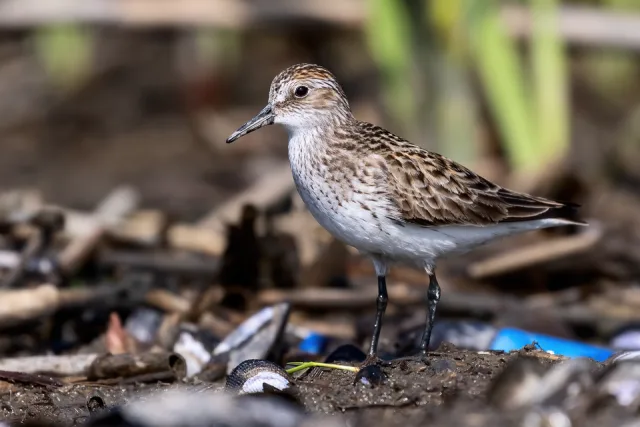
Ruddy Turnstone Semipalmated Sandpiper (Calidris pusilla): These tiny sandpipers rely on the protein-rich eggs for their migration, though they also consume other small invertebrates on the mudflats.

Viewing the Spectacle: Best Locations in Delaware
The shorebird and crab spectacle is best viewed along the beaches of Kent and Sussex Counties in Delaware, which are less developed than the New Jersey side of the Bay.
1. Prime Beach Locations
The most heavily utilized shorebird feeding beaches are often monitored and protected by state and federal wildlife agencies during the peak May window.
Slaughter Beach: A long stretch of sand known for massive crab-spawning events. Viewing is typically done from designated viewing platforms or the roadside to minimize disturbance.
Mispillion Harbor: The mouth of the Mispillion River and its adjacent mudflats offer a slightly different mix of habitat, drawing high densities of both feeding and roosting birds.
Kitts Hummock and Ted Harvey Conservation Area: These areas offer controlled access and prime viewing of the birds resting on the tidal flats at high tide.
2. Viewing Ethics and Conservation
The intense concentration of birds in the Delaware Bay requires strict viewing ethics to ensure the birds are not unnecessarily disturbed. Flushing a feeding flock forces them to expend critical energy, which can jeopardize their survival.
Stay Back: Maintain significant distance (ideally 200+ feet) and use a spotting scope for close-up viewing.
Avoid the High-Tide Line: The shorebirds are most vulnerable and concentrated near the high-tide line, where the eggs are exposed. This area is often temporarily closed or heavily monitored.
Support Conservation: The Delaware Shorebird Initiative actively monitors and protects the beaches. Their work, along with that of the state's Department of Natural Resources and Environmental Control (DNREC), is vital for the survival of the knots.
The History of a Crisis: Shorebirds and the Crab Harvest
The Delaware Bay migration faced a devastating crisis in the late 1990s and early 2000s, directly illustrating the fragility of this linked ecosystem.
The Problem: The commercial harvest of Horseshoe Crabs exploded due to demand for their blood (used by the biomedical industry for testing sterility) and their use as bait in the eel and conch fisheries. The heavy harvest dramatically reduced the number of crabs reaching the beaches to lay eggs.
The Impact: As the egg density plummeted, the arriving Red Knots could no longer gain weight fast enough. Knot populations crashed from an estimated 100,000 birds in the 1980s to below 15,000 by the early 2000s.
The Response: Delaware and New Jersey implemented strict regulations on the crab harvest, and the Red Knot was given federal protection. This concerted conservation effort has allowed both the crab and the knot populations to begin a slow, difficult recovery.
The current challenge is to manage the crab harvest for biomedical purposes (which is still necessary and involves the controlled return of the crabs) and the ongoing limited bait fishery, while ensuring that sufficient numbers of female crabs survive to spawn on the beaches.
The Delaware Bay Shorebird Supermass Migration is not just a birding trip; it is an encounter with a profound ecological nexus, a moment in time where two vastly different species—a prehistoric crab and a tiny, marathon-flying bird—become intrinsically linked. To stand on the shores of Delaware in May and watch the vast flocks arrive, exhausted but determined, is to witness the awesome power and delicate balance of life on Earth.
