
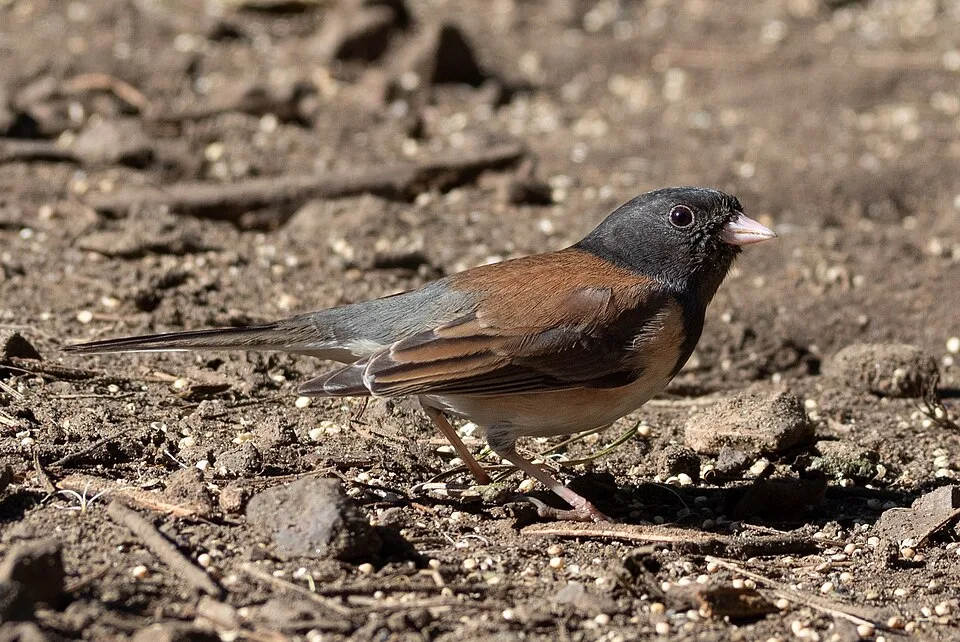
The Dark-eyed Junco (Junco hyemalis) is arguably one of the most familiar and abundant native songbirds in North America. Widely distributed across the continent, this small sparrow is affectionately known as the "snowbird" because its arrival in lower elevations and southern regions often coincides with the onset of winter weather. While seemingly drab at first glance, the Dark-eyed Junco is a fascinating study in geographic variation, boasting several distinct and beautiful regional plumage forms.
Identification and Common Features
Regardless of the regional form, all Dark-eyed Juncos share a few key features that aid in identification:
Size and Shape: They are small, plump sparrows with a relatively short, pink, conical bill, ideal for cracking seeds.
The White Tail Flash: The most reliable field mark is the white outer tail feathers. When the bird flies, lands, or hops, it often flashes these white feathers, which contrasts sharply with the dark center of the tail.
Behavior: They are primarily ground feeders, often seen hopping and scratching for seeds beneath feeders or low shrubs, and they readily join mixed-species winter flocks.

The Kaleidoscope of Color Forms
The Dark-eyed Junco is a complex species that was once classified as five separate species. They are now considered a single species because they interbreed where their ranges overlap, but they retain their distinct regional appearances. Ornithologists currently recognize at least six major color forms across the United States:
Slate-colored Junco:
Appearance: The most widespread eastern form. Males have a dark slate-gray hood, back, and breast, contrasting with a white belly. Females are similar but with slightly browner tones.
Range: Breeds across the coniferous forests of Canada and the northeastern US; winters throughout the eastern US.
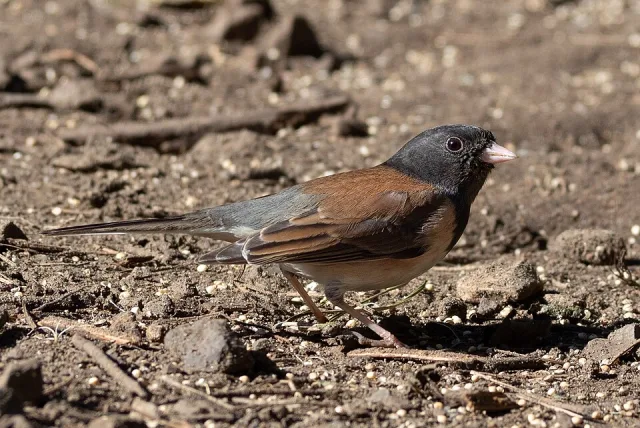
Oregon Junco:
Appearance: This is a very common western form. It features a sharp, black or dark gray hood (head and upper breast), a brown back, and a white belly.
Range: Breeds in forests across the Pacific Northwest and the western mountains; winters across the western and southwestern US.
Pink-sided Junco:
Appearance: Named for the diagnostic pinkish-buff wash across its flanks (sides). It has a gray head and breast, and a brown back.
Range: Breeds in the Rocky Mountains (mostly northern US and Canada) and winters to the south in the central and southern Rockies.
Gray-headed Junco:
Appearance: Characterized by a solid gray head and breast with a striking, contrasting rust-colored back patch. No real hood, just a uniform gray.
Range: Breeds at high elevations in the southern Rocky Mountains; winters at lower elevations nearby.
Red-backed Junco:
Appearance: Very similar to the Gray-headed Junco, but the gray on the head and breast is noticeably paler, and the rust-red back patch is usually more extensive.
Range: Restricted to the high-elevation mountains of Arizona and New Mexico.
White-winged Junco:
Appearance: A distinctive form with two bold white wing bars (unique among Juncos) and a pale gray body.
Range: Found almost exclusively in the Black Hills region of South Dakota and Wyoming.
Other Junco Species in the US
While the Dark-eyed Junco is dominant, one other distinct species is found in the United States, typically restricted to the border regions:
Yellow-eyed Junco (Junco phaeonotus): This species is easily separated by its unique, bright yellow iris, which contrasts sharply with its black lores (area between the eye and bill). It has a gray head and a rusty-brown back. In the US, it is restricted to the mountain ranges of southeastern Arizona and southwestern New Mexico, where it is a non-migratory resident of high-elevation pine-oak forests.
The Dark-eyed Junco, through its wide range and fascinating color variations, provides a unique opportunity for birders to observe evolution and adaptation in action across the varied landscapes of North America.
Masters of the Night: A Comprehensive Guide to the Owls of the US
