

If you find yourself wandering through the arid landscapes of the American Southwest—where the Saguaro stands tall and the Cholla waits to snag the unwary—you will almost certainly be greeted by a sharp, loud, two-note whistle: whit-wheet! That sound, which often sounds like someone trying to get your attention across a crowded parking lot, belongs to the Curve-billed Thrasher (Toxostoma curvirostre). While many desert birds are small and skittish, the Curve-billed Thrasher is a bold, long-tailed resident that carries itself with an air of grumpy authority. Often confused at a distance with a mockingbird or a small hawk, this bird is actually one of the most charismatic and hardy singers of the Sonoran and Chihuahuan deserts.
1. Anatomy of a Desert Specialist
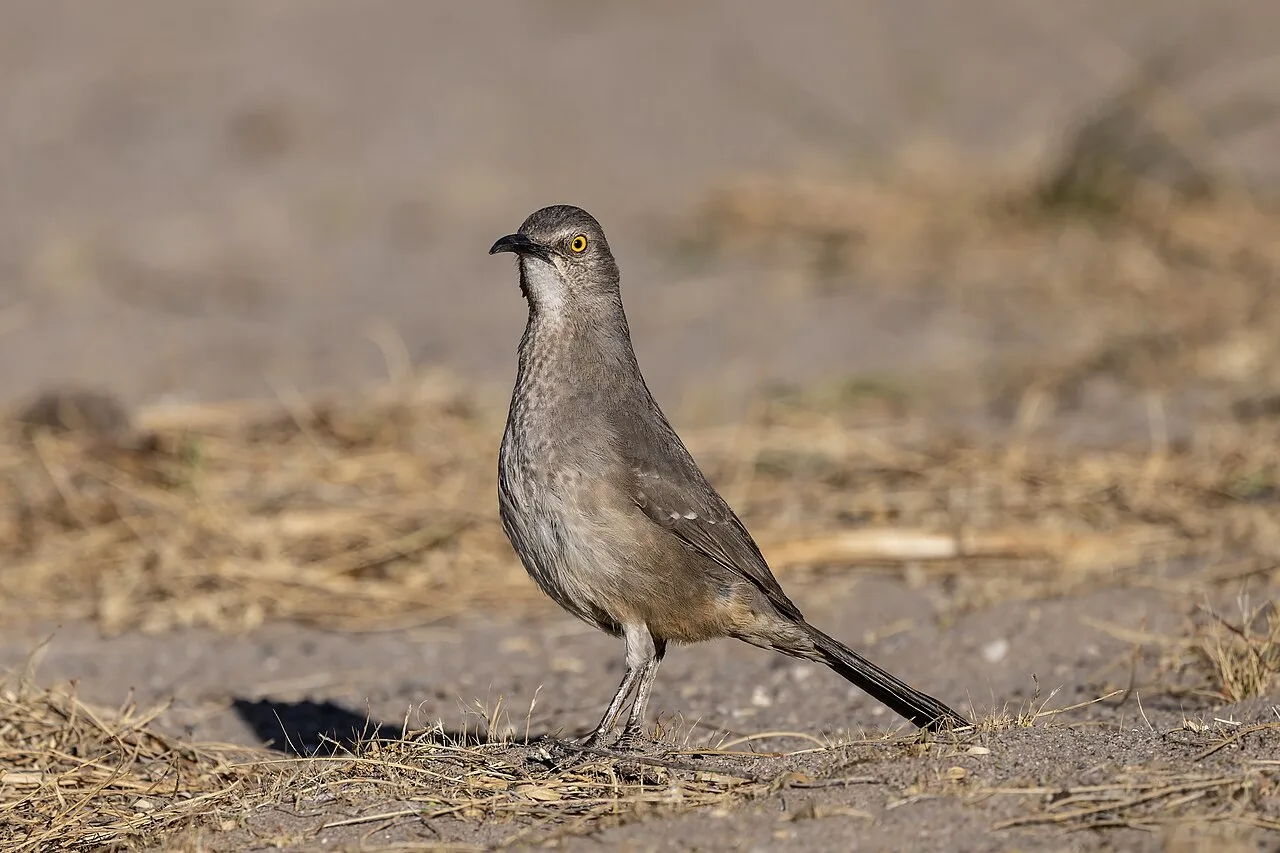
The Curve-billed Thrasher is built for life in a land of extremes. About the size of a Robin but with a much longer tail, its appearance is a study in desert camouflage.
The Bill: As the name suggests, its most prominent feature is a long, sickle-shaped black bill. This isn't just for show; it is a precision tool used for "thrashing" through leaf litter and digging into the hard-packed desert soil to find insects.
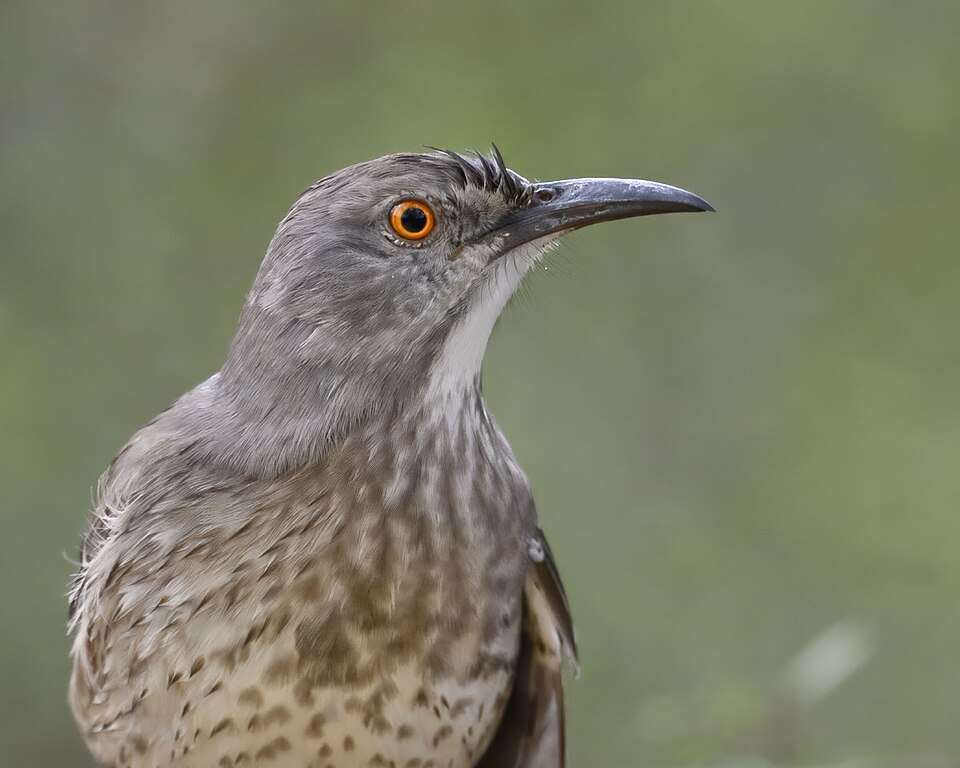
The Eyes: Perhaps the most striking feature of a mature Curve-billed is its eye. They possess brilliant, fiery orange or amber irises that give them a perpetually intense or "angry" expression.
The Plumage: Clad in a dusty, grayish-brown, they feature faint, blurry spots on their breast. Unlike their cousin, the Long-billed Thrasher, their markings are subtle, helping them blend into the shadows of a Mesquite tree.
2. A Master of the Thorns
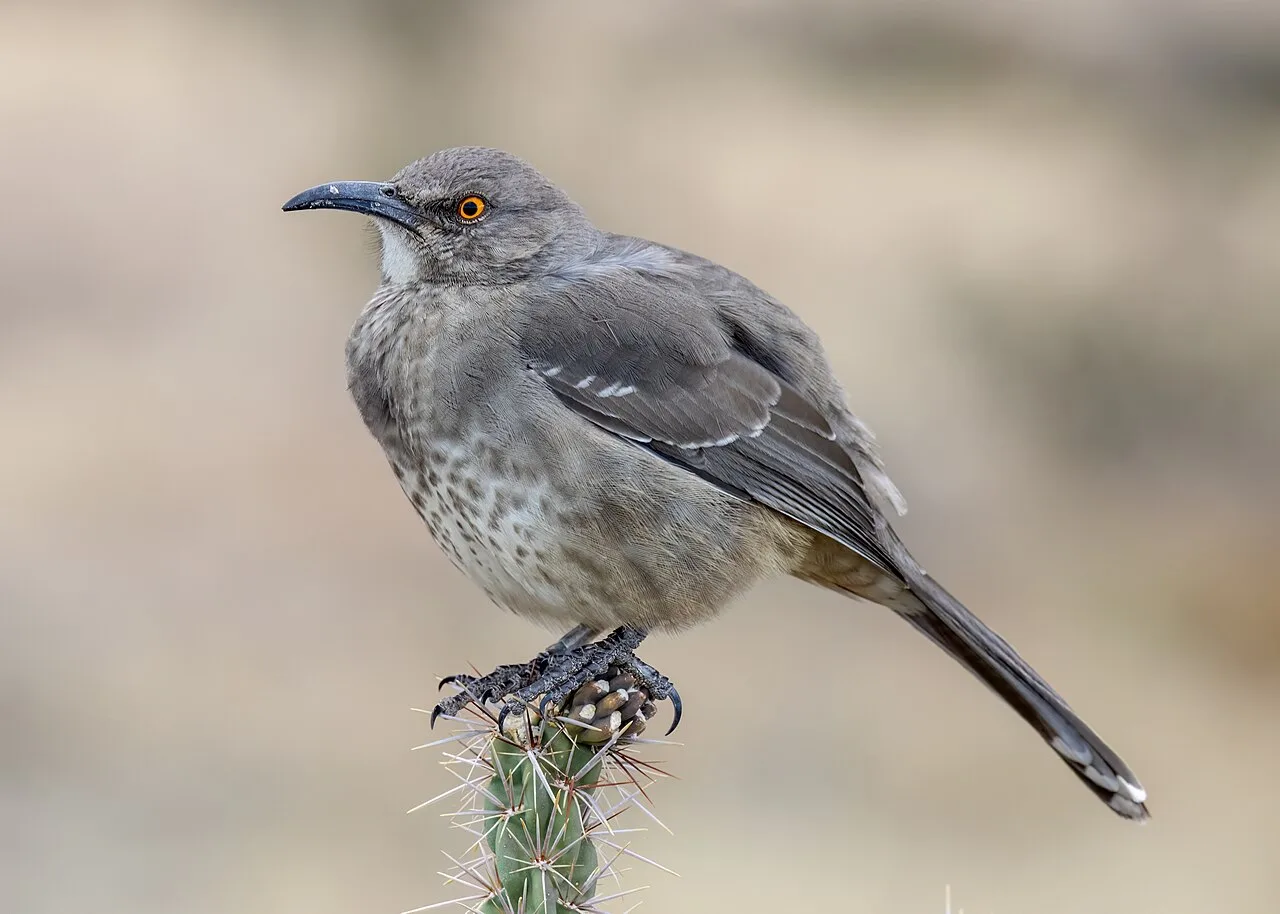
While many birds avoid the needle-sharp protection of the Cholla cactus, the Curve-billed Thrasher calls it home. In fact, in many parts of Arizona and New Mexico, the relationship between the thrasher and the Chain-fruit Cholla is almost inseparable.
They build large, bulky nests of thorny twigs deep within the center of a cactus. The maze of spines acts as a natural fortress, keeping out snakes, hawks, and ravens. It is a marvel of avian engineering: the bird somehow navigates the "jumping" spines of the Cholla without impaling itself, creating a safe nursery for its pale blue, speckled eggs.
3. The Song: The Great Imitator
Like its relative the Northern Mockingbird, the Curve-billed Thrasher is a member of the Mimidae family. This means it is a gifted mimic, capable of incorporating the songs of other birds into its own repertoire.
However, unlike the Mockingbird, which repeats a sound three or more times before moving on, the Curve-billed Thrasher usually repeats a phrase only once or twice. Its song is a disjointed, rambling series of car-alarm chirps, liquid whistles, and raspy chatters. On a quiet desert morning, a single male perched atop a Saguaro can fill a whole canyon with a one-man concert that lasts for twenty minutes.
4. Foraging: The "Thrashing" Technique

To understand how this bird earned its name, you have to watch it eat. The Curve-billed Thrasher doesn't peck at the ground like a chicken; it thrashes.
Using its powerful neck muscles and that curved bill, it sweeps its head from side to side with incredible speed, flinging dirt, rocks, and debris out of the way to uncover beetles, ants, and grasshoppers. During the summer, they also become expert fruit-eaters, feasting on the bright red fruits of the Saguaro and Organ Pipe cacti. They are even known to frequent backyard feeders, where they will aggressively defend a pile of suet or seed from much larger birds.
5. Curve-billed vs. Bendire’s Thrasher: The Birder’s Dilemma
In the Southwest, birders often struggle to distinguish the Curve-billed from the Bendire’s Thrasher. They look nearly identical at a glance, but there are three key secrets to telling them apart:
| Feature | Curve-billed Thrasher | Bendire's Thrasher |
| Bill Shape | Deeply curved, like a sickle. | Shorter, straighter, more like a "pliers." |
| Breast Spots | Blurry, round "smudges." | Sharper, more triangular "arrows." |
| Call | A loud, crisp "whit-wheet!" | A soft, low "chup." |
6. Resilience in a Changing Landscape
The Curve-billed Thrasher is remarkably adaptable. While many desert birds suffer as urban sprawl replaces the desert, the Curve-billed has learned to thrive in Southwestern suburbs. They are common sights in the xeriscaped yards of Phoenix, Tucson, and El Paso, where they use ornamental cacti and bushes for nesting.
However, they still face challenges:
Invasive Grasses: Buffelgrass, an invasive species, increases the frequency and intensity of desert fires. These fires kill the Saguaros and Chollas that thrashers need for nesting.
Climate Change: Rising temperatures in the Southwest can lead to "nest failure" if the heat becomes too intense for the chicks to survive, even in the shade of a cactus.
Where to Find Them
If you’re on a quest to see one, any desert scrub habitat in Arizona, New Mexico, West Texas, or Southern Colorado will do.
Saguaro National Park (AZ): The gold standard for thrasher spotting.
Big Bend National Park (TX): Look for them among the lechuguilla and sotol.
Desert Botanical Garden (Phoenix, AZ): An easy way to see them up close in a managed setting.
The Soul of the Scrub
The Curve-billed Thrasher isn't just a bird; it’s a character. It is the sentinel of the scrub, the bird that looks you in the eye with a fiery orange glare and tells you exactly how it feels about your presence in its territory. It reminds us that the desert is not a wasteland—it is a vibrant, noisy, and beautifully "thorny" place where life doesn't just survive; it sings.
