

If you spend enough time looking at tree trunks in a mature North American forest, you might eventually notice a tiny, cryptic flake of bark suddenly detach itself and start hitching upward.
This is the Brown Creeper. It moves methodically, spiraling up the trunk like a tiny mouse, probing deep into crevices with a tweezer-like bill before dropping down to the base of the next tree to repeat the process.
Now, transport yourself thousands of miles south into the dense, tropical rainforests of the Amazon basin. There, you will encounter a bird doing the exact same thing—hitching up a massive tropical trunk, using its tail as a prop, and pulling grubs out of the bark. It looks like a giant, robust version of our local creeper.
This is a Woodcreeper.
Despite their almost identical names, lifestyles, and physical silhouettes, these two groups are completely unrelated. The Brown Creeper is a tiny songbird from a small, specialized Holarctic family. Woodcreepers are suboscines (an entirely separate evolutionary branch of perching birds) unique to the New World tropics.
Their identical lifestyle—vertical tree-trunk foraging—has sculpted them into one of the most elegant examples of structural convergent evolution in the forest.
The Lineage Split: Separate Branches, Same Trunk

To see just how separate these birds are, we look at their taxonomy. They represent two completely different evolutionary experiments in the massive order of perching birds (Passeriformes).
| Attribute | Brown Creeper (Certhia americana) | South American Woodcreepers (Subfamily Dendrocolaptinae) |
| Range | North America (Alaska down to Mexico) | Central and South American Neotropics |
| Family | Certhiidae (Treecreepers) | Furnariidae (Ovenbirds and Woodcreepers) |
| Cousins | Wrens and Gnatcatchers | Horneros, Spinetails, and Foliage-gleaners |
While our Brown Creeper is a solitary member of a tiny lineage closely linked to wrens, South American woodcreepers are an incredibly diverse explosion of over 50 species that branched off from the tropical Ovenbird family. Yet, both groups independently hit upon the exact same structural modifications to survive on a vertical sheet of wood.
The Tree-Climbing Toolkit: Three Shared Inventions
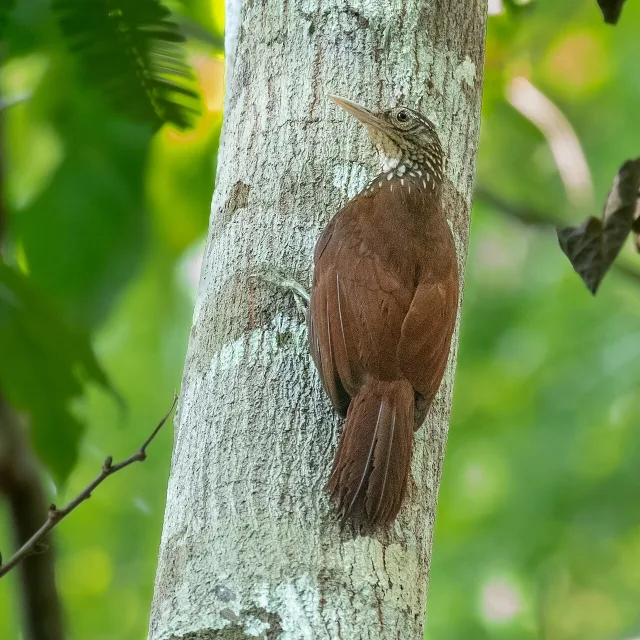
To live life pinned to the side of a tree, normal bird anatomy doesn't work. Gravity is constantly trying to pull you backward, and bark is a tough, jagged maze. To conquer this niche, evolution equipped both lineages with the exact same three inventions:
1. The Tail-Feather Tripod
If you look closely at either a Brown Creeper or a woodcreeper (like the Cocoa Woodcreeper), you’ll notice they don't sit on branches; they prop themselves against the bark. Both groups independently evolved stiff, reinforced tail feathers with exposed, spiny shafts at the tips.
These spines dig into the bark, acting exactly like a robust third leg or a carpenter's kickstand. This structural tripod supports the bird's entire body weight, freeing up its legs and upper body to lean back and hammer or probe into the wood.
2. The Curved Tweezer Bill
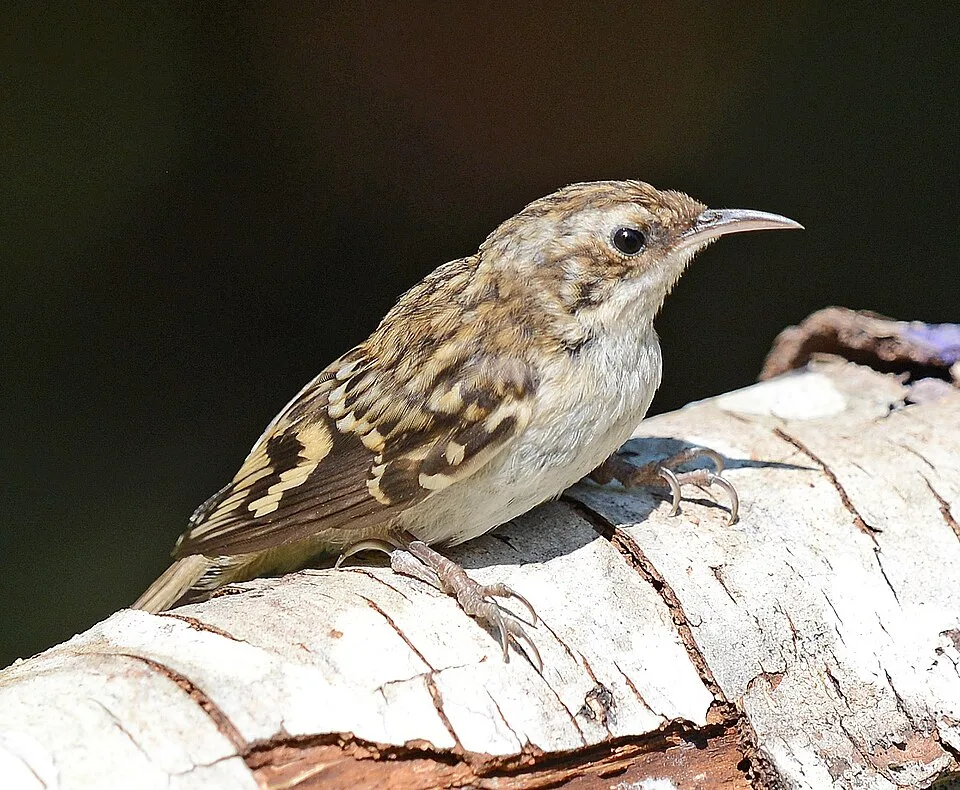
Insects hiding under bark flakes are incredibly secure. To reach them, you need highly specialized tools. Both groups evolved long, slender, down-curved (decurved) bills.
This specific curvature matches the natural contour of tree trunks, allowing the birds to slide their bills sideways under loose bark scales like a thin pry bar, flipping away debris or plucking out hiding beetles, spiders, and ants.
3. Hyper-Extended Claws
Because they spend their lives walking on walls, their feet have evolved to look more like rock-climbing anchors. Both groups feature long, strongly curved, needle-sharp claws (talons) that can latch onto the microscopic ridges of tree bark, providing immense grip even when hanging upside down.
The Hitchhiker's Rule: The Shared Flight Dynamic
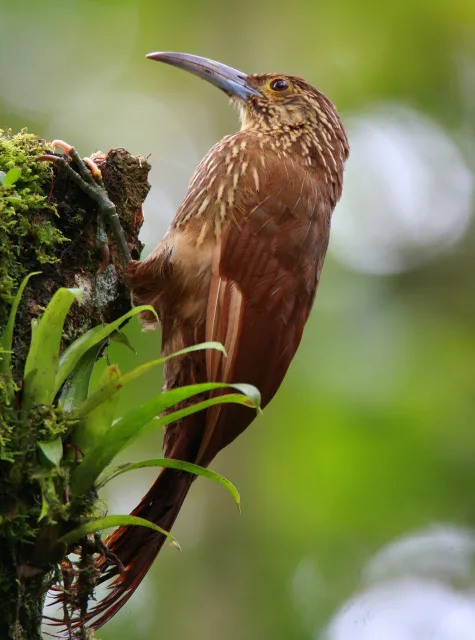
Because of their extreme structural adaptations, both the Brown Creeper and the South American woodcreepers are bound by the exact same physical limitation: they can only climb up.
Neither bird has the ankle architecture to walk headfirst down a tree trunk like a Nuthatch can. Instead, they have both developed a beautiful, rhythmic way of working a forest:
They start at the very base of a tree trunk, just above the soil line.
They hop methodically up and around the trunk in a spiral, vacuuming up insects as they ascend.
Once they reach the lower canopy or branches where the bark thins out, they swoop downward in a steep, silent glide, landing right back at the base of the next nearby tree to start the climb all over again.
The Takeaway for Birders
The Brown Creeper and the tropical woodcreepers show us that when a foraging niche is rich enough—like the massive, insect-filled surface area of the world's forests—nature will find a way to exploit it. Whether in a chilly pine forest in Maine or a steaming rainforest in Brazil, the laws of physics and biology eventually converge, turning completely unrelated songbirds into identical, bark-scaling hitchhikers.
