

The Common Raven (Corvus corax) is one of the most widespread and recognizable birds in the world. Found throughout the Northern Hemisphere, from Arctic tundra to deserts and high mountains, it is a master of survival, an apex scavenger, and perhaps the most intelligent bird species known. Revered in mythology and folklore across countless cultures, the raven is a symbol of cunning, prophecy, and wilderness.
Identification and Appearance
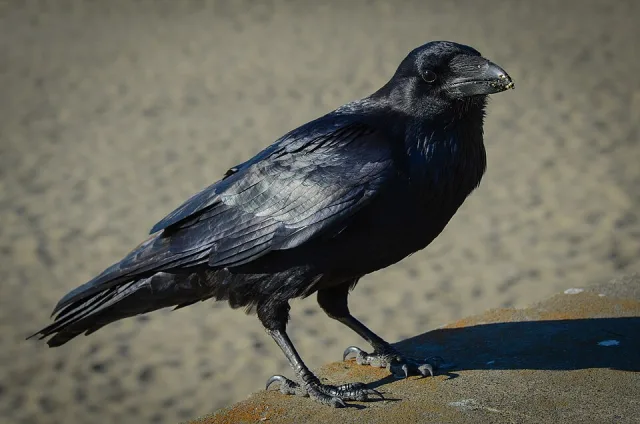
The Common Raven is the largest passerine (perching bird) in the world. Its sheer size and robust build distinguish it from other black birds, including the smaller American Crow.
Size: Ravens typically measure between 22–27 inches long, with a massive wingspan that can reach up to 59 inches.
Plumage: Its entire plumage is a glossy, iridescent black, often showing purple, blue, and greenish sheens in good light.
Bill: It possesses a massive, heavy, and slightly hooked bill used for tearing carrion and manipulating large objects.
Throat Feathers: A key field mark is the shaggy, hackled throat feathers (rattles) visible when the bird is vocalizing or displaying.
Tail Shape: In flight, its tail is typically wedge-shaped (or diamond-shaped), which differentiates it from the shorter, fan-shaped tail of a crow.
Ravens move with a characteristic deliberate and stately hop or walk, reflecting their confident demeanor.
Range and Habitat
The Common Raven has the largest distribution of any corvid species. It is a cosmopolitan species, found across North America, Europe, Asia, and North Africa.
Habitat Adaptability: Its success is due to its extraordinary adaptability. Ravens thrive in a wide array of environments:
Wilderness: Remote forests, high alpine mountains, and deserts.
Coastal Areas: Cliffs and rocky shores where they scavenge.
Suburban/Urban Edge: While traditionally less urbanized than crows, ravens are increasingly adapting to cities and suburbs where they can exploit food resources, especially in the western United States.
Ravens are generally year-round residents, though northern populations may make short-distance movements during winter to follow food sources.
Intelligence and Behavior

The Common Raven's intelligence is often compared to that of primates. They exhibit sophisticated cognitive abilities:
Problem-Solving: Ravens are known to use tools to acquire food, understand cause and effect, and solve complex puzzles. Experiments have shown they can perform sequential tasks, like pulling a string in steps to retrieve a treat.
Social Behavior: They maintain long-term monogamous pair bonds and can live for decades. Non-breeding, juvenile birds often form complex, fluid flocks where they share information about food discoveries.
Vocalization: They possess an exceptionally diverse vocabulary, including a deep, resonant "cronk" or "pruk-pruk" call. They are also masters of vocal mimicry, capable of imitating the calls of other birds, animals, and even human speech.
Play: Ravens engage in elaborate play behavior, which is an indicator of high intelligence. They slide down snowbanks, play keep-away with objects, and dangle from branches purely for enjoyment.
Diet and Ecological Role
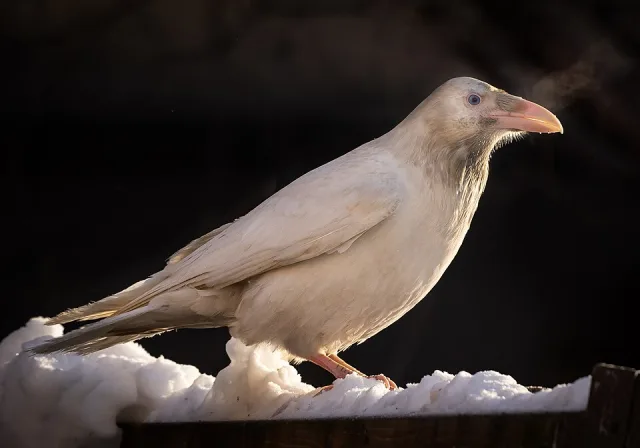
The raven is a supreme opportunistic omnivore and scavenger, a trait critical to its ecological success.
Scavenging: Their primary role is that of a nature's recycler. They are crucial to ecosystems by quickly consuming carrion (dead animals), often being the first species to locate a large carcass. Their powerful bill allows them to tear through tough hides.
Hunting and Foraging: They also actively hunt small prey, including rodents, lizards, and insects. They are expert nest predators, consuming eggs and hatchlings of other birds. Their diet is rounded out by seeds, grains, berries, and human refuse.
Cooperation: Ravens often cooperate with wolves or coyotes in the wild. They locate a large carcass and, through their calls, draw in the mammalian predators needed to open the tough hide, thus granting the ravens access to the meat inside.
In modern ecological terms, the Common Raven continues to fulfill its ancient role: a highly adaptable, intelligent sentinel of the landscape, capable of thriving wherever resources are available.
