

The Chipping Sparrow (Spizella passerina) is arguably the most common and familiar sparrow in North America, embodying the quiet, resilient success of a bird perfectly adapted to a world shaped by human activity. With an estimated continental population soaring past 200 million individuals, this small, dapper bird ranks among the most abundant avian species, yet it often escapes notice due to its small size and its simple, mechanical song.
Often overlooked in favor of its more brightly colored or vocally flamboyant neighbors, the Chipping Sparrow is nonetheless a charming, essential thread in the tapestry of the American landscape. It is the sparrow of lawns, orchards, and open woods, a ubiquitous presence whose life history is a testament to the power of adaptation and resourcefulness.
Identification: The Sparrow with the Russet Cap
Unlike many of its relatives in the New World Sparrow family (Passerellidae), the Chipping Sparrow is remarkably cleanly marked and unstreaked on its underside, making its identification surprisingly straightforward.
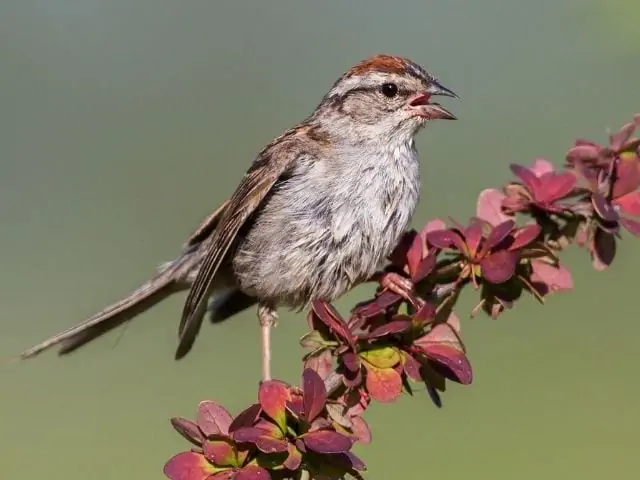
Key Field Marks
- The Rusty Cap: The defining feature of the adult Chipping Sparrow in breeding plumage is its bright russet-red cap (or crown). This distinct color immediately separates it from most other backyard sparrows, which typically have streaked or duller crowns.
- The Face Stripes: The cap is dramatically framed by a crisp, white supercilium (eyebrow) and a bold, black eye-line that passes right through the eye. This combination gives the bird a neat, alert, and dapper appearance.
- Plumage: The bird's back and wings are brown with dark streaks, while its throat and breast are a clean, unstreaked pale gray or grayish-white.
- Size and Bill: It is a small sparrow, measuring about 5 to 5.5 inches in length. It possesses a very small, conical, pale pink bill—a clear sign of its seed-eating diet.
Seasonal Variation
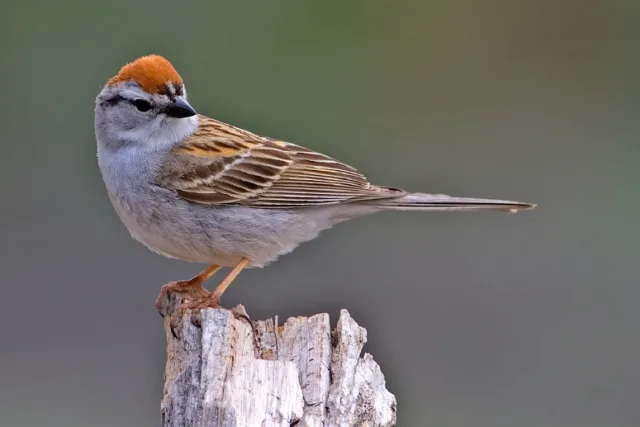
In winter plumage, the red cap is often obscured by gray feather tips, making the bird appear duller and sometimes subtly streaked on the crown. The bold facial pattern remains, though the black eye-line is less intense. Juveniles, which appear in summer, are more difficult to identify as they lack the distinctive russet cap and are lightly streaked on the breast and flanks, resembling some types of juvenile Dark-eyed Juncos.
Song and Behavior: The Sound of Summer
The Chipping Sparrow is perhaps best known for its song, which is less a melody and more a vocal percussion that is central to the sounds of late spring and summer.
- The Song: The male's song is a simple, dry, rapid trill composed of a continuous, high-pitched "chip" note repeated rapidly: "chi-chi-chi-chi-chi-chi..." delivered at a uniform speed. It sounds metallic or insect-like and can easily be mistaken for a loud insect buzz or the sound of a lawn sprinkler's spray. The bird typically delivers this monotonous, relentless song from an exposed perch atop a shrub, tree, or utility wire to defend its small breeding territory.
- The Call: Its most common call note is a simple, soft, metallic “chip” or “tsip,” which gives the bird its common name and is used constantly for contact between foraging members of a flock.
- Foraging: Chipping Sparrows are primarily ground foragers. They hop along lawns and bare soil beneath trees and shrubs, searching for seeds and insects. They often tolerate human presence well, making them a common sight in backyard feeding areas.

Chipping Sparrow - Sociality: During the breeding season, they are territorial pairs, but outside of nesting, they are highly gregarious, forming mixed-species flocks with other sparrows, juncos, and chickadees, especially during migration and in winter.

Habitat and Range: The Edge Specialist
The Chipping Sparrow's extensive population size is directly linked to its preference for open, edge habitats—precisely the environments that humans have created across the continent.
- Breeding Range: It is one of the most widely distributed sparrows, breeding across the vast majority of the United States and Canada, extending from the Pacific to the Atlantic coasts.
- Preferred Habitat: The Chipping Sparrow is an edge specialist. It favors areas that combine open, grassy ground for foraging with dense shrubs or trees for nesting and cover.
- Suburban/Urban: It thrives in residential areas, preferring lawns, parks, cemeteries, and gardens.
- Natural: It is also found in forest edges, clearings, open pine or oak woodlands, and abandoned agricultural fields.
- Migration: Northern populations are short- to medium-distance migrants, moving south to the southern U.S. (especially the Southeast and Texas) and Mexico for the winter. In the southern U.S. (like Florida and the Gulf Coast) and along the Pacific Coast, they can be year-round residents.
Breeding and Conservation: A Survivor's Tale
The Chipping Sparrow’s reproductive success and conservation status are generally strong, though they face challenges common to many North American songbirds.
- Nesting: Nests are usually placed low down in dense vegetation—often in the crotch of a small shrub, hedge, or conifer. The nest itself is a small, neat cup built of fine grasses, rootlets, and hair. A notable feature is the frequent use of fine animal hair (often horse or deer hair, sometimes even human hair) to line the interior, a trait shared with few other sparrows.
- Reproduction: The female typically lays 3–5 small, pale blue eggs speckled with dark markings. They are quick breeders, often raising two or even three broods per season, which is key to sustaining their high population numbers.
- Cowbird Parasitism: Like many small songbirds, the Chipping Sparrow is a frequent target of the Brown-headed Cowbird, a brood parasite that lays its eggs in the sparrow's nest. This can significantly reduce the sparrow's reproductive output, as the larger cowbird chick often outcompetes the smaller sparrow chicks for food.
- Conservation Status: The species is classified as a bird of Least Concern by the IUCN. While its overall continental population is massive (estimated at over 200 million), it is important to note that like many other common birds, it has seen localized declines in certain regions due to habitat loss and pesticide use. However, its overall adaptability to human-altered landscapes has allowed it to maintain its status as one of the continent’s most successful and numerous birds.
The Chipping Sparrow may lack the flamboyant color of the Tanager or the complex song of the Thrush, but its pervasive presence and quiet survival make it an essential character in the story of North American birdlife. It is the perfect, tiny anchor for the backyard ecosystem—a constant reminder that sometimes, the most successful species are simply the ones best able to live alongside us.
