

The Carolina Wren (Thryothorus ludovicianus) may be small in stature, but it’s a powerhouse of song and personality. This energetic bird with its rich, rolling call and bold demeanor has become a familiar presence in backyards, woodlands, and suburban gardens across the southeastern and eastern United States. Despite its small size, the Carolina Wren stands out as one of North America’s most spirited and endearing avian residents.
Physical Description
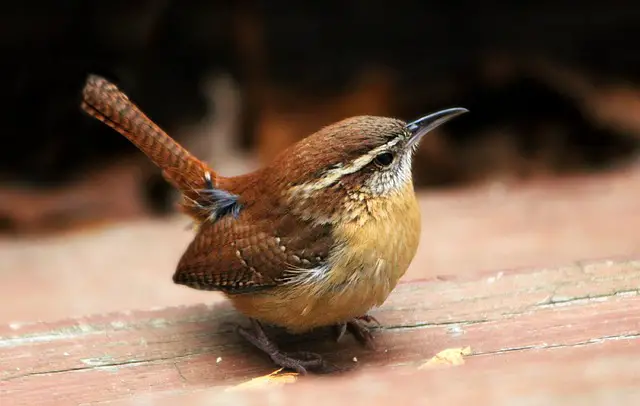
Measuring about 5.5 inches in length with a wingspan of 7 to 9 inches, the Carolina Wren is slightly larger than the common House Wren. Its body is round and compact, with a relatively long tail that it often cocks upward. The bird’s most distinctive features include:
Reddish-brown upperparts
Warm buff-orange underparts
Bold white eyebrow stripe (supercilium)
Slightly curved bill, well-suited for probing and picking
Both males and females look alike, making them difficult to distinguish by sight alone. What they lack in visual dimorphism, however, they more than make up for in behavior and vocalization.

Range and Habitat
The Carolina Wren is a year-round resident throughout the southeastern U.S., extending as far north as the Great Lakes and southern New England. Over the past century, this species has expanded its range northward, thanks in part to warming winters and increased presence of backyard feeders and birdhouses.
Preferred habitats include:
Dense undergrowth in deciduous or mixed forests
Shrubby thickets and woodland edges
Residential gardens with mature trees and brush piles
Overgrown fields and riverbanks
Unlike some birds that avoid human-modified environments, the Carolina Wren adapts well to suburban and even urban areas—as long as there is enough cover for nesting and foraging.
Vocalizations: Loud and Proud
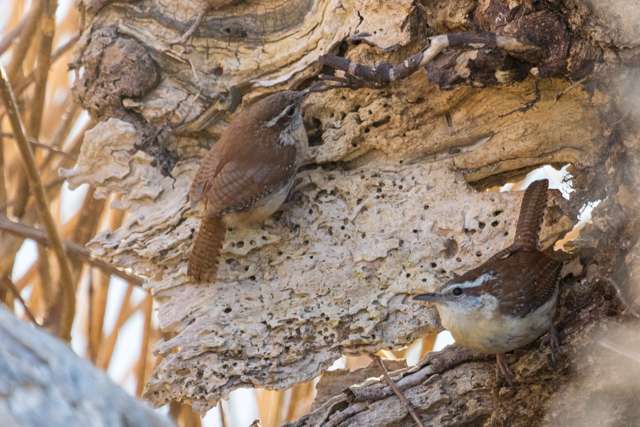
One of the most remarkable features of the Carolina Wren is its boisterous and varied song repertoire. Male wrens sing to defend territory and attract mates, often repeating a phrase three times in a rhythmic pattern. One common version sounds like:
“Teakettle-teakettle-teakettle!”
or
“Cheery-cheery-cheery!”
In addition to their main song, Carolina Wrens produce a wide array of calls, including scolding chatters, trills, buzzes, and alarm chirps. Their voices can be surprisingly loud for such small birds, often echoing through wooded neighborhoods even in winter.
Interestingly, only the male sings, but both sexes call and duet in close communication—especially when alarmed or during courtship.
Behavior and Feeding
Carolina Wrens are active and inquisitive birds. They forage in pairs year-round, hopping energetically through leaf litter, logs, and dense brush in search of food. Their diet is primarily insectivorous, but they also consume:
Beetles, spiders, and caterpillars
Ants, wasps, and crickets
Small fruits and berries (especially in winter)
Suet and sunflower seeds from feeders
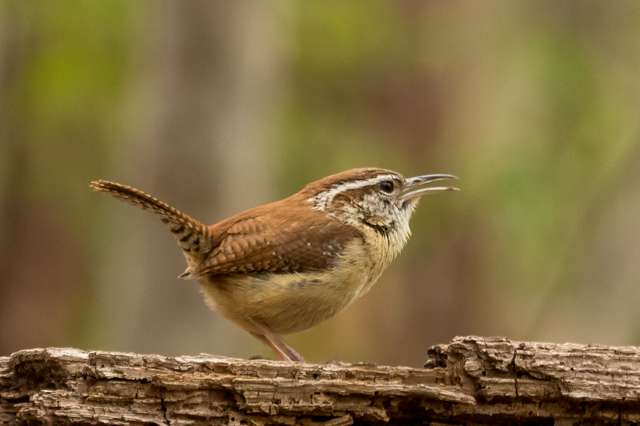
They are also known to investigate crevices and cavities, poking their slender, curved bills into cracks in bark or old wood to extract insects.
Unlike many birds that migrate or flock seasonally, Carolina Wrens form strong pair bonds and stay together year-round, maintaining and defending their territory even in harsh weather. During cold spells, they will sometimes roost together in sheltered nooks to conserve heat.
Nesting and Reproduction
Carolina Wrens are known for their creative nesting habits. They build cup-shaped nests of twigs, grass, moss, and leaves, lined with softer materials like feathers or animal hair. These nests are often placed in surprising locations:
Hanging flowerpots
Old boots, mailboxes, or tool sheds
Brush piles or vine tangles
Hollow tree stumps
Nest boxes
The female lays 4 to 6 eggs, creamy white with brown speckles, and incubates them for about 12 to 16 days. During this time, the male often feeds her and stands guard nearby.
Once hatched, both parents feed the chicks, who fledge the nest around 12 to 14 days after hatching. The pair may raise two or even three broods in a single breeding season, especially in southern parts of their range.
Adaptability and Survival
One of the reasons the Carolina Wren has thrived—despite habitat loss and climate variability—is its remarkable adaptability. Unlike more specialized birds, it doesn’t require pristine wilderness to survive. It makes good use of human-altered landscapes, provided they contain some degree of shelter and natural food sources.
However, Carolina Wrens are sensitive to harsh winters, especially in the northern parts of their range. Prolonged cold snaps with snow cover can reduce insect availability and cause significant die-offs. Still, populations usually rebound quickly due to their high reproductive rate.
Conservation Status
According to the IUCN Red List and the North American Breeding Bird Survey, the Carolina Wren is a species of Least Concern, with populations currently stable or increasing. In fact, their numbers have expanded significantly over the last several decades.
This expansion has been helped by:
Warmer winters due to climate change
Increased planting of ornamental shrubs and trees
Availability of bird feeders and nest boxes
Nonetheless, continued conservation of native vegetation, brushy habitats, and diverse insect populations remains critical to supporting this bird across its range.
Relationship with Humans
The Carolina Wren has endeared itself to many birdwatchers and gardeners. Its bold behavior, cheery song, and quirky nesting habits make it a backyard favorite. In fact, in South Carolina, the species is so beloved that it was officially designated the state bird in 1948.
To attract and support Carolina Wrens:
Provide dense shrubbery or brush piles for shelter
Offer suet and mealworms in winter months
Install nest boxes or leave cavities accessible
Avoid excessive pesticide use to preserve insect prey
Cultural and Ecological Significance
Ecologically, Carolina Wrens help control insect populations and serve as prey for larger birds and mammals. Culturally, they’ve appeared in poetry, folklore, and backyard birding journals for generations.
Despite their diminutive size, these birds are a symbol of resilience, adaptability, and song, thriving in the shadow of cities and forests alike. Whether nesting in a mailbox or serenading from a porch railing, the Carolina Wren brings life and music to wherever it makes its home.
Wrapping Up
The Carolina Wren is more than just a songbird—it’s a symbol of nature’s ability to thrive alongside humanity. Its year-round presence, lively character, and rich vocalizations make it one of the most recognizable and cherished birds in the eastern United States.
As we continue to shape our landscapes, creating space for adaptable species like the Carolina Wren helps preserve the joy and ecological balance these birds bring. With its teakettle call and curious eyes, the Carolina Wren reminds us that even the smallest creatures can leave the biggest impressions.
