

The Burrowing Owl, a charismatic and unique denizen of the North American grasslands, faces significant threats that have prompted dedicated conservation efforts across its range. Due to its dependency on the ecological activities of other animals (prairie dogs and ground squirrels) and its vulnerability to habitat loss, several federal, state, and private programs are actively working to protect and restore its populations.
The Root of the Problem: Habitat and Host Loss
The decline of the Burrowing Owl is fundamentally tied to the destruction of the prairie ecosystem. Historically, the extensive colonies of prairie dogs provided vast, interconnected neighborhoods of ready-made burrows. When these prairie dog populations were systematically decimated—often through poisoning and habitat conversion—the owls lost their essential shelter infrastructure. Without burrows, the owls cannot successfully nest, escape predators, or find refuge from weather extremes.
This massive loss of habitat, combined with the owls’ vulnerability during migration and collisions with vehicles, makes conservation a multi-pronged challenge focused on land management and direct intervention.

Direct Intervention: Artificial Burrow Installation
One of the most successful and widespread conservation strategies involves direct intervention through the installation of artificial burrows. This technique allows managers to create suitable habitat where natural burrows are scarce, or where prairie dog reintroduction is not feasible.
Design: These artificial burrows typically consist of a main nesting chamber, constructed from a bucket or plastic container, connected to the surface by a long, flexible PVC pipe that mimics the entrance tunnel.
Deployment: The structures are buried in suitable open grassland sites. The entrance pipe is disguised with natural vegetation and often lined with straw.
Effectiveness: Studies have shown high rates of acceptance; owls readily occupy and use these man-made burrows for nesting and roosting, especially in areas where native populations have been extirpated or are attempting to reestablish. This method is crucial in urbanizing areas and restored lands where habitat structure is improving but burrow hosts are still absent.
Habitat Restoration and Host Protection
Long-term survival hinges on restoring the ecosystem's integrity, focusing on the preservation of the burrow-creating host species.
Prairie Dog Colony Protection: Conservation programs, particularly across the Great Plains (e.g., in Colorado, Kansas, and Montana), focus on protecting existing prairie dog towns on public and private lands. This involves:
Education and Outreach: Working with ranchers and private landowners to promote coexistence and discourage lethal control of prairie dogs.
Legal Protection: Designating critical prairie dog habitat areas that restrict development and disturbance. The success of the owls is directly measured by the size and health of the surrounding prairie dog colonies.

Burrowing Owl
Grassland Management: Efforts are underway to restore native prairie grasses and reduce the spread of invasive species. Healthy, native grasslands provide better foraging opportunities for the owls' primary food—grasshoppers and other insects—and also support a more robust small-mammal population.

Migration and Urban Initiatives
Due to the owl's migratory habits and its surprising resilience in certain human-dominated landscapes, specific regional programs address these unique challenges.
Migration Stopover Sites: Efforts are made along major migration corridors to identify and protect key stopover habitats where owls rest and refuel. This includes ensuring that irrigation ditch banks and grazed pastures remain available for temporary burrowing.
Urban Nesting Programs: In states like California, Burrowing Owls have adapted to finding burrows in the margins of urban sprawl, such as industrial parks, airports, and drainage structures. Conservation groups partner with municipalities to:

Burrowing Owl Mitigate Disturbance: Implement management plans that restrict mowing or construction during the nesting season (spring and summer).
Relocation and Compensation: When burrows are threatened by imminent development, biologists sometimes use one-way doors to safely "evict" the owls and encourage them to move into nearby, already installed artificial burrows in designated compensation sites.

The installation of artificial burrows is a highly effective and targeted conservation strategy used to mitigate habitat loss for the Burrowing Owl. The process involves creating a safe, subterranean structure that mimics a natural burrow, offering the owls a secure place to nest, roost, and escape predators or extreme weather.
The installation process typically involves careful planning and execution across several key steps:
1. Site Selection and Preparation
The success of the artificial burrow relies heavily on choosing the correct location.
Habitat: Sites must be in suitable open grassland, short-grass prairie, or scrub-steppe habitat where the surrounding land provides excellent foraging opportunities (i.e., high insect and rodent populations).
Soil: The area needs well-drained soil to prevent the burrow from flooding, especially during heavy rains. Avoid low-lying areas or ground with high water tables.
Predator Avoidance: Burrows are often placed away from dense cover that could hide mammalian predators (like coyotes or badgers) and away from tall power poles or trees that could provide perches for large avian predators (like Great Horned Owls).
Preparation: The site is often mowed or cleared of excessive tall vegetation to create a short-grass environment preferred by the owls.
2. Construction of the Nest Chamber
The heart of the artificial burrow is the nesting chamber, which is installed underground.
Chamber Material: The chamber is typically a durable, rot-proof container, such as a five-gallon plastic bucket or a similar-sized wooden or concrete box.
Insulation and Drainage: The container is usually placed upside down. Holes are drilled in the sides or bottom to allow for proper drainage and ventilation.
Depth: The chamber is buried deep enough (usually 1 to 3 feet) to provide thermal stability, keeping the nest cool in the summer and warmer in the winter.
3. Creating the Entrance Tunnel
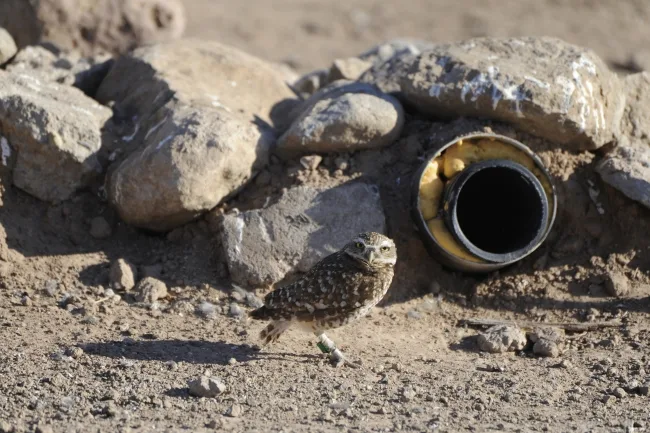
A flexible pipe is used to connect the underground chamber to the surface, mimicking the entrance tunnel dug by prairie dogs or ground squirrels.
Pipe Material: Flexible PVC or drainage piping (often 4-inch diameter) is used for the tunnel. Flexibility is important as it allows the pipe to curve, creating a natural-looking entrance that helps deter predators.
Installation: The pipe is attached to a hole cut into the side of the buried chamber and extends horizontally for several feet before curving up to the surface.
Slope and Length: The tunnel is sloped slightly upward from the chamber to the entrance to ensure any minimal water runoff flows away from the nest. The length helps provide security and temperature regulation.
4. Burrow Camouflage and Finishing
The final steps ensure the burrow is attractive to the owls and safe from predators.
Soil Replacement: After burying the chamber and tunnel, the excavated soil is carefully packed back over the structure to prevent settling and covered with grass, restoring the natural grade.
Entrance Hood: The exposed end of the PVC pipe is often fitted with a small, camouflaged hood or covering made of wood or rock. This prevents direct rain entry and provides a shaded area.
Lining Material: As the owls naturally line their burrows, a small amount of dried grass or animal scat (manure) is often placed near or just inside the entrance. This acts as an attractant and may help lure insects, a key prey item.
Pairing: To increase the chances of attraction, two or more artificial burrows are often installed close together, as the owls frequently use multiple burrows for nesting, satellite escape tunnels, and separate male/female roosting spots.
By providing this safe, ready-made housing, conservationists significantly reduce a major limiting factor for the Burrowing Owl population, enabling them to focus their energy on foraging and successful reproduction in restored habitats.
