
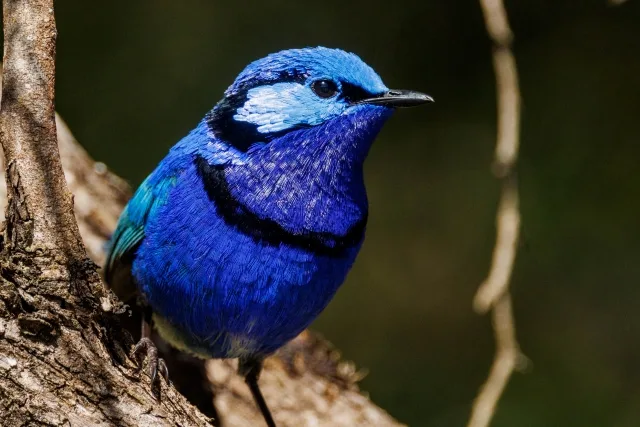
The color blue holds a special allure in the natural world. In birds, it evokes images of vast skies, deep oceans, and exotic, jewel-toned creatures. Yet, the presence of blue in avian plumage is often a marvel of physics, not pigments. Unlike most other colors, true blue pigments are exceedingly rare in birds, making the vibrant blues we see a spectacular optical illusion.
The Science of Blue: A Trick of the Light
While reds, yellows, and oranges in bird feathers are typically produced by carotenoid pigments (obtained through diet) and browns/blacks by melanins, blue is almost exclusively achieved through structural coloration.
Here's how it works:
- Microscopic Structures: Instead of a blue pigment, the feathers contain highly organized, microscopic structures—tiny air cavities, collagen fibers, or melanin granules—within the barbules (the branching filaments off the main feather barbs).
- Light Scattering: When white light (which contains all colors) hits these nanostructures, they selectively scatter only the blue wavelengths of light. Other wavelengths (red, yellow, green) pass through or are absorbed by an underlying layer of melanin.
- The Illusion: The scattered blue light is then reflected back to our eyes, making the feather appear blue.
This structural nature explains why blue feathers often look different depending on the angle of the light. They can shimmer, appear iridescent, or even shift in hue, showcasing the dynamic beauty of physics in action. This phenomenon also means that if you crush a blue feather, the structures are destroyed, and the feather will simply appear black or gray due to the underlying melanin.
Top 10 Azure Beauties: The World's Bluest Birds
Here are ten of the most exquisitely blue birds from around the globe, each a testament to nature's mastery of optical artistry:
1. Hyacinth Macaw (Anodorhynchus hyacinthinus)
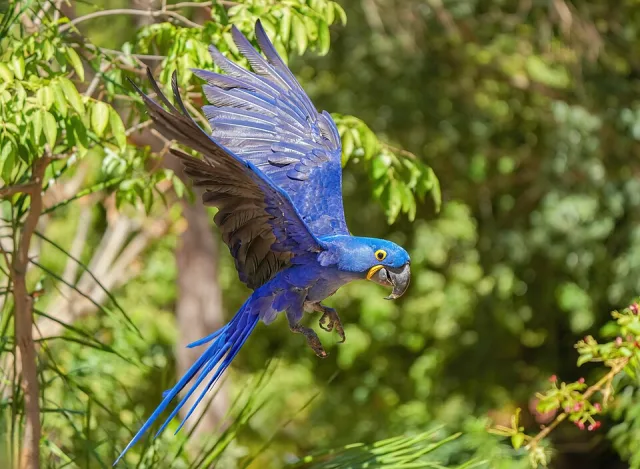
The undisputed king of blue, the Hyacinth Macaw is the largest flying parrot species and an icon of South American wetlands.
- Plumage and Description: It boasts an almost uniform, incredibly deep and vibrant cobalt blue plumage, so intense it appears almost purple in certain lights. A distinctive patch of bright yellow skin around its eye and at the base of its massive, curved black beak provides a striking contrast.
- Habitat: Found in semi-open habitats, palm groves, and woodlands of Brazil, Bolivia, and Paraguay, often near water.
- Behavior: Highly intelligent and social birds, often seen in pairs or small family groups. Their powerful beaks are perfectly adapted for cracking the hardest nuts and seeds.
2. Indigo Bunting (Passerina cyanea)
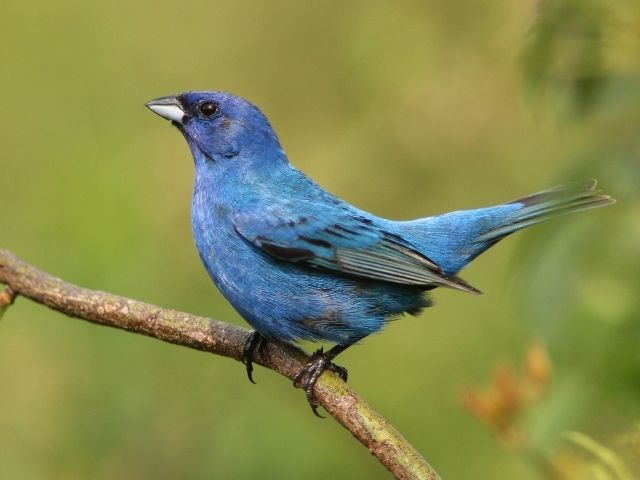
A dazzling summer resident across eastern North America, the male Indigo Bunting is a splash of living sky.
- Plumage and Description: The male is entirely a brilliant, iridescent deep indigo blue during the breeding season, often appearing almost violet-blue in direct sunlight, and duller in shade. The female is a plain brown, offering an excellent example of sexual dimorphism.
- Habitat: Prefers overgrown fields, woodland edges, and brushy areas throughout its North American breeding range.
- Behavior: A small songbird known for its persistent, cheerful song delivered from high perches. It's a migratory species, traveling to Central and South America for the winter.
3. Splendid Fairywren (Malurus splendens)
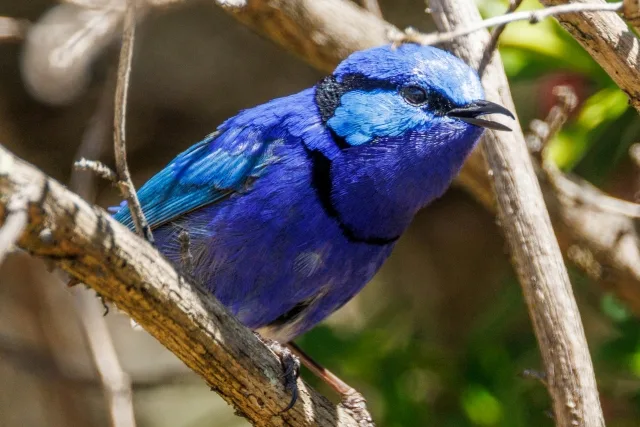
This tiny jewel is a common sight in the arid and semi-arid regions of Australia.
- Plumage and Description: The breeding male is an unforgettable vision of dazzling royal blue, with paler blue wings and a black eye-stripe and breast band. Its tail is also a rich blue. Non-breeding males and females are primarily dull brown, but always retain the blue tail.
- Habitat: Found in a variety of shrubby and grassy habitats across much of central and western Australia.
- Behavior: Highly social birds that live in small family groups, often with a dominant male. They are known for their lively displays and complex social structures.
4. Blue Jay (Cyanocitta cristata)
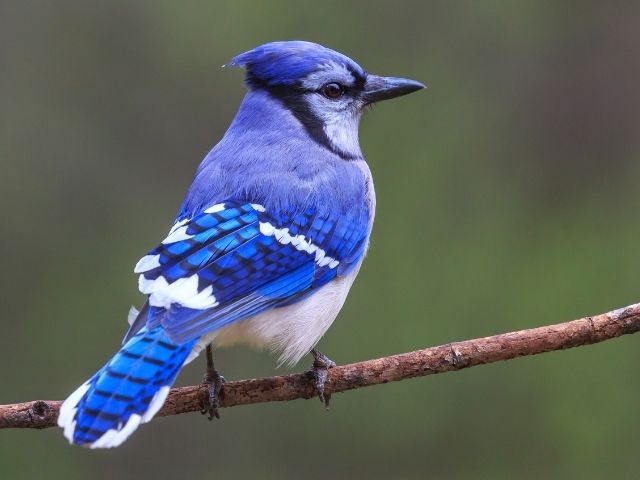
An iconic and intelligent bird of eastern North America, the Blue Jay is instantly recognizable.
- Plumage and Description: Its upperparts are a bright sky blue, fading to whitish on its underparts. It has a distinctive black "necklace" and white wing bars. Its crest can be raised or lowered to express mood.
- Habitat: Common in deciduous and mixed forests, parks, and suburban areas across eastern and central North America.
- Behavior: Known for its intelligence, complex social systems, and ability to mimic the calls of hawks (especially the Red-shouldered Hawk). They are also notorious for caching acorns and other seeds.
5. Azure Kingfisher (Ceyx azureus)
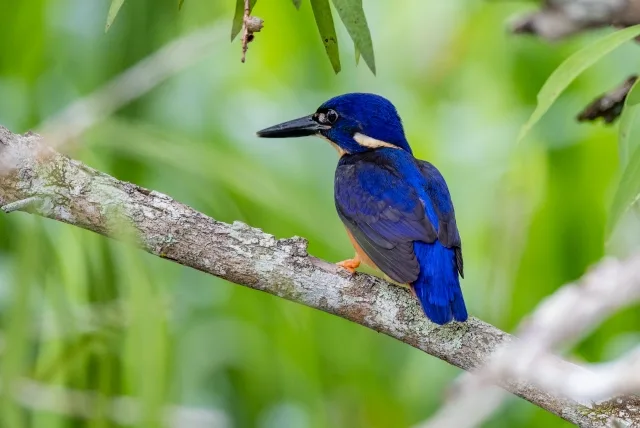
A diminutive, intense flash of blue found near the water across Australia and New Guinea.
- Plumage and Description: The head, neck, and upperparts are a brilliant, deep azure blue with a violet sheen. This contrasts sharply with its bright orange-red underparts and a distinctive white or buff spot on the side of its neck. Its legs and feet are bright red.
- Habitat: Never far from clear water, preferring vegetated freshwater rivers, creeks, billabongs, and mangroves, where it can find sheltered perches.
- Behavior: A solitary and elusive bird that hunts by plunging head-first into the water from an overhanging perch to catch fish, crustaceans, and insects. It nests in a long burrow excavated into a soil bank.
6. Greater Blue-eared Starling (Lamprotornis chalybaeus)
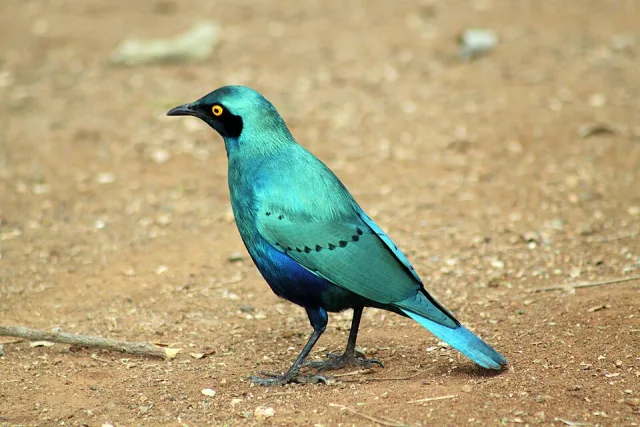
A common and spectacularly iridescent starling found across much of sub-Saharan Africa.
- Plumage and Description: Covered in a brilliant, metallic, and highly iridescent steel blue to turquoise plumage that shimmers with shades of green, violet, and bronze depending on the light. The "blue ear" refers to a darker, velvety blue patch behind the eye.
- Habitat: Inhabits open woodlands, savannas, cultivated areas, and urban gardens.
- Behavior: Highly social, often seen in large, noisy flocks, especially at roosting sites. They are omnivorous, feeding on fruits, insects, and nectar.
7. Blue-grey Tanager (Thraupis episcopus)
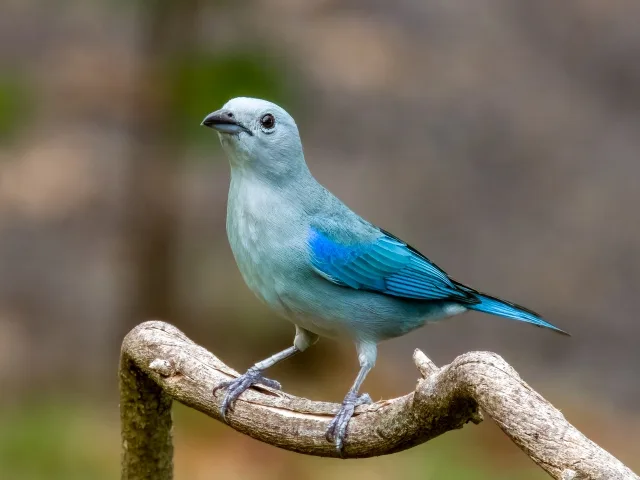
A widespread and successful songbird found throughout Central and South America.
- Plumage and Description: This bird is an elegant gradient of blue, with soft blue-gray on the head and body, brightening to a vivid sky-blue on the wings and tail. It often has a contrasting, slightly brighter shoulder patch that can be lavender or dark blue, depending on the subspecies.
- Habitat: Highly adaptable, found in open woodlands, forest edges, cultivated areas, gardens, and urban settings.
- Behavior: A restless and common species, often seen in pairs or small groups. It is primarily frugivorous, often foraging actively in the canopy for wild and cultivated fruits, and also supplements its diet with insects and nectar.
8. Varied Bunting (Passerina versicolor)
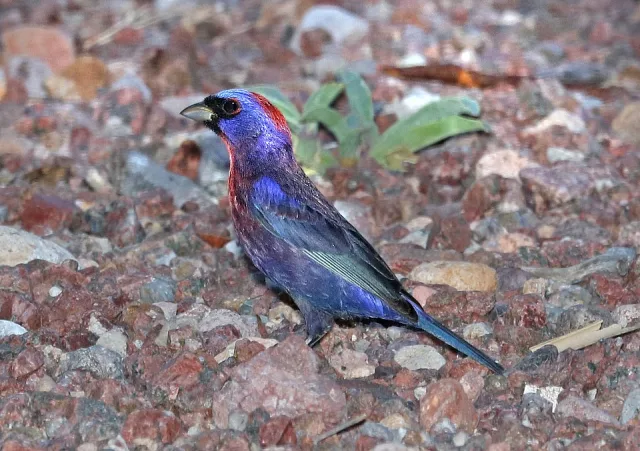
A less widely known but incredibly striking bunting from the southwestern US and Mexico.
- Plumage and Description: The male Varied Bunting is a kaleidoscope of color, with its head and throat being a deep, rich violet-blue that often shifts to a brilliant ultramarine on the crown, contrasting with crimson underparts and a reddish back. The blue is intense and structural.
- Habitat: Arid and semi-arid scrublands, thorny brush, and mesquite thickets in its range.
- Behavior: A shy and elusive songbird, often difficult to spot despite its bright colors. It feeds primarily on insects and seeds, often staying hidden in dense vegetation.
9. Mountain Bluebird (Sialia currucoides)

A breathtaking migratory songbird of western North America, famous for its nearly uniform blue color.
- Plumage and Description: The male is covered in a light, brilliant cerulean blue plumage, often appearing as if it were a piece of the sky. This blue is lighter and less streaked than its eastern and western cousins. The female is duller, with grayish-blue on her back and wings.
- Habitat: Prefers open country, high mountain meadows, prairies, and semi-arid sagebrush flats across western North America, particularly at higher elevations during the summer.
- Behavior: Known for its unique hunting style, often hovering in the air before dropping onto ground prey. It is a secondary cavity nester, relying on holes in trees, cliffs, or nest boxes.
10. Satin Bowerbird (Ptilonorhynchus violaceus)
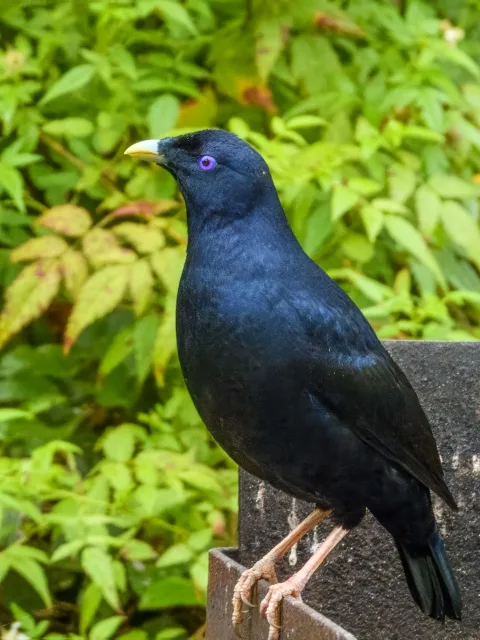
An endemic Australian bird known less for its flying ability and more for its unique architectural and artistic displays.
- Plumage and Description: The mature male is a stunning, uniform glossy, deep black-blue that shines with the iridescence of satin or patent leather. The blue is structural and often appears violet-tinged. Females and immature males are a duller greenish-brown.
- Habitat: Found in eastern Australian rainforests, tall moist eucalypt forests, and adjoining woodlands, often adapting to suburban gardens.
- Behavior: The male is famous for building an intricate avenue-style bower (a stick structure used for courtship, not nesting) and meticulously decorating the platform in front of it with blue objects it collects, such as berries, feathers, plastic, and bottle caps, to attract a mate.
The blue feathers of these magnificent birds are a testament to nature's ingenuity. They remind us that beauty can be crafted not just from pigment, but from the very fabric of light itself, turning common feathers into living, shimmering jewels.
