
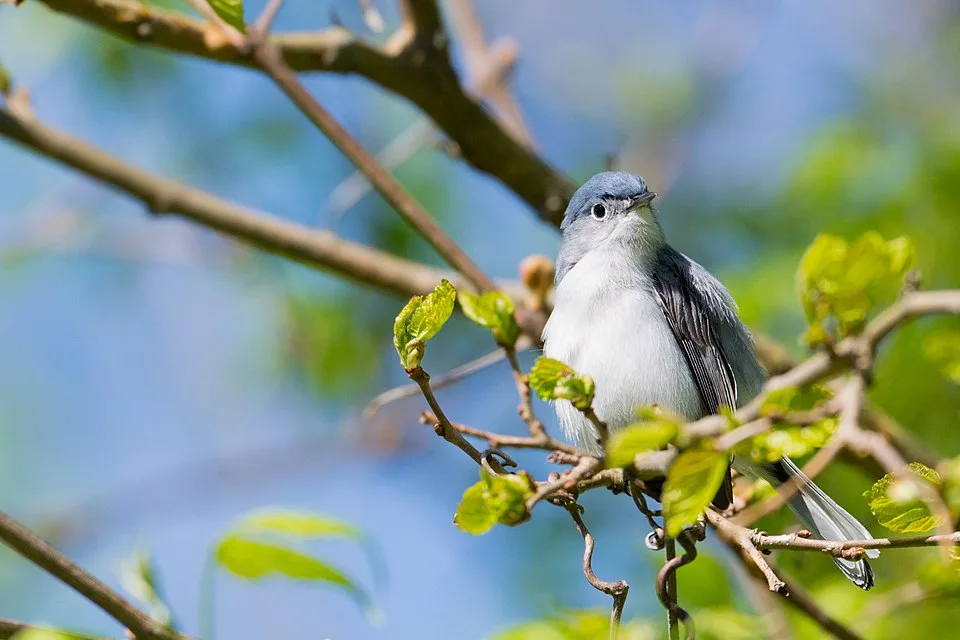
The Blue-gray Gnatcatcher (Polioptila caerulea) is a perfect paradox of the North American avian world. It is one of the continent's most abundant birds, often ranking near the very top of population estimates with hundreds of millions of individuals, yet it remains largely unseen and unappreciated by casual observers. It is a tiny bird that dominates the landscape not through its presence, but through sheer numbers—a whisper in the forest that constitutes a huge ecological success story.
A member of the Polioptilidae family, the gnatcatcher is a restless, long-tailed insectivore that brings the frenetic energy of a hummingbird to the wooded canopy. Its success across a vast range, from the swamps of Florida to the mixed forests of the U.S. and Canada, makes it a master adapter and a constant source of wonder for the dedicated birder.
I. Identification: The Miniature Mockingbird
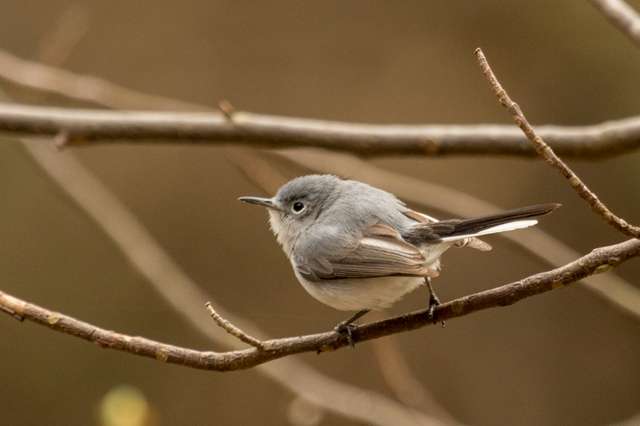
The Blue-gray Gnatcatcher is often compared to a miniature Mockingbird due to its proportionally long, slender, black-and-white tail and its constant motion.
Size and Shape
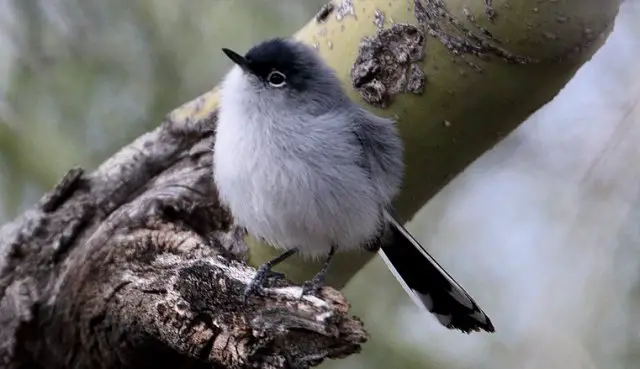
- Tiny Dimensions: This is a minuscule bird, measuring only about 4 to 5 inches (10–13 cm) in length, with most of that length taken up by its tail. It weighs a mere 0.2 ounces (5–7 grams), making it one of the smallest North American songbirds, comparable in size to a Ruby-throated Hummingbird.
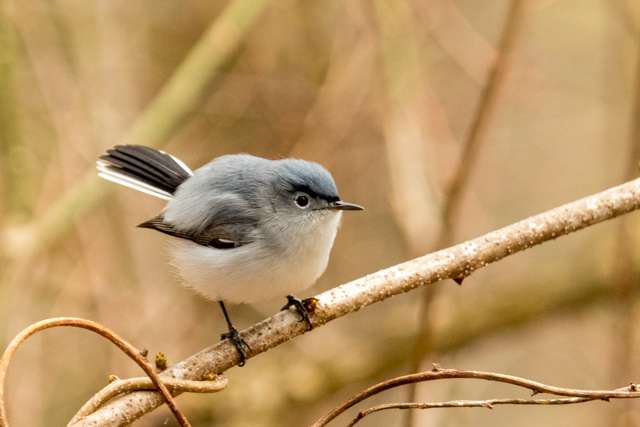
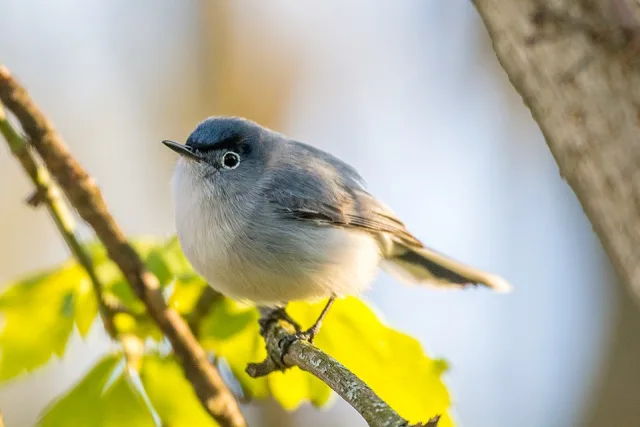
- Coloration: The upperparts are a subtle slate-blue to ash-gray, giving it a refined, steely appearance. The underparts are white to grayish-white. It has a thin, straight, dark bill perfectly suited for plucking small insects.
- Key Field Marks: Both sexes possess a distinctive thin, white eye-ring that gives the bird a perpetual look of surprise. Breeding males acquire a narrow black V-shape or line across the forehead and above the eye, which helps distinguish them from the plainer females.
- The Fidget: Its most noticeable trait is its behavior: the gnatcatcher is almost constantly flicking its long tail up, down, and side-to-side while foraging, which is often the first, and only, way birders spot this tiny, high-canopy phantom.
II. Habitat and Range: The Versatile Explorer
The Blue-gray Gnatcatcher boasts an extensive range across the contiguous United States, demonstrating remarkable habitat versatility.
- Breeding Range: It breeds across most of the U.S. east of the Great Plains, stretching from southern Ontario and New England down to Florida. In the West, its breeding range follows the mountain ranges and riparian zones through the Southwest (including Texas, Arizona, and California).
- Habitat Preference: It is a habitat generalist, thriving in a wide variety of wooded areas, including:
- Eastern Deciduous Forests (especially oak, maple, and ash).
- Riparian Corridors (along rivers and streams) in the arid West.
- Pine-oak Woodlands and Cypress Swamps in the South. It generally avoids large, dense coniferous forests, preferring open understory and forest edges.
- Migration: Northern populations are short-distance migrants, traveling to winter in the southern U.S. (especially Florida and the Gulf Coast), Mexico, Central America (Belize, Guatemala, Honduras), and the Caribbean islands (Cuba, the Bahamas). Southern U.S. populations are often year-round residents. This migratory flexibility has allowed the species to expand its breeding range northward over the last century, often attributed to climate change.
The Tiny Titans: A Profile of the Gnatcatcher Species of the U.S.
III. Diet and Foraging Strategy: The Insect Specialist
The name "Gnatcatcher" is a bit of a misnomer, as gnats do not form the bulk of its diet, but it accurately describes its food-snatching behavior. The gnatcatcher is an obligate insectivore (carnivore), relying on a constant supply of small invertebrates.
- Diet: Its primary food sources are small insects, spiders, larvae, eggs, and other small arthropods. Prey items include treehoppers, caterpillars, weevils, leaf beetles, and froghoppers.
- Foraging Style ("Gleaning"): It is one of the most active of all foragers. It primarily uses a technique called gleaning, rapidly moving through the outer foliage of trees and shrubs, hopping and fluttering to pick small prey directly off leaves and branches.
- The Tail Flick Trick: The constant flicking of its long, white-edged tail is thought to serve a functional purpose: the sudden flashes of white startle or flush small, hidden insects from the foliage, making them move and exposing them to the gnatcatcher's sharp eyes. It also occasionally sallies (darts out) to catch insects in mid-air (hawking).
IV. The Amazing Nest: An Architectural Masterpiece
The Gnatcatcher’s nest is arguably its most fascinating and distinctive feature, rivaling the complexity and camouflage of the best-known avian builders.
- Construction: Both the male and female work together for up to two weeks to build a tiny, neat, open, deep cup-shaped nest. It is placed high in a tree, often saddled on top of a horizontal branch or within a fork, usually more than 10 feet off the ground.
- Materials and Camouflage: The nest is a masterpiece of deception. The core structure is made of fine plant fibers, bark strips, and grasses, but the entire exterior is meticulously decorated and covered with lichens and fine pieces of bark, all bound together with spider webbing and caterpillar silk. This gives the nest an appearance virtually identical to a natural tree knot or a clump of moss, making it almost impossible for predators (and people) to spot.
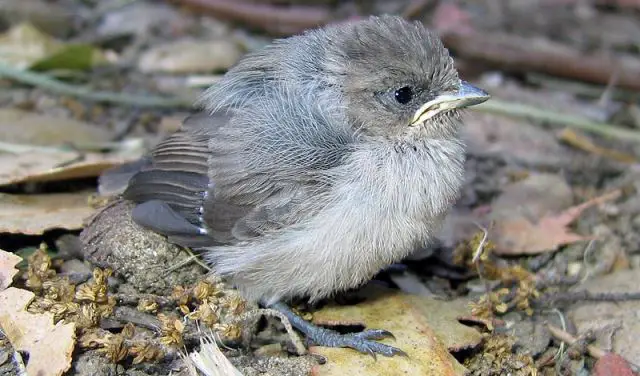
- Reproductive Success: They lay a small clutch of 4–5 pale blue or whitish eggs speckled with brown. Both parents share the duties of incubation (which lasts about 10–15 days) and feeding the altricial (helpless) young. The pair’s industrious nature is key: they may attempt up to seven nests in a single season to combat high rates of nest failure due to predation or Brown-headed Cowbird parasitism.
- Parental Care: The parents are fiercely territorial and defend their nest against intruders, even much larger birds. They will also remove the nestlings' waste, encased in fecal sacs, carrying them far away to avoid leaving a scent trail for predators.
V. Conservation Status and Unique Vocalizations
Despite being ecologically unassuming, the Blue-gray Gnatcatcher presents a fascinating case study in population dynamics.
- Continental Abundance: With an estimated global population currently around 160 million birds (though earlier estimates were higher, as seen in previous data), it is consistently ranked among the top 10 to 20 most numerous birds in North America. Its sheer numbers classify it as a species of Least Concern by the IUCN.
- Vocalization: Unlike its loud Mockingbird namesake, the Gnatcatcher's song is a weak, complex, and almost whispered warble, often containing elements stolen from other species' songs—earning it the secondary nickname, "Little Mockingbird." Its call is far more recognizable: a characteristic thin, nasal, and squeaky “speee” note that it uses constantly to keep track of its mate and defend its territory. The constant "speeing" often gives away its presence high in the canopy long before the bird itself is visible.
Wrapping Up
The Blue-gray Gnatcatcher is a testament to the fact that success in the avian world is not measured by size or conspicuousness, but by the quiet efficiency of adaptation. It is a tiny, tireless hunter whose presence weaves the fabric of woodlands across the continent, making it one of North America’s most important, yet easily overlooked, avian citizens.
