
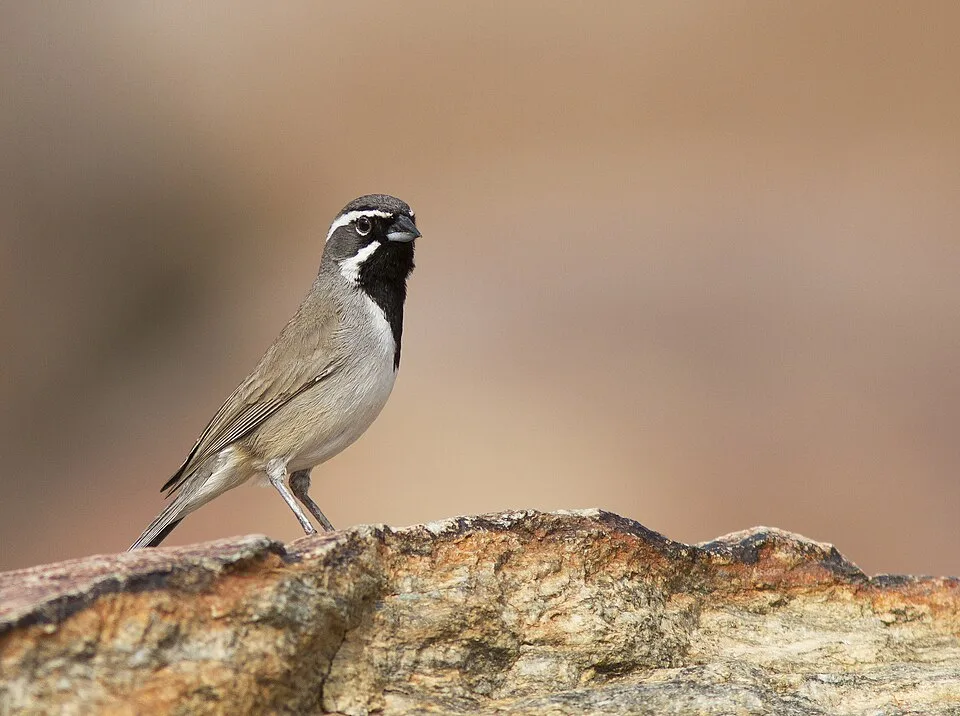
Amidst the sun-scorched creosote flats and rocky scrublands of the American Southwest, where life seems to exist on the edge of endurance, lives one of the most sharply dressed and ecologically adapted songbirds: the Black-throated Sparrow (Amphispiza bilineata). Often referred to simply as the "Desert Sparrow," this hardy species is the very embodiment of the arid West, thriving in environments that would defeat most other small birds.
To birders, the Black-throated Sparrow offers a welcome break from the monotony of "little brown jobs." Its striking, distinctive plumage makes it a standout in its stark, grayish-brown habitat, rewarding those who venture into the U.S. deserts.
Identification: A Study in Contrast

The Black-throated Sparrow is a medium-sized bird (around 5 inches long) with a relatively large, rounded head and a conical, seed-eating bill. Its appearance is defined by an elegant, high-contrast face pattern:
- The Black Bib: The defining feature is the neat, triangular patch of black that covers the throat and upper chest, resembling a dapper bow tie.
- The White Stripes: This black patch is dramatically framed by two strong white stripes: a bold supercilium (eyebrow) that extends back from the eye, and a white malar stripe (or mustache) below the cheek.
- Coloration: The rest of the bird is a soft, sleek tannish-grey on the crown, back, and wings, providing perfect camouflage against the desert soil, while the belly remains unmarked and pale.
This crisp, graphic pattern is unmistakable among North American sparrows, though juveniles lack the black throat and may show light streaking, a feature they quickly shed to adopt the adult's refined look.
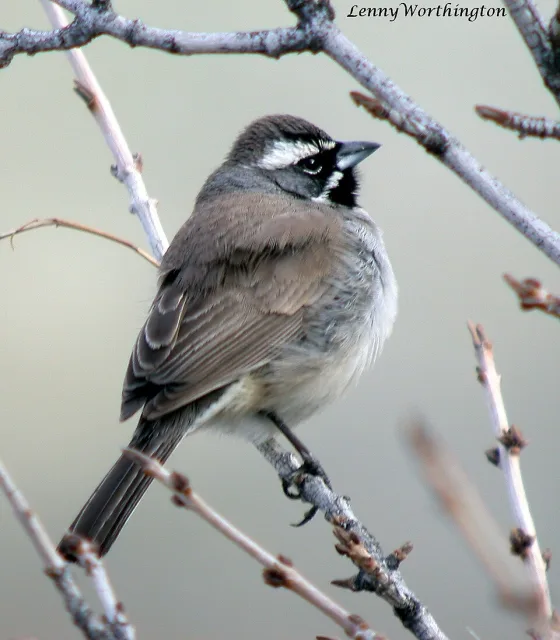
Habitat and Range: Master of the Arid Zone
The Black-throated Sparrow is the quintessential resident of the American Southwest. Its range extends across the Mojave, Sonoran, and Chihuahuan deserts, covering vast areas of Texas, New Mexico, Arizona, southern Utah, Nevada, and California.
It is a bird defined by its preference for arid scrub and open, barren flats. You can find it:
- Creosote Bush Deserts: These sparse, open habitats, sometimes mixed with saltbush or mesquite, are the core of its range.
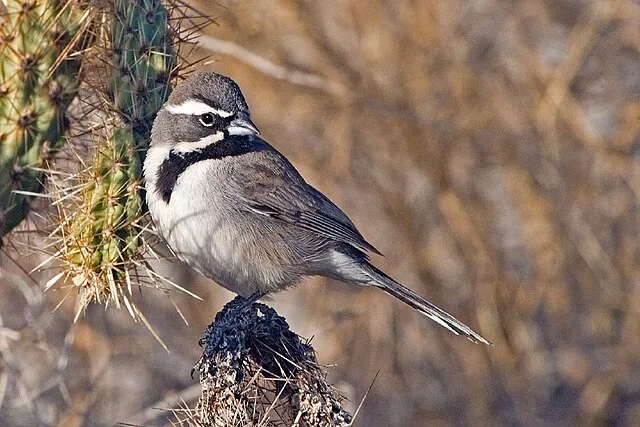
- Rocky Uplands and Canyons: It utilizes slopes and alluvial fans with scattered cacti (like cholla and jumping cholla), yucca, and low-growing juniper.
- Adaptation: The sparrow's presence is often correlated with the absence of dense grass cover, preferring the semi-open spaces provided by evenly spaced shrubs.
While southern populations are often permanent residents, northern breeders may be short-distance migrants, moving south into the core desert regions of the U.S. and Mexico for the winter.

Desert Survival: A Biological Marvel
What truly sets the Black-throated Sparrow apart is its remarkable adaptation to xerophilic (drought-loving) conditions, earning it the nickname "desert sparrow."
- Water Independence: Like other desert specialists such as the Cactus Wren and Greater Roadrunner, this sparrow can survive for extended periods without access to free water. It obtains nearly all the necessary moisture from its diet of insects and succulent vegetation.
- Efficient Kidneys: The birds possess extra-efficient kidneys that help them retain water, minimizing loss in the scorching heat.
- Dietary Shift: The sparrow is omnivorous, strategically shifting its diet to suit the season. In the summer breeding season, when moisture is vital for feeding nestlings, its diet is primarily insects (grasshoppers, caterpillars, and flies). In the drier winter months, it subsists mostly on seeds from grasses, desert shrubs, and cacti.
Behavior and Song
The Black-throated Sparrow is often heard before it is clearly seen.
- The Song: Males use a high-pitched, metallic tinkling song to establish and defend their territory. The song is a distinctive and simple series of bell-like notes followed by a rapid, often mechanical-sounding trill, ringing out from the top of a low creosote bush or cactus stem.
- Foraging: Unlike many sparrows that hop, the Black-throated Sparrow is often observed running or quickly walking along the ground between shrubs, actively foraging for food. It frequently holds its tail cocked upward while running.
- Nesting: Nests are typically built low to the ground (often less than two feet high), well-hidden within the protective cover of a dense shrub or spiny cactus. The timing of their nesting season is often dictated by the onset of rains, ensuring that insect prey is available for their young.
Wrapping Up
Though it remains widespread and common in its preferred habitat, the species has shown long-term declines in areas facing human encroachment. Its lack of adaptability to suburban environments, combined with threats from habitat degradation and increased fire frequency, reminds conservationists that even the toughest desert dwellers rely on the protection of their wild, arid homes.
