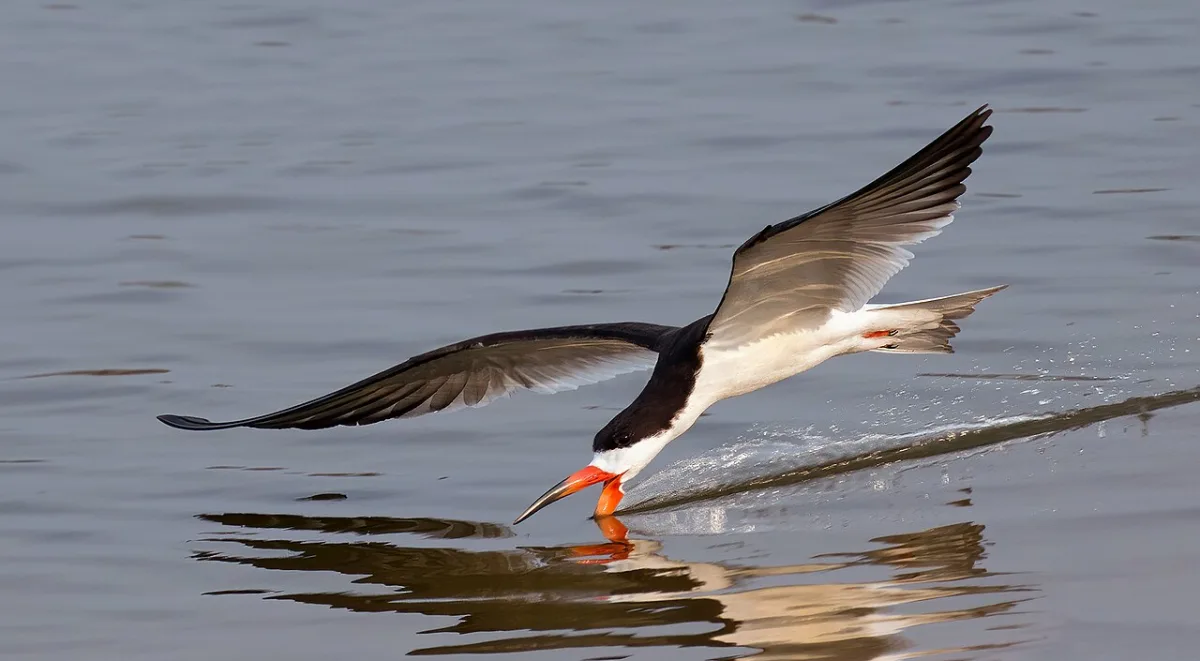
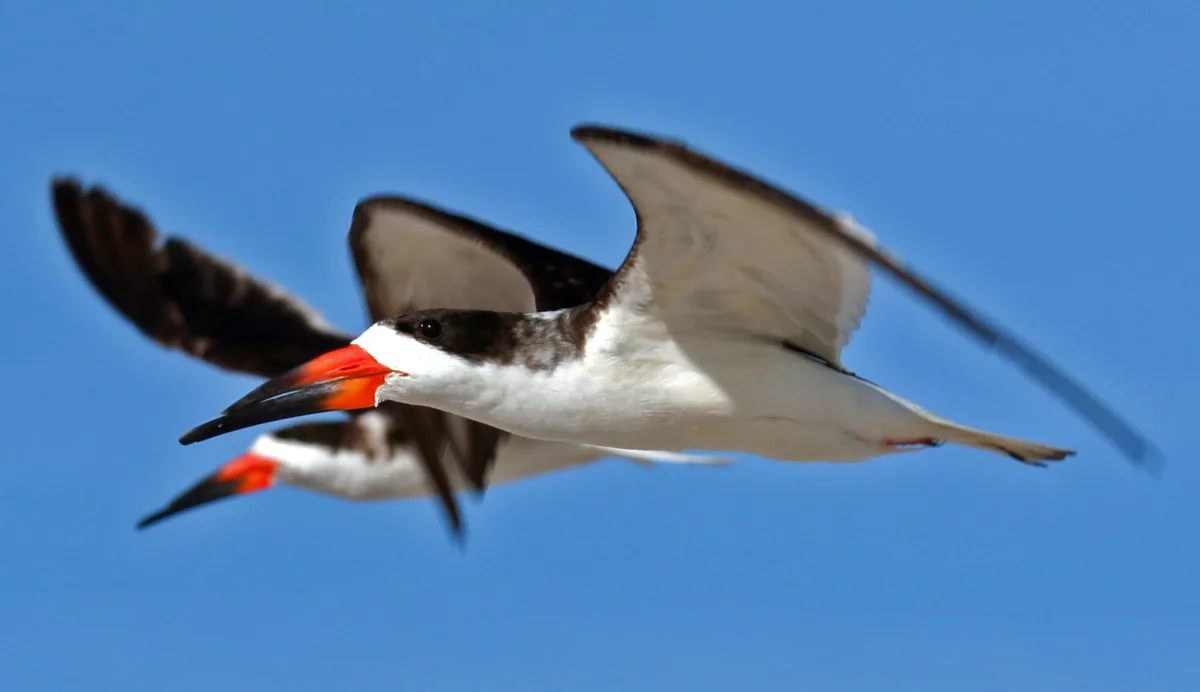
If you’ve ever spent a sunset on a beach along the Atlantic or Gulf coasts, you may have seen a silhouette that looks less like a bird and more like a logic-defying kite. It glides inches above the water’s surface, its wings held in a steady "V," seemingly tethered to the waves by its own face.
Meet the Black Skimmer, one of North America’s most distinctive and charismatic coastal residents. Part shorebird, part precision instrument, the skimmer is a master of a niche so specific that no other bird in the world can claim it.
- Scientific Name: Rynchops niger
- Least Concern globally
- Often listed as Threatened in U.S. states
- Length: 16–20 inches
Wingspan: 42–50 inches
Weight: 9–13 oz - Massive, black and red bill
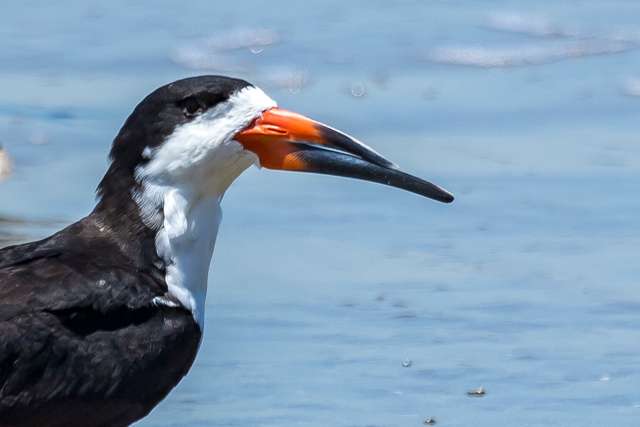
- Lower mandible significantly longer than the upper
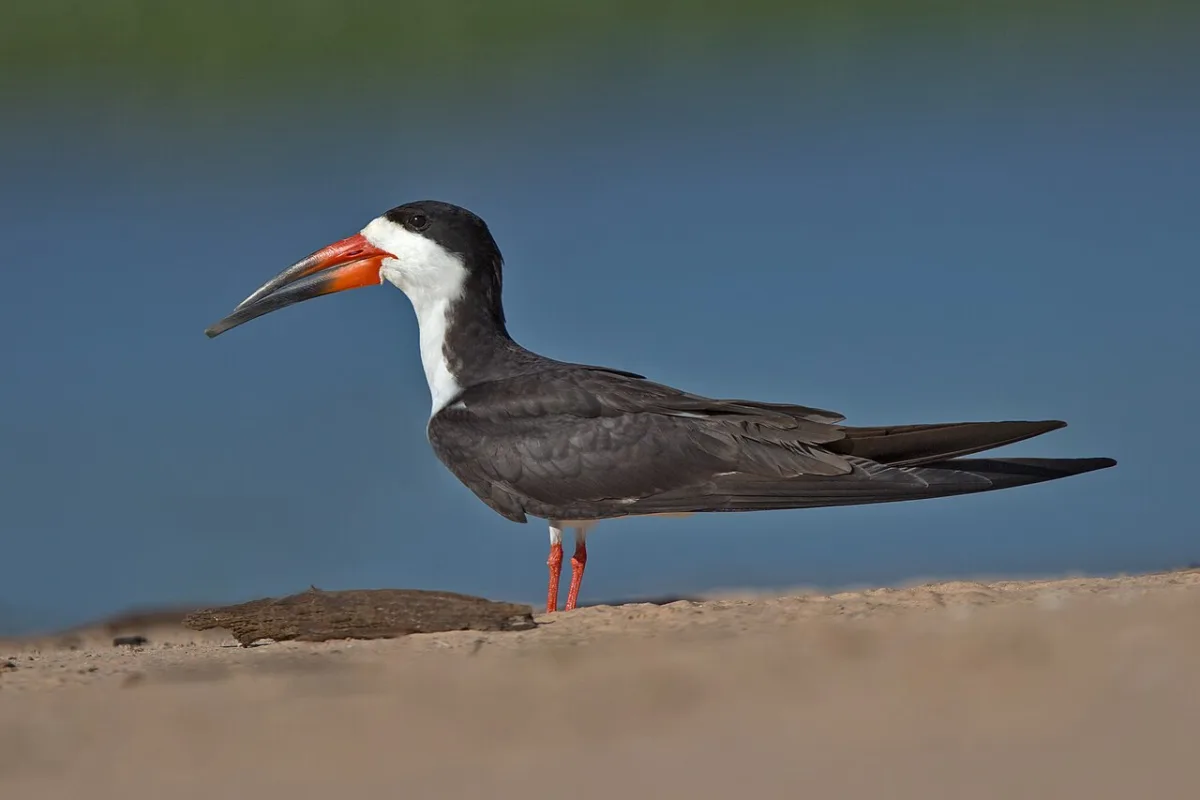
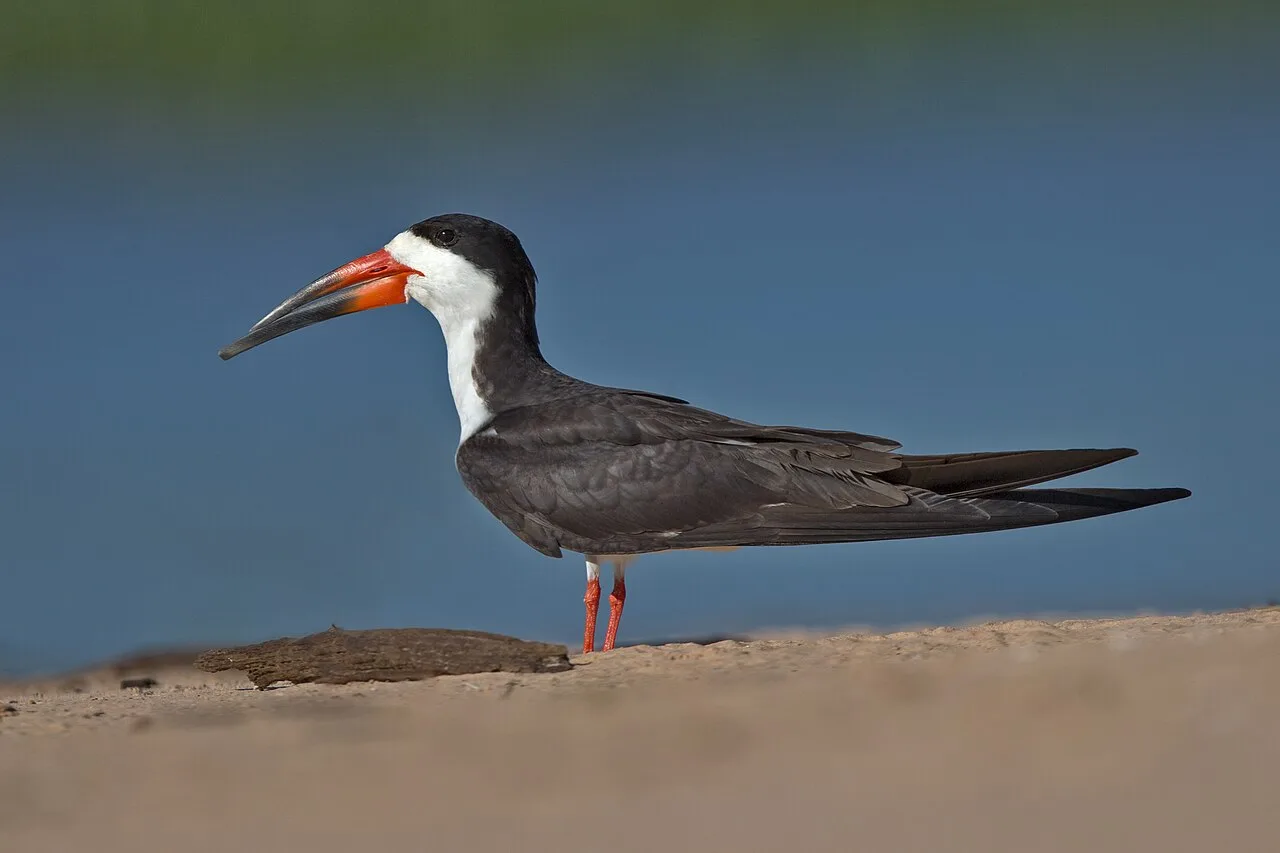
- Distinct "tuxedo" look—jet black on top and pure white underneath
- Unusual vertical pupils to help with hunting in both bright sand and dark nights.
- Extremely long, pointed wings
- Short, forked white tail.
- Prefers sandy beaches, shell keys, barrier islands, and salt marshes.
- Forages in calm waters including bays, estuaries, tidal pools, and inlets.
- Nests in open, flat areas with minimal vegetation, often shared with tern colonies.
A Design Like No Other
At first glance, the Black Skimmer is a study in high-contrast elegance. It sports a tuxedo-like plumage—sooty black above and snowy white below—paired with bright orange-red legs. But the real showstopper is the "bill."
The Black Skimmer is the only bird species in the Americas with a lower mandible (the bottom half of the beak) that is significantly longer than the upper one. This isn't a genetic fluke; it’s a highly evolved tool for a hunting technique known as skimming.
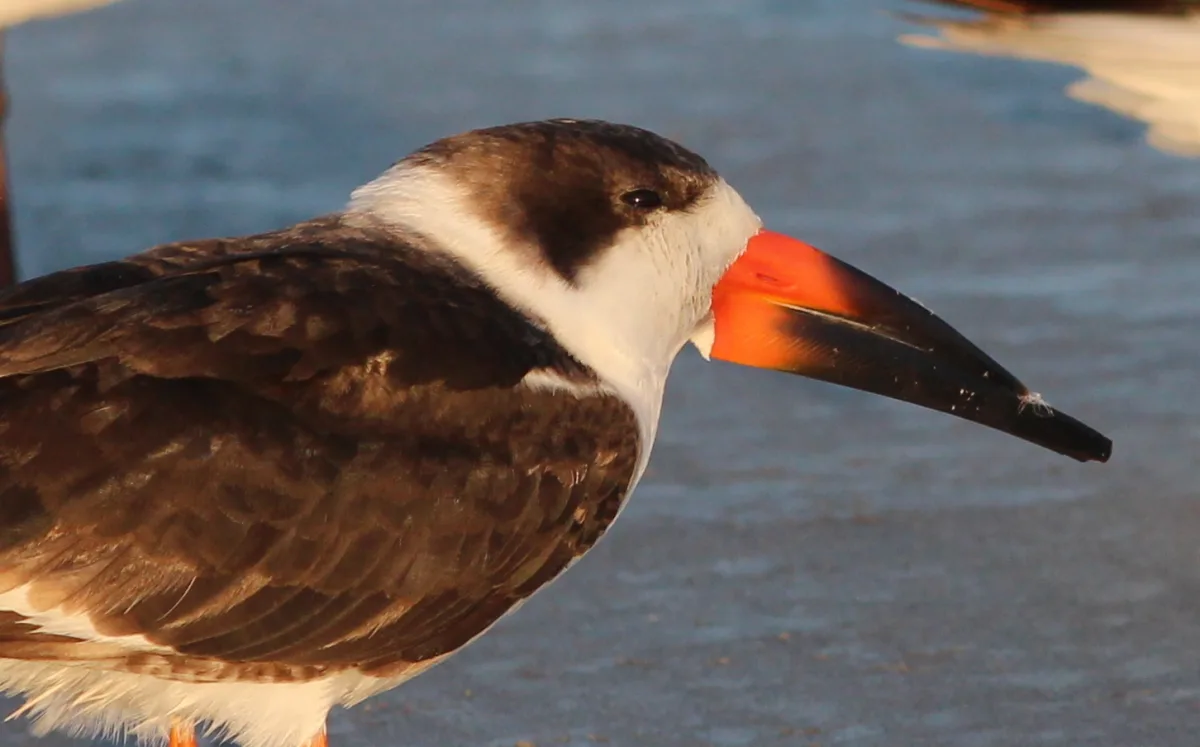
The bill is laterally compressed, meaning it is incredibly thin—razor-thin, in fact. This allows the bird to slice through the water with minimal drag. When hunting, the skimmer flies low, dips that elongated lower mandible into the water, and waits for the tactile "snap."
The Midnight Hunter
While many shorebirds are active during the heat of the day, the Black Skimmer is a creature of the twilight. They are crepuscular (active at dawn and dusk) and often nocturnal.
There is a practical reason for this "night shift." As the sun sets, many small fish and crustaceans rise toward the surface of the water. Furthermore, the calm, glassy waters of protected bays and inlets at night make it easier for the skimmer to detect prey by touch rather than sight.
Watching a colony of skimmers hunt in the moonlight is a ghostly, beautiful experience. Because they rely on touch, they can hunt effectively even in murky water or total darkness, snapping their bill shut the instant they strike a fish.
Range and Movement: A Coastal Traveler
The Black Skimmer is found exclusively in the Americas, where it maintains a massive range that spans from the coastal United States and the Caribbean down through the major river systems and coastlines of South America as far south as central Argentina.
While the Black Skimmer is a quintessential bird of the American coast, its movement across the U.S. is a dynamic mix of year-round residency and strategic migration.
- Atlantic Coast - Breeding range stretches as far north as Massachusetts and New York, though these northern populations are strictly seasonal, typically arriving in late April and departing by November.
- Gulf Coast - Often permanent residents along the coast and into the southern tip of Florida where they take advantage of the consistent subtropical climate.
- Pacific Coast - Since the 1960s they have colonized southern California, where they can be found nesting at the Salton Sea and near San Diego.
- Latin America - In the winter, northern birds move south though they are notoriously "nomadic" after the breeding season—it isn’t uncommon for large flocks to wander far north of their nesting grounds or be pushed inland by tropical storms, appearing as "erratic visitors" in states where they aren't usually seen.
A Quick Comparison
Here is how their presence generally breaks down by U.S. region:
| Region | Status | Peak Months | Typical Habitat |
| Northeast (MA, NY, NJ) | Migratory Breeder | May – Sept | Barrier beaches & salt marshes |
| Mid-Atlantic (VA, NC) | Seasonal / Year-round | April – Oct | Estuaries & tidal flats |
| Gulf Coast (TX, LA, AL, FL) | Year-round Resident | March – Sept (Breeding) | Dredge spoil islands & shell banks |
| Southern California | Localized Resident | April – Aug | Coastal lagoons & the Salton Sea |
Life in the Colony: A Family Affair
Black Skimmers are intensely social birds. They nest in large colonies, often alongside Least Terns or Gull-billed Terns. There is safety in numbers; when a predator like a crow or a stray dog approaches, the entire colony rises in a synchronized, barking cloud of black and white to harass the intruder.
Their nesting habits, however, are deceptively simple. They don't build elaborate nests of twigs or mud. Instead, they create a scrape—a shallow depression in the sand or shell fragments.
- Incubation: Both parents share the duty of sitting on the eggs (usually 3–4).
- The "Even" Phase: Interestingly, when skimmer chicks hatch, their upper and lower bills are of equal length. This allows them to pick up food dropped by their parents on the ground.
- The Growth Spurt: As the chicks mature and prepare to fledge, the lower mandible begins its dramatic growth, eventually outstripping the top half just in time for them to learn the art of the skim.
The flight of the Black Skimmer is perhaps more elegant than that of any waterbird with which I am acquainted.
John James Audubon
Conservation: The Battle for the Beach
Despite their resilience, Black Skimmers face significant challenges in the modern United States. Their preferred habitat—flat, sandy beaches and salt marshes—is exactly where humans like to build condos, park cars, and lounge under umbrellas.
Habitat Loss and Disturbance are the primary threats. When humans or off-leash dogs get too close to a nesting colony, the adult birds flush. In the scorching summer heat of Florida or the Carolinas, even ten minutes of exposure to the sun can "cook" an unprotected egg or cause a chick to perish from heatstroke.
Furthermore, rising sea levels and increased storm intensity (driven by climate change) threaten to wash away the low-lying sandbars where these birds raise their young.
How You Can Help
The good news is that Black Skimmers are a "charismatic megafauna" of the bird world, and many local communities have rallied to protect them. Here is how you can be a good neighbor to these aerial acrobats.
- Respect the Tape: Most nesting sites are marked with "Closed Area" signs and string fencing. Stay outside these boundaries, even if you don't see birds immediately.
- Trash In, Trash Out: Skimmers can easily become entangled in discarded fishing lines or mistake plastic debris for food.
- Give Them Space: If you see a skimmer on the shore, avoid walking directly toward it. If the bird starts "barking" (a sound much like a small dog), you are too close.
A Coastal Icon
The Black Skimmer is more than just a bird; it is a symbol of the wild, precarious beauty of the American coastline. From the tip of Long Island down to the barrier islands of Texas, they remind us that nature has a solution for every environment—no matter how strange that solution might look.
Next time you're at the beach as the sun begins to dip below the horizon, look for that low-flying silhouette. Watch the way it grazes the surface of the Atlantic, a perfect marriage of form and function, cutting a line through the water as it has done for millennia. It’s a performance you won’t want to miss.