
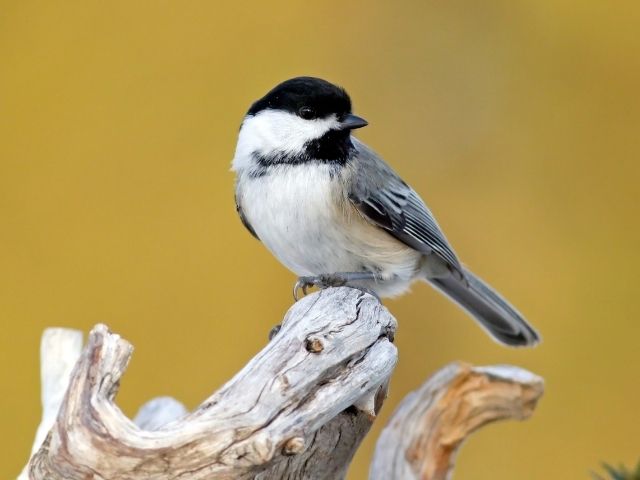
The Black-capped Chickadee (Poecile atricapillus) is arguably the cheeriest and most recognized backyard bird across much of North America. Small, quick, and remarkably fearless, this diminutive songbird is a symbol of winter hardiness and perpetual optimism. Its distinctive, namesake call, “chick-a-dee-dee-dee,” is a common fixture in woodlands and suburban parks from the northern forests of Alaska and Canada down through the central United States.
More than just a familiar sight at the feeder, the Black-capped Chickadee is a biological marvel. It possesses exceptional intelligence, a complex social hierarchy, and a suite of physiological adaptations that allow it to survive sub-zero temperatures, often where larger, ostensibly tougher birds fail. Profiling the chickadee reveals a tiny titan whose success is rooted in adaptability, memory, and a cooperative spirit.
Identification and Vocal Virtuosity
Despite its wide distribution, the Black-capped Chickadee is easily identified by its simple, bold plumage and its varied vocal repertoire.
The Look
The chickadee is a very small, active bird, measuring just 5 to 5.5 inches in length. Its appearance is defined by:
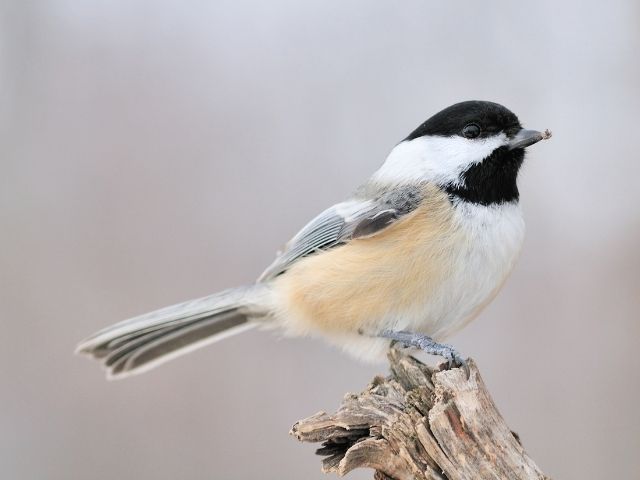
- The Cap and Bib: A smooth, velvety black cap extending from the forehead to the nape, and a matching black bib covering the throat. This is contrasted by crisp white cheeks.

Black-capped Chickadee - Plumage: The back is a uniform gray, and the wings are gray with white edging on the flight feathers. The flanks are buffy or yellowish, and the underside is a pale white.
- Body Shape: It has a relatively large head on a small body, giving it a compact, endearing profile. Its short, sturdy bill is ideal for cracking seeds and probing bark.

The Calls and Songs
The chickadee is a linguistic expert, using a versatile vocabulary that is among the most studied in the avian world:
- The Chick-a-dee Call: This is the most familiar call and serves as a flock contact call and an alarm signal.5 The number of "dee" notes following the "chick-a" is thought to encode information about the predator: more "dee"s usually indicate a smaller, higher-threat predator (like a small owl or hawk) that is more dangerous to the quick-moving chickadee.
- The Fee-bee Song: This simple, clear, two or three-note whistle, often described as a soft "fee-bee" or "fee-bee-ee," is the male's primary territorial song. It’s surprisingly loud and clear for such a small bird, and is typically heard from late winter through spring.
- Chatters and Whines: They use a variety of other short calls for close-range communication within the flock, signaling food, danger, or movement.
Survival Superpowers: The Winter Specialists
The Black-capped Chickadee is a model of cold-weather survival, capable of living year-round in areas that freeze solid for months.
Cognitive Adaptation: The Hippocampus
One of the chickadee's most incredible adaptations is its brain structure. In late summer and fall, as the bird begins to cache (hide) thousands of seeds and insects for winter, its hippocampus—the region of the brain responsible for spatial memory—grows significantly. This enlargement helps the chickadee accurately recall the specific location of its hidden food stores, a vital function when snow cover makes finding food impossible.
The brain tissue shrinks again in spring, demonstrating an astonishing flexibility tied directly to seasonal survival needs.
Physiological Adaptation: Nighttime Hypothermia
When temperatures plummet, the chickadee employs a controlled state of nocturnal hypothermia. By lowering its body temperature by as much as 18 to 22 degrees Fahrenheit from its daytime norm, the bird significantly reduces the difference between its body temperature and the frigid air. This saves a massive amount of energy (calories) that would otherwise be required to maintain a constant high internal temperature. They also puff up their feathers to create thick insulation, sometimes increasing their volume by 50 percent.
Food Caching
Chickadees are avid seed hoarders. They take single seeds (often sunflower or peanut pieces from a feeder), fly off, and hide them individually in bark crevices, under lichens, or in moss.17 They can cache thousands of items per season, relying on their prodigious memory to retrieve them later. They preferentially cache high-fat, high-calorie foods, optimizing their limited winter energy budget.
Social Structure and Life in the Forest
Chickadees exhibit a complex social organization that helps them maximize their chances of survival, especially during the non-breeding season.
The Winter Flock
During winter, chickadees typically move in small, integrated mixed-species flocks (often including nuthatches, creepers, and Downy Woodpeckers). These chickadee-led flocks are organized by a strict dominance hierarchy.
- Alpha Status: Within the chickadee group, one male and one female form the dominant pair, known as the alpha pair. Their social status is critical:
- Feeding: Alpha birds have priority access to food sources, including the best feeder spots and freshly discovered caches.
- Mating: The alpha male and female are the pair that will breed and defend the best territory in the spring.
- Social Benefit: The primary advantage of the flock is safety. The more eyes searching for predators (the "many-eyes" hypothesis), the safer each individual is. The chickadee’s alarm calls alert the entire mixed flock.
Nesting and Territory
In early spring, the winter flocks dissolve as the alpha pairs move off to establish breeding territories.
- Primary Cavity Nesters: Chickadees are secondary cavity nesters, meaning they cannot excavate holes in healthy wood like a woodpecker. Instead, they enlarge natural tree cavities, use abandoned woodpecker holes, or readily occupy nesting boxes. Both the male and female prepare the nest site, which is lined with soft materials like moss, hair, and fine fibers.
- Parental Care: The female incubates the clutch of 6 to 8 eggs, relying entirely on the male to bring her food. Once the young hatch, both parents feed the chicks for about two weeks before the young fledge.
Interacting with Humans
The Black-capped Chickadee’s fearless nature and adaptability have made it a beloved, approachable species.
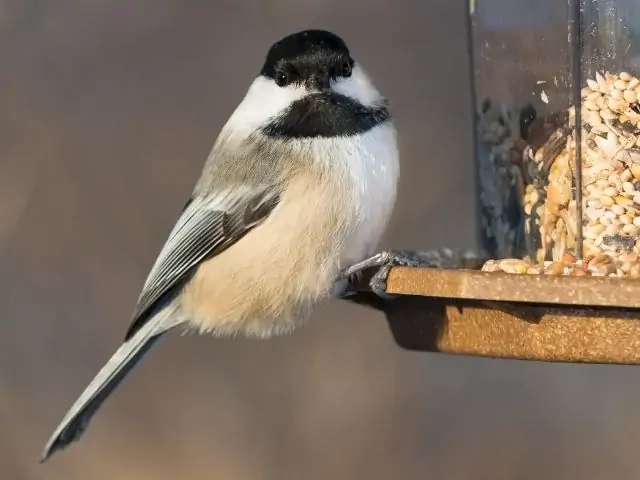
- Feeder Visits: Chickadees are champion feeder visitors, preferring black oil sunflower seeds and suet—both high-fat, energy-rich foods vital for their survival. They rarely eat at the feeder, instead practicing a “take-and-fly” strategy to hide the seed and avoid predators.
- Hand-Feeding: Their remarkable boldness allows them to be easily trained to feed from a human hand, especially in quiet, rural areas. This close interaction is a cherished experience for many nature enthusiasts and demonstrates their low fear response compared to other small songbirds.
The Black-capped Chickadee is far more than just a cute face on a winter morning. It is an intelligent, complex, and highly resilient organism whose survival story is written in its flexible mind, its efficient metabolism, and its cooperative social structure. The next time you hear that unmistakable chick-a-dee-dee-dee, remember you’re listening to a tiny titan that has truly mastered the challenges of the North American environment.
