
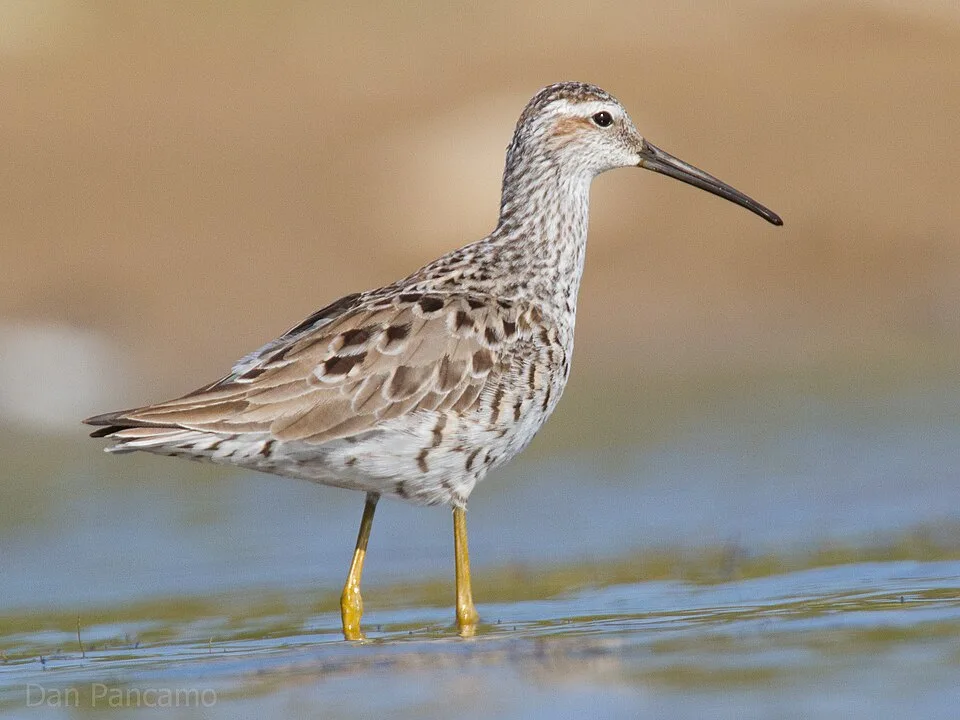
For birdwatchers, knowing the names and locations of a bird's external parts is foundational. It’s the language we use to describe what we see, to pinpoint subtle differences between similar species, and to appreciate the intricate adaptations that allow birds to thrive. From the specialized bill that defines its diet to the intricate patterns on its feathers, every part of a bird tells a story. This guide will walk you through the essential external anatomy, helping you articulate your observations with greater precision and confidence.
The Head: A Canvas of Identification
The head of a bird is often the first place to look for identifying marks, harboring a surprising number of distinct regions and features.
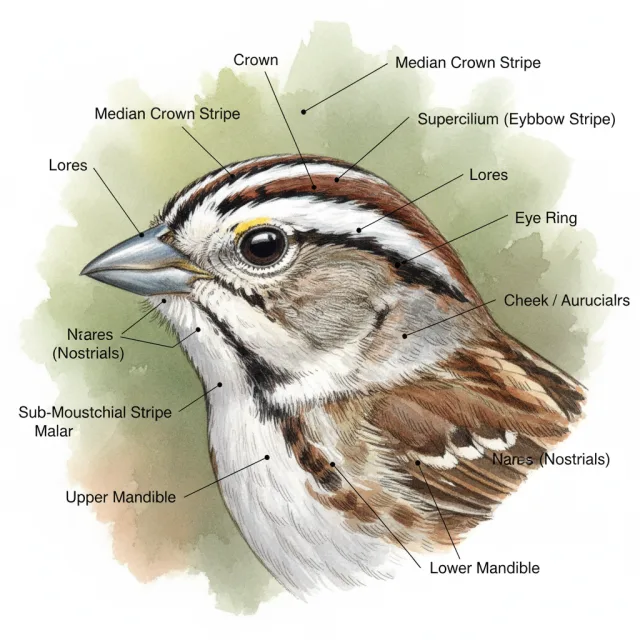
Crown: The very top of the bird's head.
Median Crown Stripe: A stripe running down the center of the crown, seen on many sparrows (e.g., White-throated Sparrow).
Supercilium (Eyebrow Stripe): A stripe extending above the eye, often contrasting with the rest of the head (e.g., Warbling Vireo).
Lores: The area between the eye and the bill. Coloration here can be a key ID feature (e.g., Black-capped Vireo's white lores).
Eye Ring: A ring of feathers encircling the eye (e.g., Hutton's Vireo).
Cheek / Auriculars: The feathered area covering the bird's ear opening, often forming a distinct patch of color.
Nares (Nostrils): The external openings of the respiratory system, typically at the base of the bill.
Upper Mandible: The upper part of the bill.
Lower Mandible: The lower part of the bill.
Malar (Mustache Stripe): A stripe extending downward from the gape (corner of the mouth), often seen on woodpeckers (e.g., Red-bellied Woodpecker).
Sub-Moustachial Stripe: A stripe below the malar, separating it from the throat.
The Body: Core Structure and Plumage
The main body of the bird provides large areas of plumage crucial for overall coloration and pattern.
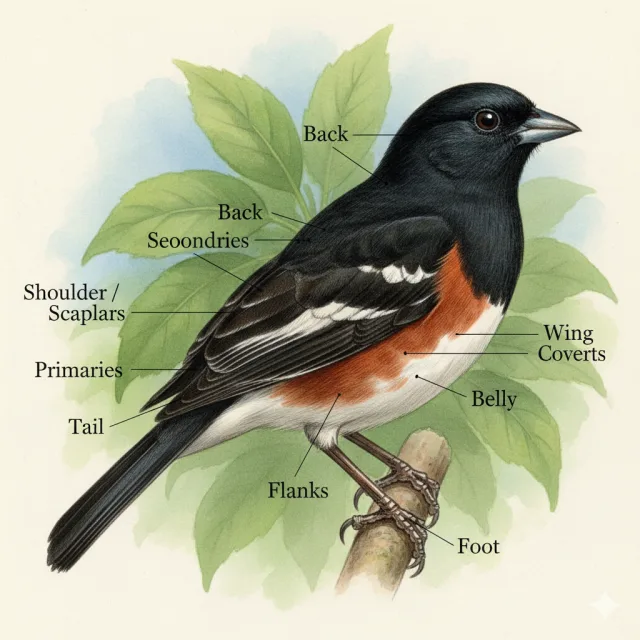
Back: The upper surface of the bird's body, between the neck and the tail.
Mantle: Sometimes used interchangeably with "back," but technically refers to the feathers on the upper side of the body, including the upper back and scapulars (shoulder feathers).
Rump: The area above the tail, often a distinct color (e.g., Northern Flicker's white rump).
Breast: The front of the bird's body, below the throat.
Belly: The lower underside of the bird, below the breast.
Flanks: The sides of the bird, between the belly and the wings, often distinctively colored (e.g., Spotted Towhee's rufous flanks).
Vent: The area around the cloaca (excretory opening), sometimes a different color.
Wings: The Engine of Flight
The wings are complex structures of bone, muscle, and feathers, with specific feather groups crucial for flight and identification.
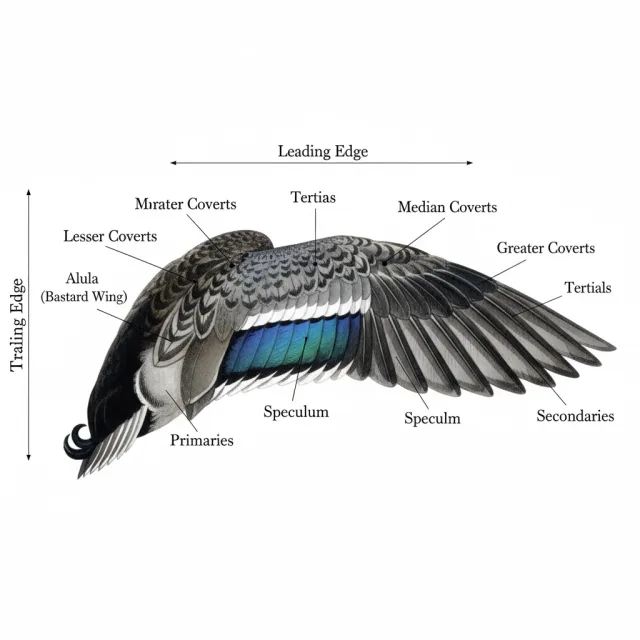
Primaries: The long, stiff feathers at the outer tip of the wing, responsible for thrust in flight. Usually 9-10 in songbirds.
Secondaries: The feathers closer to the body, along the "forearm" of the wing, responsible for lift.
Tertials: The innermost secondary feathers, closest to the body.
Coverts: Shorter feathers that cover the bases of the larger flight feathers. They are named by their position:
Greater Coverts: Cover the bases of the secondaries.
Median Coverts: Cover the bases of the greater coverts.
Lesser Coverts: The smallest coverts, forming the shoulder area.
Underwing Coverts: Feathers on the underside of the wing.
Wing Bars: Stripes formed by the contrasting tips of the greater and/or median coverts (e.g., White-eyed Vireo).
Speculum: An often iridescent, brightly colored patch on the secondary feathers, particularly prominent on dabbling ducks (e.g., Mallard).
Alula (Bastard Wing): A small group of three to five stiff feathers on the leading edge of the wing, controlled independently, which acts like a slat on an airplane wing to prevent stalling at slow speeds.
Tail: Steering and Display
The tail is crucial for steering, braking, and balance in flight, and often for display.
Rectrices: The long, stiff flight feathers of the tail. Their shape, length, and patterns (e.g., white outer tail feathers on a Dark-eyed Junco) are important ID features.
Undertail Coverts: Feathers covering the underside of the tail base.
Uppertail Coverts: Feathers covering the topside of the tail base.
Tail Shape: The overall shape of the tail (e.g., forked, squared, rounded, pointed, wedge-shaped) is a critical identification marker, especially in flight.
Legs and Feet: Tools for Movement
Legs and feet are adapted for a bird's specific locomotion and perching habits.
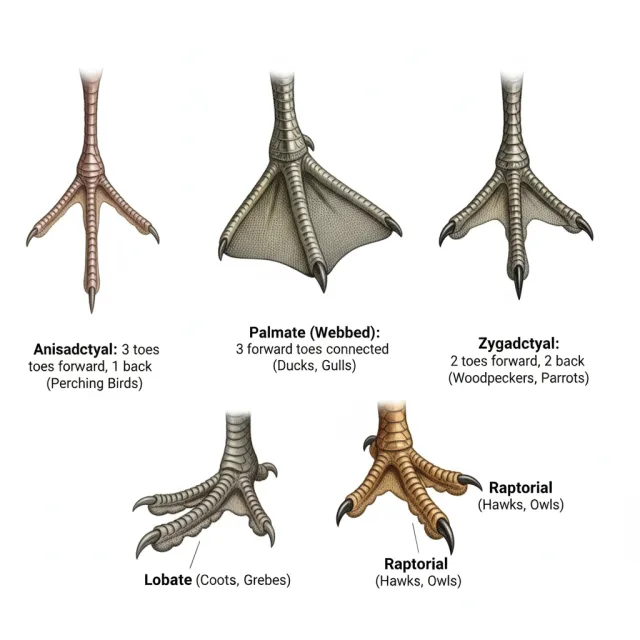
Tarsus: The lower leg bone, extending from the "heel" joint down to the toes. Its length and color can be distinctive.
Toes: Usually four, but can vary.
Anisodactyl: Three toes pointing forward, one backward (most songbirds). Ideal for perching.
Zygodactyl: Two toes forward, two backward (woodpeckers, owls). Great for climbing.
Palmate (Webbed): Three front toes connected by webbing (ducks, gulls). For swimming.
Lobate: Toes with individual lobes, not fully webbed (coots, grebes). For swimming and walking.
Raptorial: Large, strong toes with sharp talons (hawks, owls). For grasping prey.
Wrapping Up
Mastering the terminology of bird anatomy enriches the birdwatching experience immeasurably. It transforms a simple sighting into a detailed observation, allowing you to appreciate the specific adaptations that make each species unique. The next time you spot a bird, take a moment to look beyond its general appearance; notice the pattern of its supercilium, the distinct color of its flanks, or the precise number of wing bars. With practice, these anatomical details will become second nature, deepening your connection to the fascinating world of birds.
