

For the dedicated birdwatcher, understanding the external and internal anatomy of a bird is far more than an academic exercise. It is the key to unlocking subtle identification features, appreciating the mechanics of flight, and truly grasping the extraordinary adaptations that allow birds to thrive in virtually every corner of the planet. Birds are lightweight, feathered machines engineered for efficient motion, whether soaring at altitude or foraging on the forest floor. Focusing on a few core anatomical systems—the skeleton, respiratory system, and specialized external features—can transform casual observation into deep, informed appreciation.
The Skeleton: Engineered for the Sky
A bird's skeleton is perhaps its most astonishing piece of engineering—a structure that is simultaneously strong enough to withstand the stress of flight and light enough to be lifted by air.
Lightweight Strength (Pneumatic Bones)
One of the most critical adaptations is the presence of pneumatic bones. Many bones in a bird’s skeleton, particularly in the wings, pelvis, and skull, are hollow and contain air sacs connected to the respiratory system. This doesn’t mean the bones are weak; rather, they are reinforced by internal struts and trusses, creating a structure that is both remarkably rigid and incredibly light.
The Flight Girdle
The core structural requirement for flight is a stable and rigid anchor point for the powerful flight muscles:
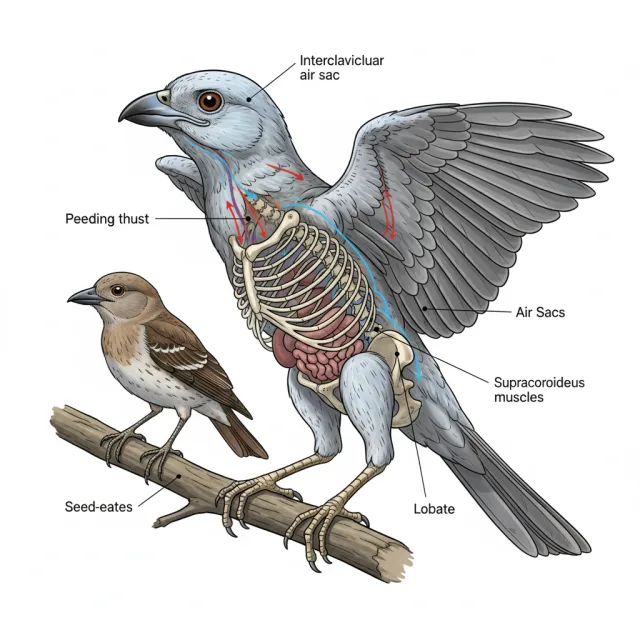
The Keel (Sternum): The breastbone, or sternum, is massive and features a large, projecting ridge called the keel (or carina). This keel provides the broad surface area necessary for the attachment of the huge pectoral muscles (the primary downstroke muscles) and the smaller supracoracoideus muscles (the muscles responsible for the upstroke). The size of the keel often correlates with the bird’s flight ability; large flying birds like raptors have very deep keels, while flightless birds lack them entirely.
The Furcula (Wishbone): Formed by the fused collarbones, the furcula acts as a spring that stores and releases energy with each wingbeat, helping to power the wings and prevent the chest cavity from being crushed during the strenuous downstroke.
Fused Vertebrae: The thoracic, lumbar, and sacral vertebrae are often fused together into a rigid structure called the synsacrum, which is also fused to the pelvis. This rigidity provides an unyielding anchor for the legs and stabilizes the body during the powerful movements of flight.
The Respiratory System: Supremely Efficient
The avian respiratory system is the most efficient in the animal kingdom, necessary to support the high metabolic demand of flight. Unlike mammals, which inhale and exhale stale air, birds have a one-way flow system.
Air Sacs
Birds possess nine specialized air sacs that extend into the body cavity and even into the pneumatic bones. These sacs do not directly exchange oxygen, but act as bellows, constantly pushing fresh air over the lungs.
It takes two full inhale-exhale cycles for a single breath of air to pass completely through the system. This ensures that the bird’s lungs are continuously bathed in oxygen-rich air, both on the inhale and the exhale—a critical adaptation for sustained activity at high altitudes where oxygen levels are low.
External Anatomy: Keys to Identification
The external features of a bird are the elements most useful for field identification and for understanding a bird's ecological niche.
Feathers and Plumage
Feathers are unique to birds and serve multiple functions: insulation, waterproofing, camouflage, and flight. Understanding plumage cycles is crucial for bird identification.
Contour Feathers: These provide the overall shape, color, and smooth surface of the bird.
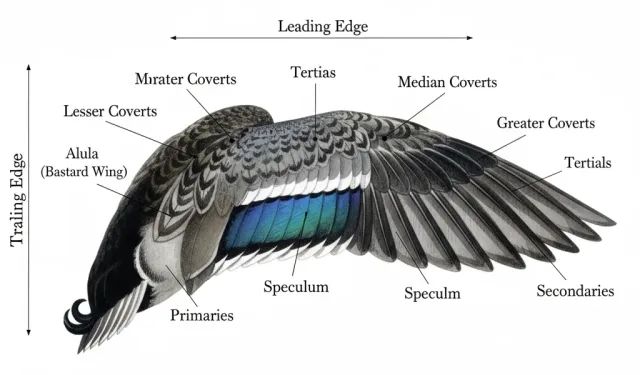
Flight Feathers: Primaries (at the wingtip) generate thrust, while secondaries (along the arm) generate lift.
Plumage: The annual cycle of feather replacement (molt) leads to different plumages. Birdwatchers frequently distinguish between Breeding (Alternate) Plumage (often bright and showy, like a male Warbler's spring colors) and Non-breeding (Basic) Plumage (often duller and more cryptic, like the winter appearance of a sandpiper).
Bills: Form Dictates Function
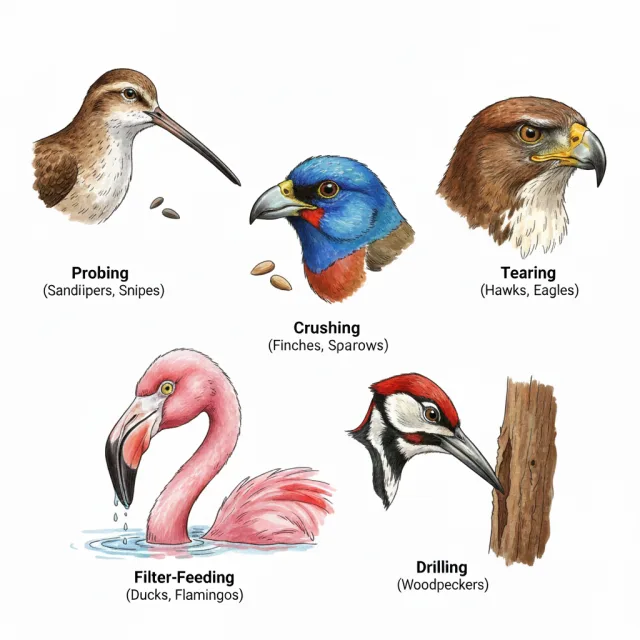
The shape of a bird's bill (or beak) is the clearest indicator of its diet, demonstrating the principle of adaptive radiation:
Probers: Long, thin bills (like those on sandpipers) for probing mud or soil for invertebrates.
Seed-eaters: Short, thick, powerful conical bills (like those on finches and sparrows) for crushing hard seeds.
Insectivores: Thin, needle-like bills (like those on warblers) for snatching insects.
Raptors: Strong, hooked bills (like those on owls and hawks) for tearing flesh.
Legs and Feet
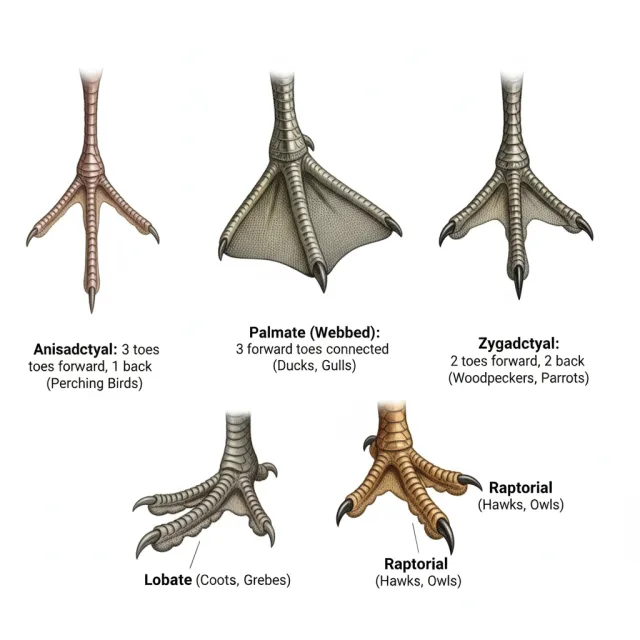
The structure of the legs and feet reveals how the bird moves and uses its environment:
Anisodactyl: Three toes forward, one toe back (most perching birds/passerines), allowing them to grasp branches tightly—a crucial adaptation achieved by the foot flexing automatically upon bending the knee.
Zygodactyl: Two toes forward, two toes back (woodpeckers, parrots), providing excellent climbing ability on vertical surfaces.
Palmate (Webbed): Three toes forward, connected by webbing (ducks, gulls), for powerful swimming propulsion.
Lobate: Toes fringed with lobes, not fully webbed (coots, grebes), allowing for both swimming and walking on land.
The Head: Sensory Perception
The head houses the bird’s primary sensory organs, optimized for the high speeds of flight and rapid processing of information.
Eyesight: Birds possess arguably the keenest vision in the animal kingdom. Their eyes are large relative to their skull size, and many diurnal (daytime) birds of prey have a visual acuity up to eight times greater than humans. Their eyes have a special area called the fovea that allows for extremely sharp central vision.
Hearing: While they lack external ear flaps, birds have acute hearing, vital for interpreting the songs and calls of other birds.
Olfaction (Smell): Once thought to be absent, it is now known that many birds—especially scavengers like vultures and seabirds like petrels—have highly developed senses of smell, which they use to locate carrion or distant food patches over the ocean.
By recognizing the underlying anatomical principles—from the rigidity of the keel to the continuous flow of air through the air sacs—the birder can move beyond mere pattern recognition and fully appreciate the intricate, highly specialized, and brilliantly successful architecture that defines every single bird species.
