
Few things ruin a day of birdwatching faster than constant eye strain or a target bird that refuses to snap into crisp focus. If you find yourself fine-tuning your central focus wheel endlessly yet still feeling like one eye is slightly out of phase, the culprit is often a miscalibrated diopter—compounded by astigmatism.
Properly adjusting your binocular diopter compensates for focal differences between your left and right eyes. However, when astigmatism is involved, achieving true optical clarity requires a slightly modified calibration routine depending on whether you observe with or without corrective lenses.
Understanding Diopters & Astigmatism
The central focus wheel on your binoculars moves both barrels in tandem to focus on objects at varying distances. However, human eyes are rarely identical. The diopter adjustment—usually located on the right eyepiece collar or integrated into the central focus mechanism—allows you to independently adjust the focus of one barrel to match the exact visual prescription of that eye.
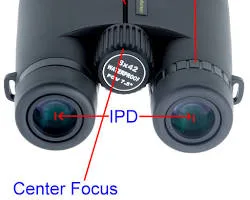
Common Diopter Designs
Right Eyepiece Collar (Most Common)
Location: Located directly beneath the right rubber eyecup.
Appearance: A textured/knurled ring marked with a
+ 0 -scale or hash marks.Function: Rotating this ring independently shifts the focus of the right eye barrel.
Central Column / Integrated Diopter
Location: Built directly into the main central focus wheel mechanism.
Appearance: Often activated by pulling the main focus wheel backward or pushing an inner dial until it clicks up.
Function: Once popped up, rotating the dial adjusts the secondary eye focus without changing the main wheel distance.
Camera Viewfinder Diopter (SLR / Mirrorless)
Location: A tiny wheel or slider directly adjacent to the rubber eye cushion of a camera's viewfinder.
Appearance: Marked with a small
+ / -symbol.
Astigmatism occurs when the cornea or lens of the eye has an irregular, asymmetrical curvature. This causes light rays entering the eye to focus on multiple points rather than a single sharp point. Standard spherical binocular lenses can easily compensate for spherical vision differences (nearsightedness or farsightedness), but spherical optics cannot correct for the cylinder and axis aberrations of uncorrected astigmatism.
Glasses On vs. Glasses Off
Important Rule of Thumb: If you have moderate to severe astigmatism, calibrating your diopter while wearing your prescription glasses or contacts is essential. Your corrective lenses handle the astigmatic axis correction, allowing the binocular diopter to simply equalize focal distance between your eyes.
Step-by-Step Diopter Calibration Routine
Stop Guessing: 5 Essential Binocular Tips Every Beginner Birder Needs to Know.
Follow this step-by-step process to calibrate your diopter perfectly. Choose a stationary, high-contrast target (such as a weathered tree branch, power line insulator, or detailed bark pattern) roughly 30 to 50 feet away.
Set Eyecups & Interpupillary Distance:
With Eyeglasses: Twist or push the eyecups down fully to maintain proper eye relief and avoid vignetting.
Without Eyeglasses: Fully extend the eyecups.
Adjust the central hinge of the binoculars until you see a single, unified circular field of view.
Isolate the Left Eye (Fixed Barrel):
Cover the right objective lens with your lens cap or hand (keep both eyes open under the cover to prevent eye fatigue).
Look through the left barrel with your left eye.
Set Master Focus:
Rotate the central focus wheel until your stationary target snaps into crystal-clear focus for your left eye.
Isolate the Right Eye (Diopter Barrel):
Move the lens cover from the right objective lens to the left objective lens.
Look through the right barrel with your right eye only.
Adjust the Diopter Ring:
Without touching the central focus wheel, rotate the diopter adjustment ring on the right eyepiece until the target reaches maximum sharpness for your right eye.
Uncover Both Lenses & Verify:
Uncover both objective lenses and observe the target with both eyes open.
The image should feel effortless, 3D, and tack-sharp, with zero strain or feeling of "pulling" in your eye muscles.
Special Considerations for Astigmatism
Observing Without Glasses (Mild Astigmatism)
If your astigmatism is mild and you prefer birding without glasses for a wider field of view, pay close attention to directional lines during calibration:
Target fine, intersecting lines running in different angles (such as crisscrossing pine needles or mesh wire).
Because astigmatism causes lines along specific axes to blur while others remain sharp, adjust the diopter until horizontal and vertical lines reach the best possible optical balance.
Lock in Your Setting
Once your diopter is calibrated, lock it in place if your binocular model features a locking diopter mechanism. If it does not lock, note your setting on the +/- scale or mark it with a small silver marker dot or piece of tape. Diopter rings are easily bumped when hiking through dense brush or taking gear in and out of harness cases.
