
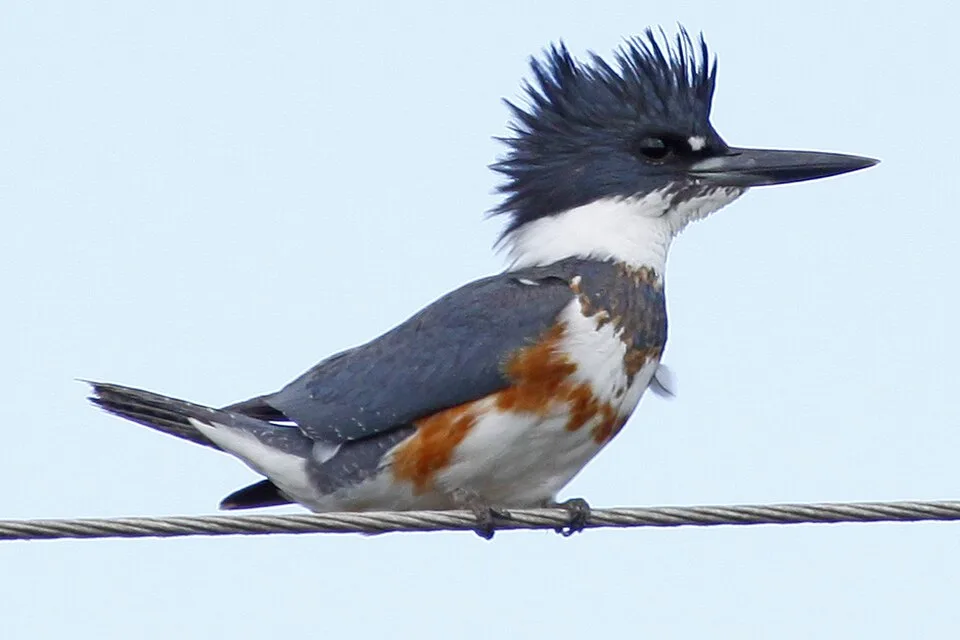
With its distinct, rattling call and punk-rock crest, the Belted Kingfisher (Megaceryle alcyon) is one of the most recognizable and widespread avian residents of North America's waterways. This dynamic bird is a ubiquitous sight near rivers, lakes, and coasts across the entire continental United States, embodying the spirit of a focused, solitary angler. They are not merely colorful additions to the landscape; they are crucial apex predators in small aquatic ecosystems, instantly distinguishable by their unique plumage and impressive hunting prowess. For U.S. birders, spotting this blue-gray dynamo is a sign of healthy, vibrant water systems.
Appearance and Distinctive Features
The Belted Kingfisher is the only kingfisher commonly found throughout North America, making it a familiar sight from Alaska to Florida.
Size and Structure
It is a medium-sized bird, about the size of a robin or a jay, measuring between 11 and 14 inches long with a robust body and a short, stubby tail. Its most striking physical feature is its oversized head topped with a shaggy, spikey crest. This crest is often raised, giving the bird a perpetual look of intense concentration or agitation. The bird’s bill is large, dagger-like, and jet-black, perfectly suited for plunging headfirst into water to spear prey.

The "Belt" and Reversed Sexual Dichromatism
The Belted Kingfisher exhibits what is known as reversed sexual dichromatism, a rarity among North American birds where the female is more brightly colored than the male. Both sexes share the same base colors:
- Head and Back: Slate-blue to blue-gray, with fine dark barring on the head.
- Collar and Underparts: A white throat and a distinct white spot ("lore") in front of the eye.
- The Belt: A prominent slate-blue band (the "belt") across the white chest.
The key difference lies in the sides and abdomen:
- Male: Has only the single blue chest band.
- Female: Has the blue chest band plus a second, rusty-red/chestnut band running across her lower chest and down the flanks. This makes her the flashier, tricolored bird.

Belted Kingfisher
Habitat and Range: The Sentinel of the Water
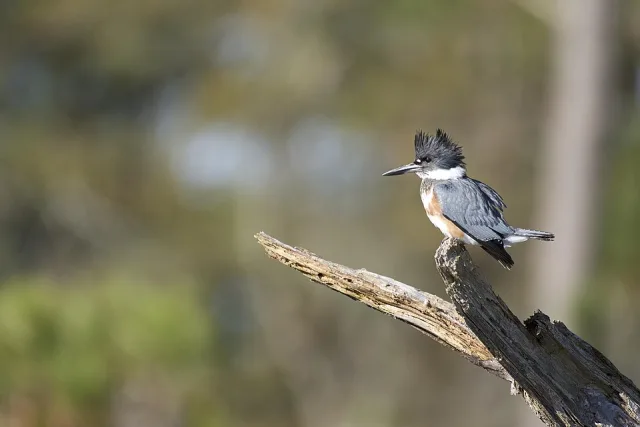
The Belted Kingfisher is remarkably adaptable, demanding only two things from its habitat: clean water for fishing and a suitable steep earthen bank for nesting.
- Widespread Range: They are year-round residents in the southern half of the U.S. and along the coasts, but they are highly migratory in the northern interior (e.g., New England, upper Midwest, and interior Canada). Northern populations migrate south to the Gulf Coast and Central America for the winter, always following the open water.
- Habitat: They are found on virtually any type of open water: large rivers, small creeks, rocky coastlines, tidal estuaries, freshwater lakes, and even urban retention ponds. They require perching spots—dead snags, utility wires, or prominent branches—from which to survey their territory.
Hunting and Diet: The Dive of the Dagger
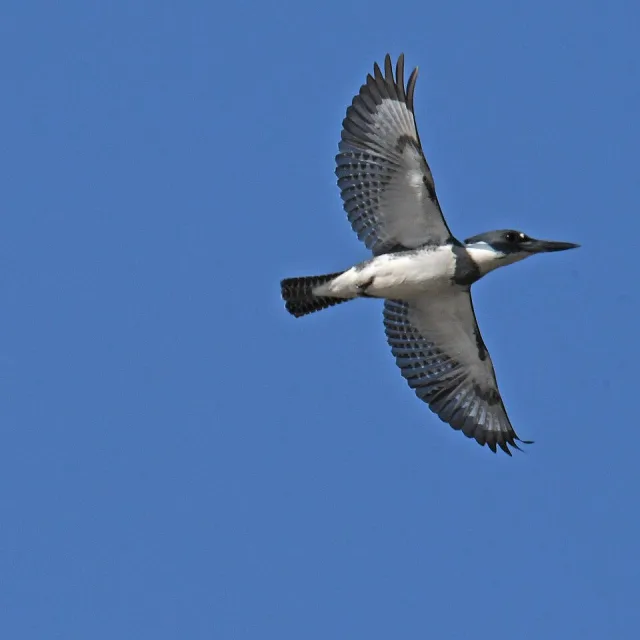
The Belted Kingfisher is almost exclusively a piscivore, a predator of fish, though it will occasionally take amphibians, insects, small rodents, or crayfish.
The Hunting Process
Their hunting technique is a masterclass in aerial precision:
- Perch or Hover: The bird perches quietly, often bobbing its head to precisely gauge the distance and angle of its prey in the water. They can also hunt by hovering in place, rapidly beating their wings while staring straight down, an energy-intensive but highly effective method.
- The Plunge: Once a target is spotted, the kingfisher folds its wings back and dives straight down, hitting the water with a loud splash. Its thick, protective feathers and ability to snap its nictitating membrane (a clear third eyelid) closed protect its eyes during the impact.
- The Capture: They grab the fish sideways with their powerful, dagger-like bill. They surface and fly quickly back to their perch.
- The Meal: Before consumption, the bird must stun the fish by violently beating it against the perch to ensure it is killed and rendered easier to swallow. They always swallow the fish head-first to prevent fins and scales from getting stuck in their throat.
Nesting and Social Structure
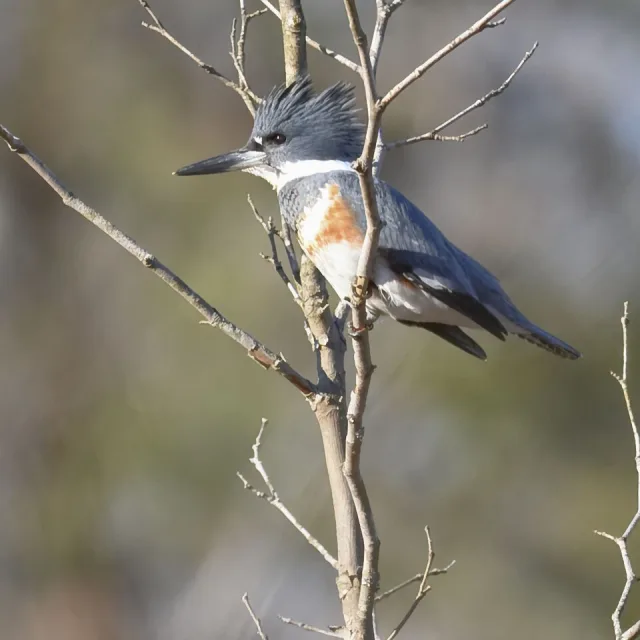
Belted Kingfishers are fiercely territorial and solitary outside of the breeding season.
- Nest Tunnels: Unlike most birds, kingfishers do not build a stick nest; they excavate a nest tunnel into a vertical, sandy or loamy earthen bank, such as a riverbank, road cut, or gravel pit.
- Excavation: Both the male and female take turns excavating the tunnel, which can be surprisingly deep—from 3 to 7 feet long, ending in a wider nesting chamber. They primarily use their bills to loosen the soil and their feet to kick the dirt out.
- Family Life: The female lays 5–8 eggs inside the chamber. Both parents share incubation duties and, critically, share the massive workload of feeding the voracious chicks, which will eat dozens of fish per day. The male is known to continue feeding the young even after they fledge for a period of time, training them in hunting techniques.
Distinguishing the Belted Kingfisher from Others
While the Belted Kingfisher is the common North American representative, two other species are found in the extreme southern U.S., offering crucial differentiation points. Both are visually much larger than the Belted Kingfisher and lack its distinct head crest.
1. Ringed Kingfisher (Megaceryle torquata)
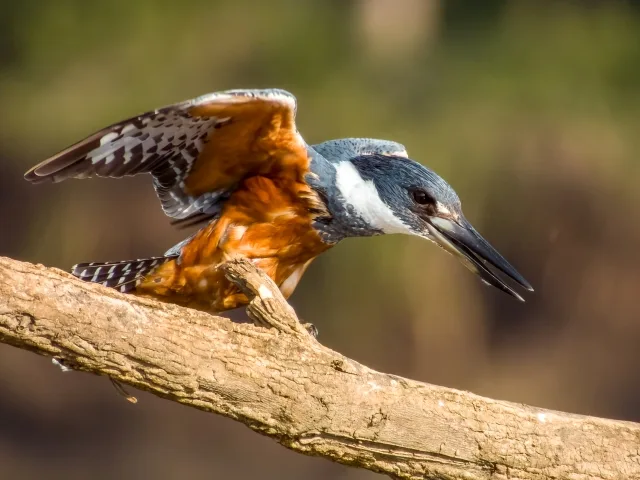
- U.S. Range: Primarily found along the Rio Grande Valley in South Texas, though occasionally wanders north.
- Key Differences:
- Size: Significantly larger (up to 16 inches long).
- Coloration: Much more rufous/red overall. The male has a chestnut belly and a white collar; the female has a rusty breast band like the Belted Kingfisher female, but with much more extensive rufous on the belly, not just the flanks.
- Crest: Has a large, less shaggy, often blacker crest that contrasts more sharply with the body.
- Call: Lacks the sharp, dry rattle of the Belted Kingfisher; its call is a deeper, harsher, more guttural krack-krack-krack.
2. Green Kingfisher (Chloroceryle americana)
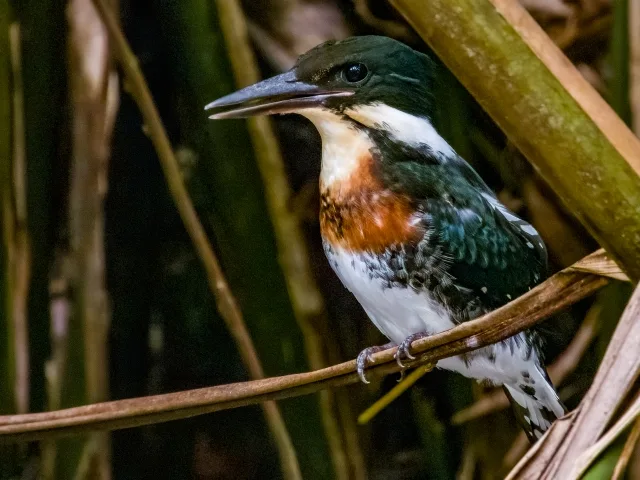
- U.S. Range: Limited to the lower Rio Grande Valley in Texas and occasionally southeastern Arizona.
- Key Differences:
- Size: Much smaller (only 7–8 inches long), barely larger than a sparrow.
- Coloration: Mostly dark metallic green above, with a white collar and heavily spotted underparts.
- The Belt: The male has a single narrow, red breast band; the female has two green bands with white spots. It looks much less like a miniature Belted Kingfisher than a unique green specimen.
- Habitat: Prefers small, slow-moving creeks and heavily vegetated areas, unlike the Belted Kingfisher's preference for open water.
In short, the Belted Kingfisher remains easily identifiable by its intermediate size, its shaggy blue-gray crest, its loud, dry rattle call, and the unique presence of a chestnut belt on the female only. It is a testament to conservation that this dazzling, widespread species continues to patrol the waterways, providing endless entertainment for those who take the time to watch its magnificent, missile-like dives.
The next time you hear that distinctive rattling call near a river, look up—chances are you’ve spotted North America’s resident aquatic hunter.
