

The sight of a Bald Eagle (Haliaeetus leucocephalus) is synonymous with the wild spirit of America. Yet, to truly witness this majestic bird in its element, one must travel to Alaska, which hosts the largest concentration of Bald Eagles in the United States, and arguably the world. While the species has recovered spectacularly across the lower 48 states, the sheer density and abundance of eagles in the Last Frontier are unmatched. This unparalleled success is not due to a single factor, but rather a perfect confluence of ecological resources, favorable geography, and limited human interference.
The Abundance of Food: A Salmon Superhighway
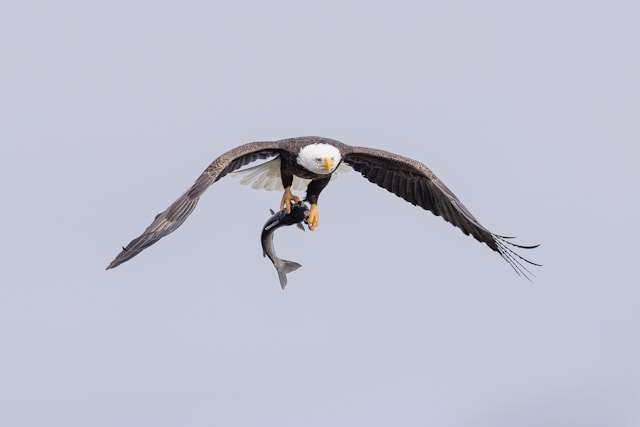
The most significant driver of the Bald Eagle's population boom in Alaska is the state's incredible marine and anadromous fish productivity. Bald Eagles are opportunistic predators and scavengers, but their diet is overwhelmingly dominated by fish, particularly Pacific Salmon.
Annual Salmon Runs: Alaska's rivers host some of the largest and healthiest annual runs of five species of Pacific salmon (Chinook, Sockeye, Coho, Chum, and Pink). When these fish migrate upstream to spawn and subsequently die, they provide a colossal, seasonal feast—a rich, reliable, and easily accessible source of protein and fat.
Marine Scavenging: Beyond salmon, the coastal eagles thrive on the vast marine resources of the Gulf of Alaska and the Bering Sea, scavenging marine mammal carcasses, fish discards from commercial fishing operations, and exploiting abundant schooling fish. This perpetual food supply minimizes the need for long-distance travel and allows eagles to focus energy on reproduction.

Geography and Habitat: Ideal Coastal Real Estate
Alaska's coastline, particularly the Southeast Panhandle and the western islands, offers optimal habitat that fulfills all of the eagle’s critical life cycle requirements.
Temperate Rainforest: The Southeast Panhandle is defined by the Tongass National Forest, the largest national forest in the U.S. This is a temperate rainforest ecosystem dominated by massive, old-growth Sitka Spruce and Western Hemlock trees.
Prime Nesting Sites: Bald Eagles require immense, sturdy trees to support their massive nests, which can weigh up to a ton and be reused for decades. The dense, tall canopies of the old-growth forests provide ideal, predator-safe platforms, often located directly adjacent to prime fishing grounds.
Sheltered Waters: The complex coastline, composed of countless fjords, islands, and protected bays, provides calm, shallow waters where fish are easily caught and where eagles can roost and hunt without battling constant high winds and ocean swells.
Limited Human Disturbance and Historical Protection
While the Bald Eagle faced catastrophic decline in the lower 48 states due to the pesticide DDT, persecution, and habitat destruction, Alaska offered a sanctuary that limited the impact of these threats.
DDT’s Minor Impact: Alaska largely escaped the widespread environmental impact of DDT used in the mid-20th century. The pesticide, which caused thin, brittle eggshells and reproductive failure, was primarily used in agricultural zones further south. Because Alaska has minimal agriculture, its eagle populations remained reproductively robust.
Persecution (Historical Context): Ironically, Alaska was historically a place of intense persecution for the Bald Eagle. From 1917 to 1953, the territorial government offered a bounty on the eagles, viewing them as competitors for salmon. Over 100,000 eagles were killed during this period. However, this practice was eventually stopped, and the subsequent recovery was dramatic, highlighting the resilience of the population when persecution ceased. The species has been under federal protection since the Bald Eagle Protection Act of 1940.

Bald Eagle Vast Wilderness: Much of Alaska remains pristine wilderness, particularly the coastal areas preferred by the eagles. This lack of human encroachment, paired with responsible forest management on public lands, ensures that nesting and foraging areas are protected from development and fragmentation.

Density and Spectacle: The Peak Season
The sheer density of Bald Eagles in Alaska is most evident at specific locations during seasonal feeding events.
Haines and the Chilkat Valley: This region, particularly the Chilkat River Bald Eagle Preserve near Haines, is home to the world’s largest gathering of Bald Eagles every fall (late October to early December). Up to 4,000 eagles congregate here to feast on a late run of Chum and Coho salmon, which remain unfrozen due to groundwater upwelling in the river. This phenomenon creates an unparalleled avian spectacle.
Kodiak Island and the Aleutians: These islands support massive year-round populations, where the eagles often share territories with the similarly sized Steller's Sea Eagle (a rare vagrant, but the largest sea eagle species globally), showcasing the extreme richness of the marine food web.
Alaska's Dominance in Numbers
While precise counts are challenging, estimates place Alaska's Bald Eagle population at around 30,000 to 40,000 individuals, representing more than half of the entire US population. This density is particularly concentrated along the 47,000 miles of coastline, where eagles can be seen perched on nearly every suitable branch along the waterway.
The Bald Eagle's success in Alaska is a profound ecological statement. It demonstrates the direct correlation between a healthy, intact ecosystem—rich in marine resources and characterized by vast, protected old-growth forests—and the ability of a top-tier predator to thrive. Alaska is, and remains, the true Bald Eagle country.
