
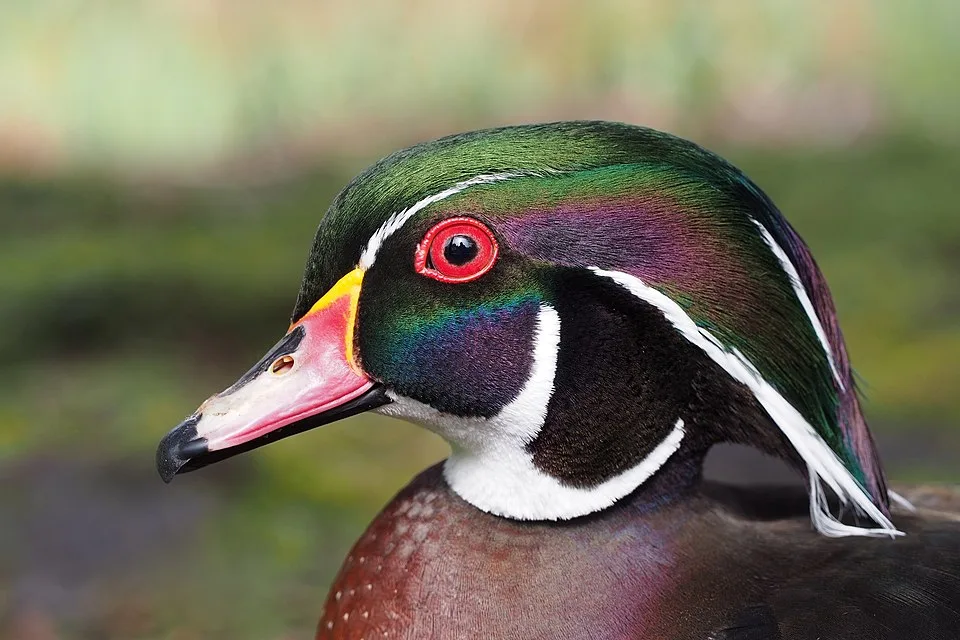
The Wood Duck (Aix sponsa) is widely regarded as one of the most beautiful and easily recognizable waterfowl in North America. Unlike its primarily aquatic cousins, this duck is uniquely adapted to a life shared between water and the trees, where it nests in cavities high above the water line. The male, or drake, with his shimmering, kaleidoscopic plumage, is often described as the most beautiful duck on the continent. The Wood Duck’s history is a compelling narrative of near-extinction due to habitat loss and overhunting, followed by a dramatic and heartwarming conservation success story that has brought it back to abundance across the United States.
Identification: A Masterpiece of Color and Form
The Wood Duck exhibits extreme sexual dimorphism (differences between male and female), especially during the breeding season. Its unique features and brilliant coloration make it unmistakable.
The Male
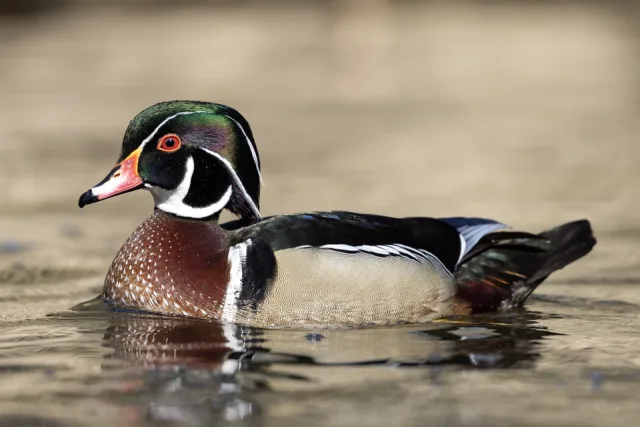
The drake is a breathtaking sight, a mosaic of iridescence and sharp patterns.
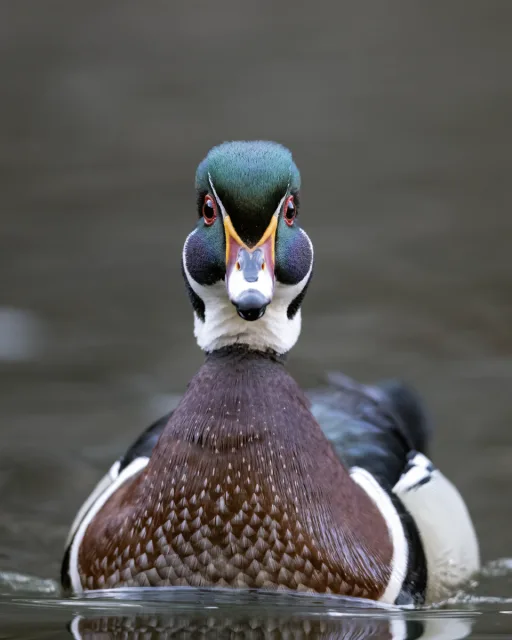
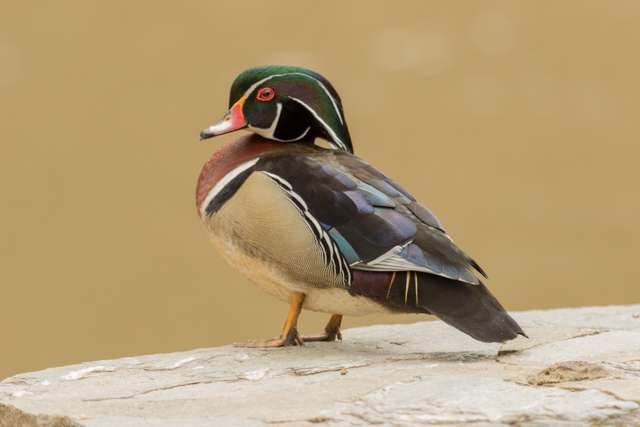
Head: The most striking feature is the large, puffy crested head, which flashes brilliant green and purplish-blue iridescence. The crest is patterned with thin, sharp white lines that frame the head and extend back from the eye, giving it a painted appearance.
Eyes and Bill: It possesses a bright red iris and a bold, patterned bill that is red at the base, yellow toward the tip, and black at the nail.
Body: The throat is white, the breast is a rich chestnut-red marked with white triangles, and the flanks are buff-colored, separated from the black back by a thin line of black and white.
The Female
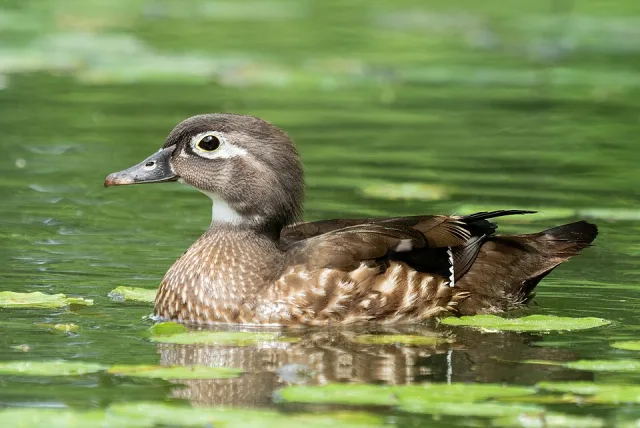
The hen, while drabber for camouflage, is still distinctive and quite beautiful in her own right.
Plumage: She is predominantly mottled grayish-brown, providing excellent cover in the undergrowth.
Eyes: Her key identifying feature is a prominent, unique white teardrop-shaped ring around her dark eye, creating a spectacled look.
Crest: She retains a shorter, less vibrant crest than the male.
Speculum: Both sexes share a beautiful iridescent blue-green speculum (a patch of feathers on the secondary wing) visible in flight.

Wood Duck
Range and Habitat: The Woods and the Water
The Wood Duck is primarily a native of North America, distinguished by its strong preference for forested wetlands.
Geographic Range: The species has two main population centers in the US: the large Eastern population, which extends from the Atlantic Coast west to the Great Plains, and the smaller Western population, found along the Pacific Coast. It is a migratory bird in the north, moving south for the winter, but it is resident year-round in the southern US, especially along the Gulf Coast and in Florida.
Habitat Preference: Wood Ducks are strictly associated with wooded swamps, freshwater marshes, secluded ponds, and slow-moving rivers bordered by mature trees. Unlike open-water ducks like scaup or canvasbacks, they prefer environments with dense cover, overhanging vegetation, and shallow water for foraging.
Unique Behavior: The Tree Nesters
The Wood Duck is unique among most North American ducks for its nesting requirement—it is an obligate cavity nester.
Nesting Sites: The female searches for natural cavities, typically formed by decay or created by large woodpeckers (like the Pileated Woodpecker), high up in the trunks or limbs of mature trees. These cavities must be located near water but can be as high as 60 feet off the ground.

Wood Duck Brood Parasitism: A peculiar behavior among Wood Ducks is "dump nesting," where multiple females (often up to a dozen) will lay their eggs in a single nest cavity, resulting in massive clutches that are often too large for any one female to successfully incubate. This is considered a form of communal nesting gone awry.
The Leap of Faith: Roughly 24 hours after hatching, the ducklings undertake one of nature's most dramatic events. The mother flies to the ground below the nest and calls to the young. The poults, despite being only one day old, climb up the inside of the cavity and leap out of the hole, falling harmlessly to the ground (or water) below thanks to their light weight and soft downy feathers. The mother then leads the precocial (mobile at birth) brood to safety.
Diet and Foraging
The Wood Duck is a skilled, if opportunistic, feeder, foraging primarily in the shallow water and on the forest floor.
Diet: It is an omnivore, with its diet shifting seasonally.
Fall/Winter: Heavily reliant on mast—especially acorns and tree nuts, which it consumes in large quantities—as well as seeds and aquatic vegetation.
Spring/Summer: Switches to a protein-rich diet of insects, spiders, fly larvae, and small crustaceans to support egg production and growth.
Foraging Style: Like dabbling ducks, it tips up its body to reach submerged food, but it is also highly adept at walking on land to pick up fallen nuts and seeds, particularly under oak trees.
The Conservation Triumph
The story of the Wood Duck is one of the greatest successes in North American wildlife conservation.
The Crisis: By the late 19th and early 20th centuries, the Wood Duck population faced collapse. Its beautiful feathers were prized for the millinery trade, and its habitat was destroyed by rampant logging of mature bottomland forests, eliminating the necessary nesting cavities.
Protection: Early protection was critical. The Migratory Bird Treaty Act of 1918 provided necessary legal enforcement against market hunting.
The Solution: Nest Boxes: The true driver of recovery was the widespread implementation of artificial nest boxes. Wildlife managers and conservationists designed and installed thousands of predator-proof wooden nest boxes in appropriate habitat areas across the country. These boxes perfectly mimic the natural tree cavities the ducks require.
The Result: The provision of safe, abundant housing, combined with forest regrowth, led to a spectacular and rapid population rebound. Today, the Wood Duck is once again a thriving and common species, hunted sustainably, and serving as a shining example of how targeted management can restore a species from the brink of extinction.
The Wood Duck stands as a testament to the resilience of nature and the power of human intervention. Its silent leap of faith from a high tree cavity each spring is a powerful, recurring symbol of renewal and a successful recovery.
