

The American White Pelican (Pelecanus erythrorhynchos) is one of North America's most magnificent and easily recognizable birds. With its massive size, striking white plumage, and unmistakable orange bill and pouch, it commands attention whether soaring effortlessly on broad wings or fishing cooperatively on a glassy lake. Far from the coastal bird many assume it to be, the White Pelican is a master of inland waters, undertaking one of the continent's most impressive migrations.
Physical Profile: Built for Gliding and Gulping
The American White Pelican is a giant among North American birds, second only to the California Condor and Trumpeter Swan in wingspan.
Size and Appearance
- Massive Dimensions: These birds average 50 to 70 inches (1.3–1.8 meters) in length and boast a spectacular 9-foot (2.7-meter) wingspan. They weigh between 11 and 20 pounds (5–9 kg).

American White Pelican - Plumage: Adults are almost entirely brilliant white, with the striking exception of their black primary and secondary flight feathers. This black-and-white pattern is highly visible when they are in flight, contrasting sharply with the pale sky.
- The Bill and Pouch: The most distinctive feature is the enormous, long, orange-yellow bill. Attached to the lower mandible is a large, elastic gular pouch capable of holding up to three gallons of water and fish.

The Breeding Horn
During the breeding season, both male and female adult pelicans develop a unique, fibrous, triangular "horn" on the upper ridge of their bill. This temporary structure, often bright orange, is shed shortly after the young hatch. Its exact function is debated, but it is believed to play a role in courtship and pair bonding.
Behavior and Hunting: A Cooperative Angler
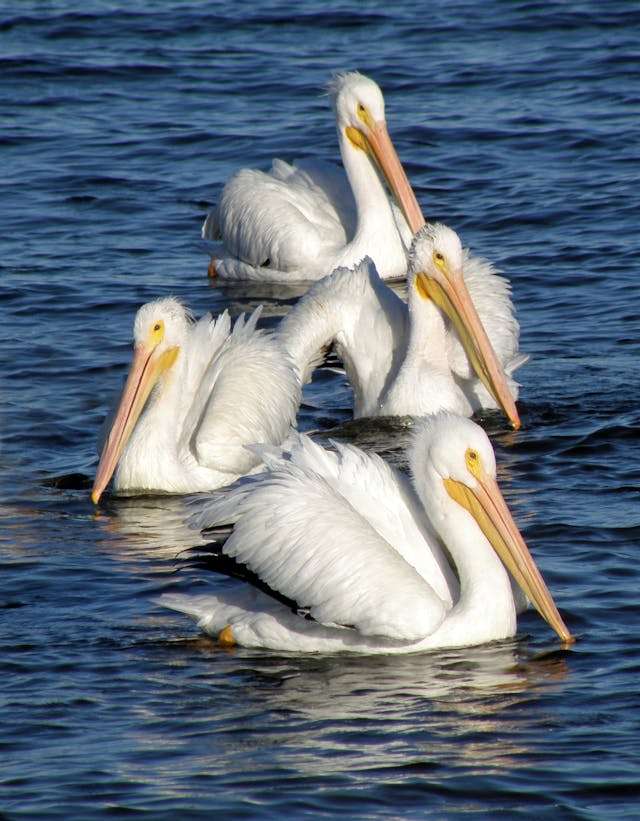
Unlike its coastal cousin, the Brown Pelican, which plunge-dives from the air, the American White Pelican employs a more stately, cooperative fishing technique.
Collaborative Fishing
White Pelicans are highly social hunters. They rarely fish alone, instead forming coordinated groups on the water.
- Forming a Line: A group of pelicans forms a semicircular line and begins to paddle, driving schools of small fish toward the shallower water.
- The Scoop: Once the fish are concentrated, the pelicans simultaneously dip their heads and use their large pouches to scoop up water and fish.
- Draining the Pouch: The pelican tips its head forward, contracting the pouch to drain the water before swallowing the captured fish whole.
Their diet consists primarily of non-game fish like minnows, carp, and chubs, along with crayfish and salamanders. They generally avoid consuming commercially valuable sport fish, making their impact on fisheries minimal.

Masterful Soaring
Despite their great bulk, White Pelicans are spectacular fliers. They utilize thermals (columns of rising warm air) to gain altitude and then glide effortlessly for miles, often soaring in large, synchronized flocks in a "V" formation or a single line. This energy-efficient method allows them to make their long migratory journeys.
Habitat and Migration: Inland Breeders, Southern Winters
The American White Pelican’s life cycle is a journey between remote northern islands and warmer southern estuaries.
Breeding Grounds
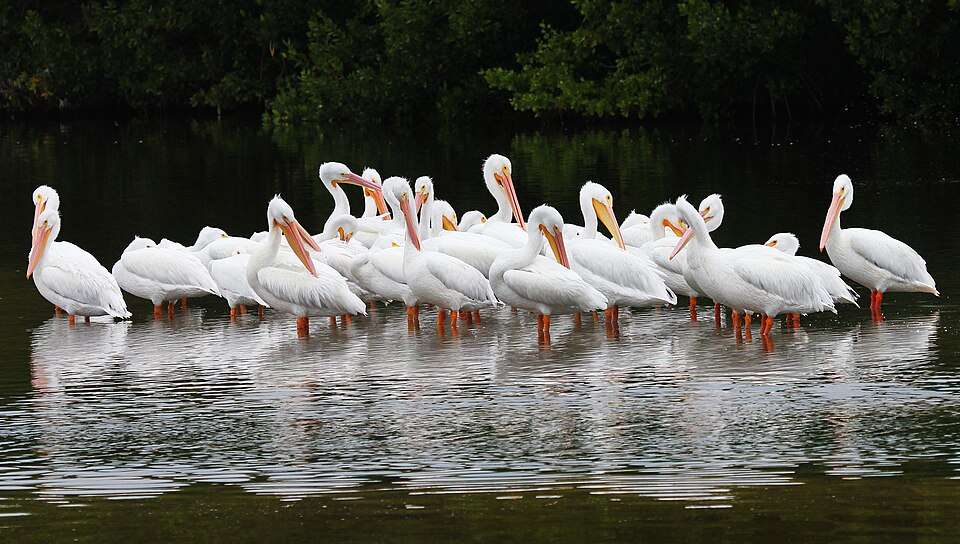
White Pelicans are colonial nesters, choosing remote, undisturbed islands in large inland lakes across the North-Central U.S. and Central Canada. Key breeding colonies are found in states like Utah, Nevada, Montana, and the Dakotas. They build simple nests—shallow depressions on the ground lined with vegetation—where the female lays two to three chalky-white eggs. Due to intense sibling rivalry, often only one chick survives.
Migration and Wintering
The birds undertake one of the longest annual migrations of any North American bird.
- Journey: They travel thousands of miles, often in large flocks, following major flyways.
- Wintering Areas: They winter primarily along the Gulf Coast of Florida, Texas, Louisiana, and Mexico. They also use the Pacific Coast of California and Central America.
This reliance on widely separated breeding and wintering sites makes them particularly vulnerable to environmental changes across a vast geographic range.
Conservation Status and Threats
While the American White Pelican has recovered well since the early 20th century, it remains a species whose survival is intimately tied to the health of wetlands.
Historic Decline and Recovery
The species suffered massive declines in the late 19th and early 20th centuries due to habitat loss and, notably, persecution. They were often viewed as competitors by commercial fishermen and were shot in large numbers. Protection under the Migratory Bird Treaty Act and successful conservation efforts, particularly the designation of protected nesting islands, have allowed their populations to rebound significantly.
Modern Threats
Today, the primary threats to the American White Pelican are:
- Contaminants: As top-level predators of aquatic ecosystems, they are highly susceptible to the effects of environmental contaminants, such as pesticides and heavy metals, which bioaccumulate in the food chain.
- Habitat Disturbance: Their colonial nesting habit means that a single disturbance event (human intrusion, predators) can lead to the abandonment of an entire colony and the loss of thousands of young.
- Water Management: Being an inland species, their breeding success is often directly linked to water levels and flow rates controlled by dams and irrigation systems, especially in the arid Western U.S.
The sight of the American White Pelican, with its striking colors and impressive flight, is a powerful reminder of the importance of conserving North America's vast network of inland lakes and coastal wetlands. They are not merely birds; they are vital, charismatic indicators of the continent's ecological health.
