
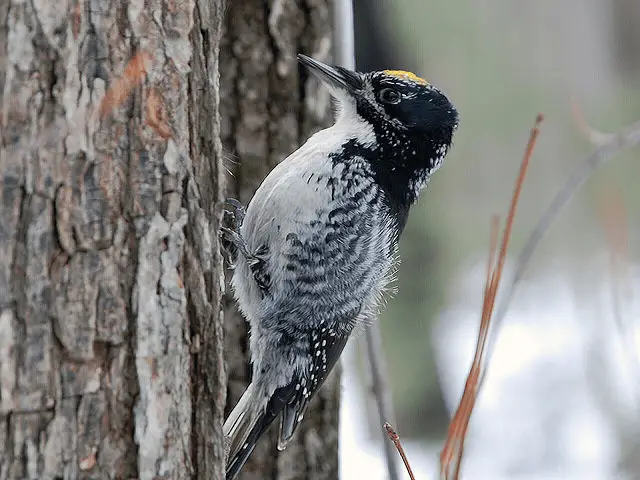
The American Three-toed Woodpecker (Picoides dorsalis) is a fascinating, yet often elusive, inhabitant of North America's boreal and subalpine forests. Unlike its flashier, more widespread cousins, this medium-sized woodpecker is a quiet, diligent worker, perfectly adapted to a life centered around beetle larvae in conifer trees. Its unique morphology and specialized diet make it a critical component of the forest ecosystem.
Identification and Appearance
The American Three-toed Woodpecker is distinguishable by several key features:
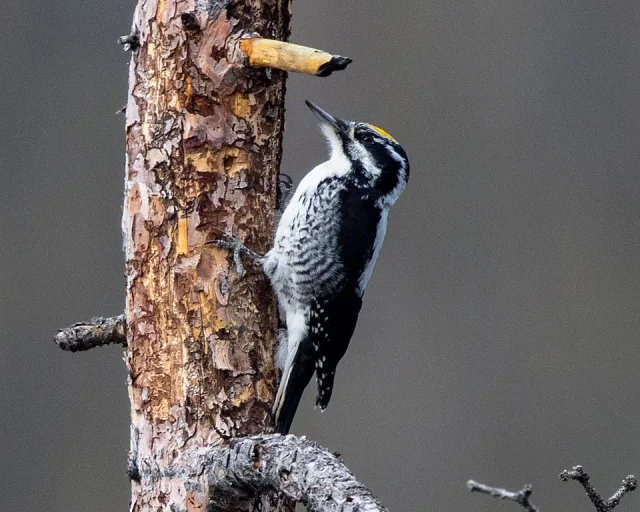
Plumage: Its body is predominantly black and white. It features a solid black back (or barred black and white in the Rocky Mountain subspecies), bold white stripes running down the sides of its head, and heavily barred black and white flanks.
Head: The face is black with a distinctive white stripe extending from behind the eye down the neck. The male is easily identified by a striking yellow patch on its crown, which the female lacks.
Size: It's a relatively small to medium-sized woodpecker, roughly 8 to 9 inches (20-23 cm) in length.
The Three-toed Adaptation: The most defining characteristic, and the source of its name, is having only three toes per foot—two pointing forward and one pointing backward. Most other woodpeckers have four toes (two forward, two backward). This specialization is thought to provide a better grip for shimming and bracing on tree trunks, especially on rotten or scaling bark.
Habitat and Distribution
This species is a true specialist of cold, high-altitude, and high-latitude environments.
Range: Its distribution is patchy but extensive, primarily covering the boreal forest (taiga) of Canada and Alaska, and extending south along the Rocky Mountains and the Cascade Mountains into the western United States.
Preferred Habitat: It strictly favors coniferous forests, especially those dominated by spruce, fir, and lodgepole pine. They are often found in mature or old-growth forests, and notably, they thrive in areas affected by recent burns or insect outbreaks—where their primary food source is abundant.
A Diet of Tree-Borers
The diet of the American Three-toed Woodpecker is highly specific, which dictates its foraging behavior:
Primary Food: Its main sustenance consists of the larvae of wood-boring beetles, particularly the spruce beetle and mountain pine beetle.
Foraging Strategy: Instead of drilling deep holes into healthy wood like some woodpeckers, the Three-toed often engages in "flaking" or "scaling" the bark off dead or dying trees to expose the tunnels and chambers of the insects underneath. This behavior leaves noticeable patches of peeled bark on infested trees.

American Three-toed Woodpecker Ecosystem Role: Because it preys heavily on tree-killing beetles, this woodpecker plays a significant role in naturally controlling insect populations and aiding in the decomposition cycle of the forest.

Behavior and Conservation
The American Three-toed Woodpecker is considered one of the least vocal and most shy woodpeckers in North America.
Drumming: They communicate and mark territory through drumming, but their drumming is softer and less percussive than that of the Hairy or Downy Woodpecker.
Nesting: They excavate their nesting cavities in dead or live trees that have soft, rotting heartwood, typically close to the ground.
Conservation Status: While not globally endangered, the species is sensitive to habitat changes. Logging and intensive forest management that remove dead or dying snags (essential for foraging and nesting) pose the primary threats to local populations. Conservation efforts focus on preserving tracts of mature and disturbed conifer forests to ensure the availability of their specialized food source and nesting sites.
Maine Woodpeckers: 8 Lovable Tree Knockers You Hate Missing!
