

Thrashers are among the most evocative and unique songbirds of the American landscape, yet they often remain overlooked, hidden in dense thickets and scrub. These birds—named for their habit of thrashing through leaf litter with their long, curved bills to find insects—are best known for two things: their spectacular vocal mimicry and their distinctively long tails. As members of the family Mimidae, which also includes mockingbirds and catbirds, thrashers are integral to the soundscapes of deserts, grasslands, and dense coastal thickets across the United States.
Seven species of thrashers regularly occur in the US, each occupying a specific ecological niche, from the famous Brown Thrasher of the Eastern woodlands to the highly localized California Thrasher of the West Coast chaparral. Understanding these birds requires patience, as they are often heard much more easily than they are seen.
The Eastern Mimic: The Brown Thrasher

The Brown Thrasher (Toxostoma rufum) is the most widespread and recognized species, serving as the official state bird of Georgia. Its presence defines the brushy edges and second-growth woodlands of the Eastern and Central United States.
Identification
Plumage: Large, slim body with a long, rounded tail. It is rich rufous brown above and heavily streaked on the creamy white underparts.
Key Feature: Its most defining features are its two conspicuous white wing bars and its large, bright yellow eyes.
Voice: The Brown Thrasher is considered the premier vocalist of the family, known for its vast repertoire and incredible ability to mimic other birds' songs. Unlike the Northern Mockingbird, which typically repeats phrases three or more times, the Brown Thrasher usually repeats each phrase twice. A single male's song may contain thousands of different song types, making it a true artist of avian sound.
Habitat
Brown Thrashers thrive in the dense, low vegetation of forest edges, suburban thickets, hedgerows, and overgrown fields, where they can effectively forage in the leaf litter.
The Desert Dwellers: Curve-billed and Crissal Thrashers
The American Southwest, particularly the Sonoran and Chihuahuan Deserts, is the undisputed epicenter of thrasher diversity. Here, four species of thrashers have evolved to cope with the heat and aridity.
1. The Curve-billed Thrasher (Toxostoma curvirostre)

This is the quintessential desert thrasher. It is often found in thorny desert scrub, mesquite thickets, and even desert parks and gardens across Texas, Arizona, and New Mexico.
Identification: Medium-sized and uniform gray-brown with a faintly streaked breast. Its most notable feature is its long, downward-curved bill and its dull orange or yellow-orange eye.
Behavior: It is perhaps the boldest and most easily observed of the thrashers, often perching conspicuously on the tops of tall shrubs or cacti. Its call is a characteristic, sharp "whit-wheet!"
2. The Crissal Thrasher (Toxostoma crissale)
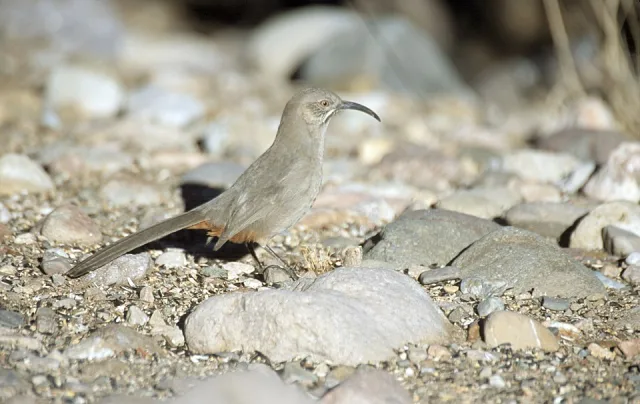
A true denizen of dense, low desert riparian thickets, the Crissal Thrasher is more secretive than the Curve-billed.
Identification: Long-tailed and dull brown, its most reliable field mark is the rich rufous or chestnut patch beneath its tail, known as the "crissum." Its bill is very long and dramatically curved, and its eyes are pale yellow.
Habitat: It is strictly tied to dense riparian growth (areas near water) and dense mesquite thickets, and is one of the more challenging desert thrashers to spot.
3. The LeConte’s Thrasher (Toxostoma lecontei)
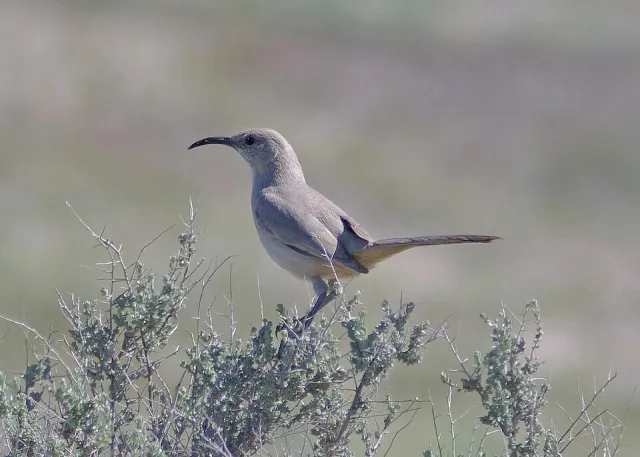
This highly specialized species is a creature of the most desolate, sparse, and extremely arid areas of the Southwestern deserts, including parts of California, Nevada, and Arizona.
Identification: It is the palest of the thrashers, with a uniform grayish-sandy color that allows it to blend seamlessly into the barren landscape. It has a long, slender, dark bill and a proportionally long tail.
Behavior: They are primarily runners rather than flyers, quickly dashing between low shrubs, making them extremely difficult to locate. They are one of the most locally distributed bird species in the US.
4. The Bendire’s Thrasher (Toxostoma bendirei)
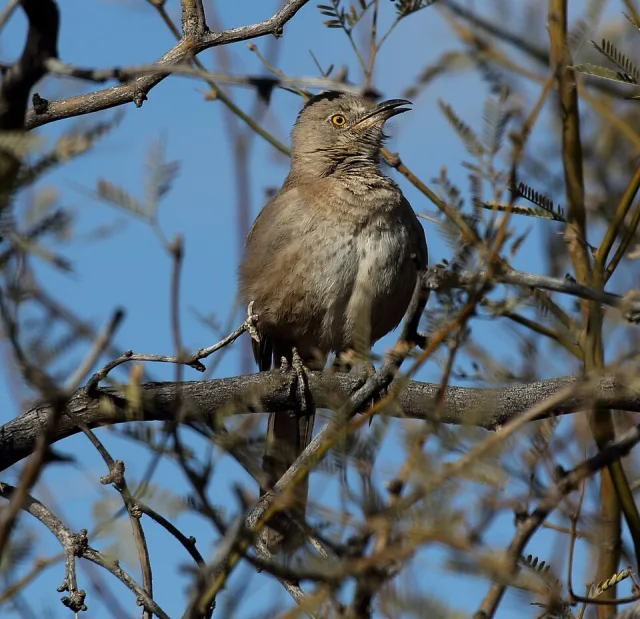
Often confused with the Curve-billed, the Bendire’s Thrasher is a desert upland specialist found in the scrub and open grasslands of Arizona and New Mexico.
Identification: It is generally paler and grayer than the Curve-billed. Crucially, its bill is shorter and less strongly curved than that of its cousins, and it has more noticeable streaking on its breast. Its song is more melodic and less disjointed than the Curve-billed's.
The Pacific Coast Specialists
The far western edges of the continent host two thrashers adapted to the specific challenges of the Pacific climate.
1. The California Thrasher (Toxostoma redivivum)
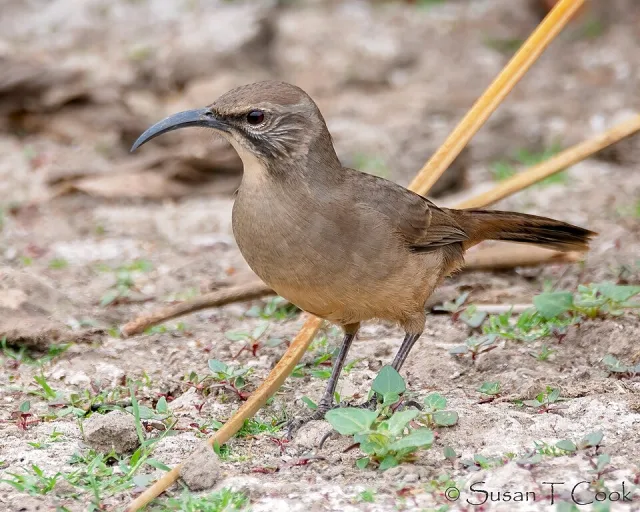
An endemic resident of the California chaparral—dense, shrubby, evergreen vegetation found in dry, fire-prone areas.
Identification: A large, uniformly dark brown thrasher with a very long, dramatically curved bill and a pale buffy throat.
Behavior: The California Thrasher rarely flies, preferring to run and hop through the dense undergrowth. It is a non-migratory species, meaning it lives year-round in the same territory. Its extensive, rich song is full of short, varied phrases.
2. The Sage Thrasher (Oreoscoptes montanus)

This is the outlier of the group; genetically, it is slightly more distant from the Toxostoma thrashers, and it is the only one that undertakes long-distance migrations.
Identification: It is smaller and shorter-tailed than other thrashers, appearing more like a large sparrow or small mockingbird. It is heavily streaked on the breast and has a drab, grayish-brown back.
Habitat and Migration: It breeds in the high-altitude sagebrush scrub of the Great Basin and the intermountain West, and migrates south to winter in the Southwest.
The Thrasher’s Ecological Role and Conservation
Thrashers are essential components of their respective ecosystems. Their constant "thrashing" and digging through leaf litter and soil helps aerate the soil and control insect populations, including beetles, spiders, and larvae. They also consume various berries and seeds, acting as important seed dispersers in scrub and desert habitats.
Conservation Concerns
While most thrasher populations are currently stable, the highly specialized nature of several species makes them particularly vulnerable to habitat destruction:
LeConte's Thrasher: Its reliance on pristine, undisturbed arid desert scrub means that any large-scale development or energy projects in its habitat pose a direct threat.
California Thrasher: The loss and fragmentation of coastal chaparral, primarily due to urbanization and intense fire management, constantly pressures this endemic population.
The genus Toxostoma represents the success of specialization. These birds have mastered the art of living in dense, often hostile environments. To hear a thrasher's rich, varied, and often imitative song emanating from an otherwise quiet thicket is a reminder that some of America's greatest natural treasures are those that take the most patience and dedication to find. They are the unseen chorus, providing the complex soundtrack to the country's most rugged and wild landscapes.
