
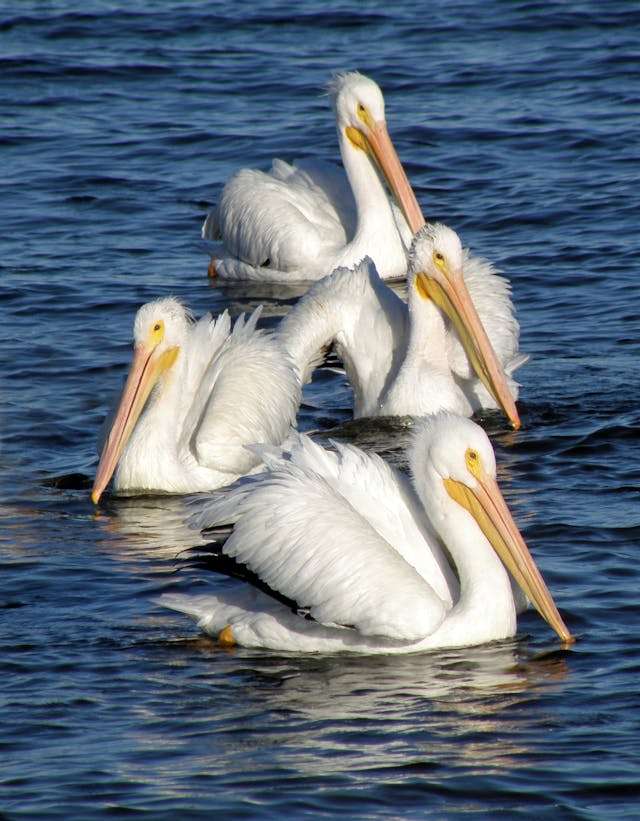
With their oversized bills, enormous throat pouches, and distinctive lumbering flight, pelicans are among the most recognizable and charismatic birds on the coastal and inland waters of the United States. These ancient mariners, part of the order Pelecaniformes, have captivated observers for centuries. Despite their unusual appearance, pelicans are highly effective and intelligent hunters, known for their communal fishing strategies.
The U.S. is home to two distinctly different species of pelicans: the large, striking American White Pelican (Pelecanus erythrorhynchos), an inland specialist, and the more commonly recognized Brown Pelican (Pelecanus occidentalis), an exclusively coastal diver. Their combined range covers the vast majority of the lower 48 states, offering birders and wildlife enthusiasts a chance to observe these magnificent birds in diverse habitats, from the wetlands of the Great Basin to the bustling piers of the Atlantic, Pacific, and Gulf Coasts.
The Coastal Diver: The Brown Pelican
The Brown Pelican is perhaps the most iconic seabird of the American coastline. It is the only pelican species in the world that employs a spectacular plunge-diving technique to capture its prey, marking it as a true master of the marine environment.

Distribution and Habitat
The Brown Pelican is strictly a saltwater species, inhabiting the warm and temperate coastal regions of the United States. Its range is split into three major populations along American shores:
Atlantic Coast: Found from the Carolinas south to Florida.
Gulf Coast: Abundant from Florida west through Texas and Louisiana.
Pacific Coast: Ranges from California south to Mexico.
Brown Pelicans are rarely found far from land, preferring shallow coastal waters, estuaries, bays, and harbors where schools of small fish are plentiful. They are highly tolerant of human presence and are often seen perched on jetties, pilings, and fishing boats.

Identification and Behavior
The adult Brown Pelican is unmistakable. It is a large bird, but smaller and darker than its white counterpart.
Plumage: Adults feature a dark brown body, a white neck, and a dark reddish-brown head in breeding plumage. Juveniles are a more uniform dull brown.
Hunting: Their foraging is a breathtaking display. The bird flies relatively low over the water, then suddenly spots a school of fish, stalls its wings, and drops into a steep dive, tucking its wings back just before impact. It hits the water with a tremendous splash, using the immense gular pouch to scoop up fish and water. Before swallowing, the pelican drains the excess water by tilting its head forward.
Conservation Success: The Brown Pelican is a classic success story of conservation. Its numbers plummeted in the mid-20th century due to the widespread use of the pesticide DDT, which caused thinning eggshells and reproductive failure. Following the ban of DDT in the U.S. in 1972, and thanks to dedicated conservation efforts, the species has made a remarkable recovery, leading to its removal from the Endangered Species List in all areas except the California population.
The Inland Soarer: The American White Pelican
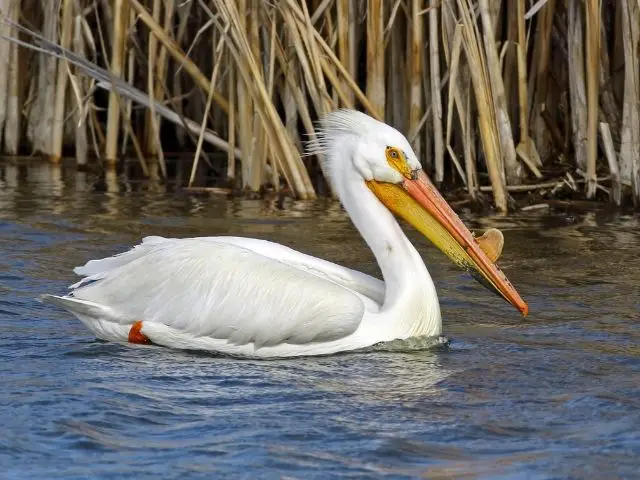
The American White Pelican presents a dramatic contrast to its coastal cousin. It is one of the largest birds in North America and, unlike the Brown Pelican, is almost exclusively an inland species that does not dive for its food.
Distribution and Habitat
The White Pelican has a broad, though patchy, distribution across the continental U.S., occupying vast inland wetlands:
Breeding: They breed primarily on isolated islands within freshwater lakes and reservoirs across the Western States, including North Dakota, Montana, Wyoming, and Utah (especially the Great Salt Lake).
Migration and Wintering: After breeding, they undertake extensive migrations, forming massive flocks. They winter mainly along the southern coasts of the Gulf of Mexico, Florida, and California, as well as inland areas of Texas and Mexico. Their migratory routes can take them over almost any state in the U.S.
Identification and Behavior
The American White Pelican is characterized by its sheer size and striking plumage.

Plumage: It is pure white, except for the black primary and secondary flight feathers visible only when the bird is in flight—a stunning black and white pattern that makes it look like a flying checkerboard.
The Horn: During the breeding season (spring and early summer), adults develop a unique, temporary fibrous plate or "horn" on the upper part of the bill. The purpose of this structure is not fully understood, but it is shed after the pair has successfully nested.
Hunting Strategy: Instead of diving, White Pelicans hunt cooperatively. They form semicircles or lines, sometimes involving dozens of birds, to herd fish into shallow water. They then simply scoop up the trapped prey with their massive pouches. They require large, shallow bodies of water for this communal feeding.
Pelicans Across the Map: State by State
While both species are found in the U.S., their status—resident, breeding, or wintering migrant—varies widely by region.
| Region | Primary Species | Status | Key States |
| West Coast | Brown & White | Brown: Resident/Breeder; White: Migrant/Winterer | California, Oregon, Washington (less common) |
| Gulf Coast | Brown & White | Brown: Resident/Breeder; White: Winterer | Texas, Louisiana, Florida |
| Atlantic Coast | Brown | Resident/Breeder | Florida, Carolinas, Georgia |
| Inland/Plains | White | Breeder/Migrant | Utah, Nevada, Montana, North Dakota |
The fact that White Pelicans migrate from the Canadian border to the Gulf Coast means that they can be spotted as rare but exciting visitors in unexpected states throughout the interior, from the Great Lakes region (e.g., Minnesota, Wisconsin) to the desert southwest (e.g., Arizona, New Mexico) and the central flyway states (e.g., Kansas, Oklahoma).

A Conservation and Ecological View
Both pelican species have essential, if sometimes controversial, roles in their ecosystems.
Predator Status: As large, effective predators, pelicans are sometimes viewed negatively by commercial fishing and aquaculture interests. While they consume large amounts of fish, their diets are often dominated by non-commercial species, serving a vital role in controlling populations of common prey fish.
Ecotourism: The presence of both species, particularly the large colonies of the White Pelican and the dramatic diving of the Brown Pelican, drives significant ecotourism and birding interest, supporting local economies in coastal towns and near inland refuges.
Vulnerability: Both species are vulnerable to marine pollution, particularly oil spills, which can devastate entire coastal colonies (as seen during the Deepwater Horizon disaster). The White Pelican's reliance on remote, undisturbed islands for nesting makes their breeding success highly dependent on protecting these pristine sites from human intrusion.
The next time you see that unmistakable silhouette soaring overhead—be it the powerful black-and-white of the White Pelican riding a thermal high above an inland lake or the darker, streamlined form of the Brown Pelican plummeting into the sea—take a moment to appreciate the diversity and ecological drama that these two magnificent species bring to the American landscape.
