
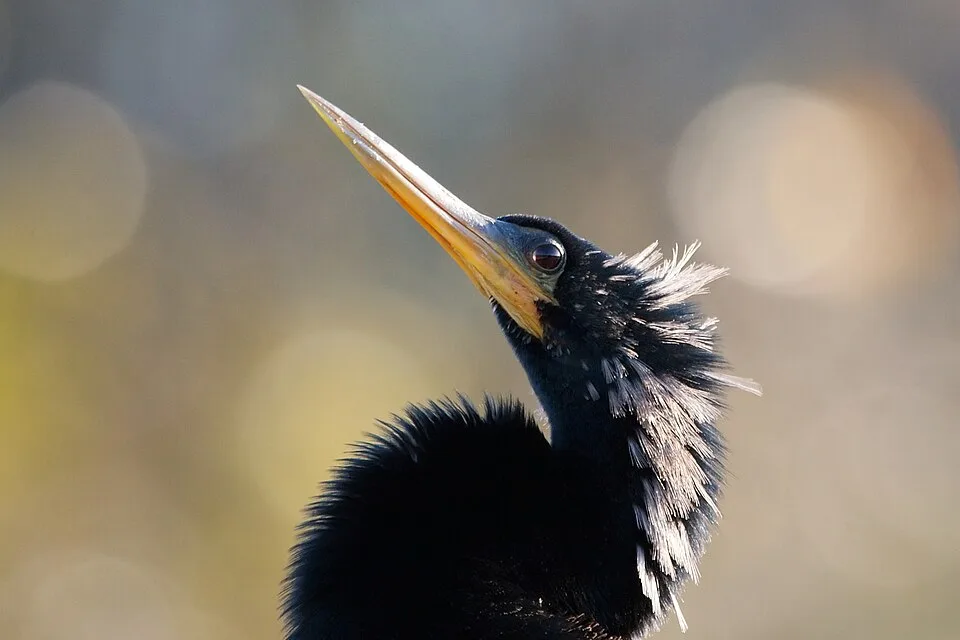
The American Anhinga, Anhinga anhinga, is one of the most uniquely adapted and visually arresting waterbirds of the Americas. Ranging from the warm, cypress-studded swamps of the southeastern United States south through Mexico and into South America, this bird is known by the evocative nicknames "Snakebird" and "Water Turkey," both of which speak to its appearance and behavior. It belongs to the darter family (Anhingidae), a small group of birds known for their specialized underwater hunting technique.
Habitat and Physical Description
Anhingas are strongly associated with shallow, slow-moving, sheltered freshwater habitats, including swamps, marshes, wooded lakes, and canals. They show a preference for areas with overhanging trees or snags where they can perch safely to dry and sun themselves.
The Anhinga is a large, slender bird, typically measuring 75–95 cm (30–37 in) in length with a broad wingspan.
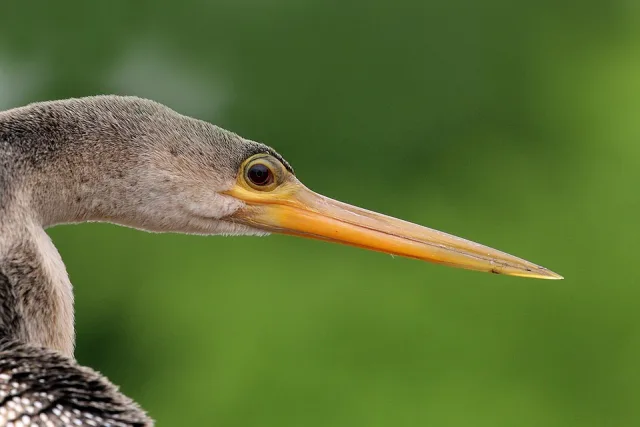
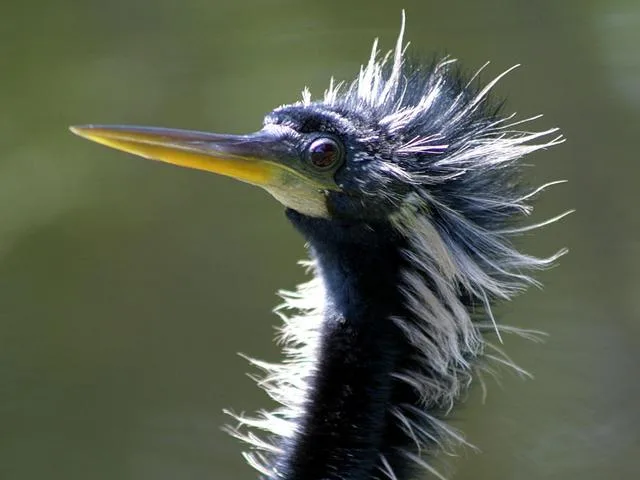
Bill: A long, extremely straight and pointed, dagger-like bill is its most defining feature, essential for spearing fish.
Plumage (Sexual Dimorphism):
Males are a glossy, greenish-black with a spectacular display of silvery-white streaks and spots on their upper wings and back.
Females and juveniles are paler, sporting a light brown or buff head, neck, and upper chest, which sharply contrasts with the darker body.
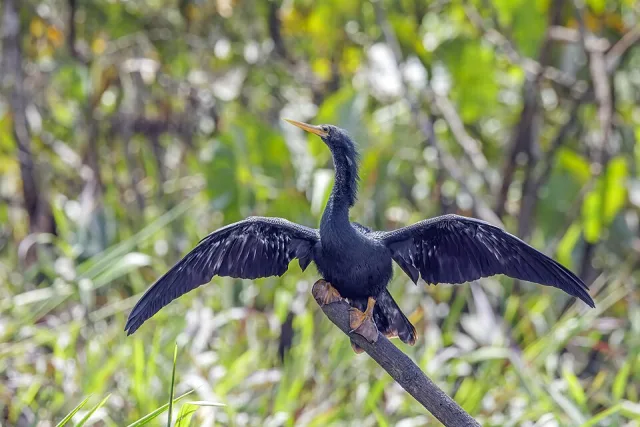
Tail: The tail is long and fan-shaped, which gives rise to the "Water Turkey" moniker, and is often spread wide during flight or sunning.
Neck: The neck is remarkably long and serpentine, facilitating its underwater movements.
Hunting Strategy: The Snakebird's Stealth
The "Snakebird" name is earned by the Anhinga’s characteristic swimming and hunting posture. Its feathers are not fully waterproof—they lack sufficient oil and have a unique structure—and its bones are notably dense. This lack of buoyancy allows the bird to control its depth, often swimming with its body entirely submerged, leaving only its head and S-shaped neck visible above the water, perfectly mimicking a swimming snake.
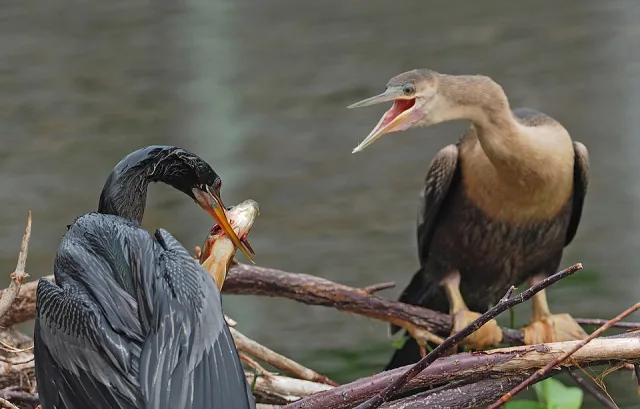
Its primary diet consists of fish, but it also preys on aquatic invertebrates, amphibians, and occasionally snakes or small turtles. It hunts by stalking prey underwater, then using a specialized, flexible joint in its neck vertebrae to execute a rapid, forward thrust—essentially a living harpoon—to impale the fish with its sharp bill. After securing the catch, the Anhinga surfaces, flips the fish off its bill and into the air, and swallows it head-first.
After a dive, an Anhinga must spend considerable time sun-bathing on a perch with its wings spread wide to dry its waterlogged plumage. This posture is vital for drying its feathers to restore its ability to fly and also helps it absorb solar energy to compensate for a relatively low metabolic rate.
Reproductive Behavior and Nesting
Anhingas are typically monogamous and may reuse their nest sites year after year. Breeding can occur year-round in tropical regions, but is seasonal in the southeastern US, usually peaking from March through May.
Courtship: The male initiates courtship with elaborate aerial displays, soaring high on thermals, followed by marking a potential nest location with leafy twigs. He performs various ground displays, including wing-waving and deep bowing, to attract a female. An iconic part of pair-bonding involves the male and female intertwining their long necks.
Nesting: Nests are typically built on branches overhanging the water or in open tree tops, often in small, loose colonies that may include herons and cormorants. The male primarily collects materials (sticks, twigs, green leaves), while the female constructs the final platform nest.
Young: The female lays a clutch of 2 to 6 eggs (average of 4), which are incubated by both parents for about 25–30 days. Hatchlings are initially naked and helpless. Parents feed the young by regurgitating partially digested food. The chicks fledge at about six weeks of age, but a unique anti-predator behavior allows them, if threatened, to drop from the nest into the water and swim away, later climbing back up the tree.
Anhinga vs. Cormorant
The Anhinga is often confused with the Double-crested Cormorant, as both are dark, long-necked waterbirds that exhibit the wing-spreading behavior. The key distinguishing features are:
| Feature | American Anhinga | Double-crested Cormorant |
| Bill Shape | Long, straight, sharp, dagger-like (for spearing) | Shorter, strongly hooked at the tip (for grabbing) |
| Tail | Long and fan-shaped (Water Turkey) | Short and stiff |
| Swimming | Body submerged, only neck/head visible (Snakebird) | Body floats higher, entire back visible |
| Flight | Frequently soars high on thermals, often holding wings flat | Flaps continuously, unable to soar |
Conservation Status
The American Anhinga is currently classified as a species of Least Concern globally, with an estimated population in the millions. However, threats include loss of wetland habitat due to development and drainage, as well as being vulnerable to discarded fishing line and environmental pollution. Continuous monitoring of their freshwater habitats is essential for maintaining the health of this unique and fascinating species.
