

The official theme for World Migratory Bird Day 2026 has taken over the nature community: "Every Bird Counts – Your Observations Matter."
This year, global conservation organizations aren't just talking about the abstract concept of migration flyways. Instead, the U.S. Fish & Wildlife Service and Environment for the Americas have handpicked a small group of "Ambassador Species" to show exactly how regular, everyday citizen scientists can protect birds right from their own backyards and local patches.

While mainstream sites love to post generic flyers about the event, they rarely give you the deep-dive identification hacks and concrete action steps needed to actually find, track, and log these trending birds.
Whether you are scanning a local wetland or watching from your suburban patio, here is your definitive field guide to the three major U.S. Ambassador species of 2026 and how your data protects them.
1. The Crimson Marsh-Dweller: Cinnamon Teal (Spatula cyanoptera)
The Cinnamon Teal is a crown jewel of Western U.S. wetlands, primarily breeding across the Great Basin and Intermountain West. It serves as a vital ambassador for the 60th Anniversary of the International Waterbird Census, highlighting the fragile state of our freshwater marshes.
The Identification Challenge: Breaking Down the Plumages
While a breeding male is an unmistakable explosion of rich, coppery-red, identifying this species isn't always straightforward—especially because they frequently mingle with Blue-winged Teal.
Adult Breeding Male: Vibrant cinnamon-red head and body, a distinct red eye, and a long, spatula-shaped black bill. When in flight, look for a striking chalky-blue patch on the forewing.
Adult Female: A mottled brown duck with a dark line through the eye. To separate her from a female Blue-winged Teal, look for a longer, wider bill and warmer, overall richer brown tones on the flank.

The "Eclipse" Plumage Trap: In late summer and early autumn, males molt into an "eclipse" plumage that looks nearly identical to females. Your best clue here is the eye color—if the duck looks like a drab female but has a distinct, glowing red eye, you are looking at a molting male Cinnamon Teal.
How Your Data Helps
Because this is a harvested waterfowl species, accurate field observations via eBird help biologists generate sustainable harvest models and track shifting wetland health across the Pacific and Central Flyways.
2. The Backyard Dyno: Ruby-throated Hummingbird (Archilochus colubris)
Weighing barely as much as a U.S. penny, the Ruby-throated Hummingbird is the ultimate ambassador for suburban connection. These tiny powerhouses migrate from Central America, frequently crossing the entire Gulf of Mexico in a single, nonstop flight before arriving in gardens across the Eastern United States.

The Problem: The Hidden Backyard Threat
While the Ruby-throated Hummingbird population is currently stable, the broader hummingbird family is in trouble—nearly 68% of hummingbird species globally are facing population declines due to habitat loss and intensive agriculture. In the suburbs, the single biggest threat they face is glass window collisions.
Patio Citizen Science: 3 Ways to Log Data Without Leaving Home
You don't need to hike deep into a national forest to participate in the 2026 campaign. You can run community science directly from your porch:
Log First Arrivals via Journey North: Map out the exact date you spot your first male or female Ruby-throat. This helps scientists track how climate change and unseasonable spring shifts impact flower bloom times versus hummingbird arrival dates.
Audit Your Glass: Walk around your house and look at your windows from a bird's perspective. If you see tree reflections, apply UV-reflective window decals or temporary window film.
Map Your Foraging Plants: When you log a hummingbird on platforms like iNaturalist, note exactly what flowers they are feeding on in your yard. This helps build regional databases of critical nectar sources.

Ruby-throated Hummingbird

3. The Urban Pocket-Rocket: Merlin (Falco columbarius)
The Merlin is a small, aggressively fast falcon that has increasingly adapted to nesting in suburban parks and urban tree lines across the northern U.S., migrating south to the southern states and Mexico for the winter.
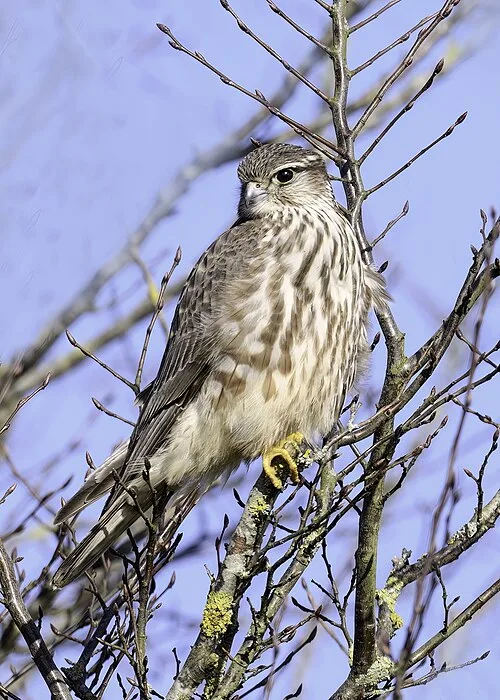
Quick Field Identification Profile
| Feature | Mature Male | Female / Juvenile |
| Upperparts | Sleek, dark blue-gray | Warm, heavily streaked chocolate brown |
| Underparts | Heavily streaked chest and belly | Barred brown chest |
| Flight Style | Rapid, continuous wingbeats; rarely glides | Slower, deceptive flight that mimics a pigeon |
The "Pigeon Hawk" Comeback
In the mid-20th century, Merlin populations plummeted due to DDT poisoning, which caused severe eggshell thinning. While they have made a spectacular comeback since the DDT ban, they now face a new urban threat: collisions with vehicles and glass windows as they chase songbirds through residential neighborhoods.
How Your Data Helps
Because Merlins hunt by flying incredibly low and fast through urban spaces, tracking their breeding success in city parks is crucial. Logging a Merlin sighting—especially noting if you see a pair displaying nesting behavior in a neighborhood pine tree—gives city planners the data needed to protect urban canopy zones.

How to Get Involved Across the U.S. Today
| Platform | Best For | What to Log |
| eBird | All Species | Exact counts of Cinnamon Teal and Merlins in local reserves. |
| Journey North | Hummingbirds | First-of-season arrival dates and backyard feeder activity. |
| iNaturalist | Broad Habitat Data | Photos of local native plants that hummingbirds and insects rely on. |
What are you seeing? Have you managed to spot any of the 2026 Ambassador birds in your area this month? Drop a comment below with your state, your latest sighting, and what native plants you are putting out to help our migratory guests!
