

We admire birds for their song and their effortless flight, but beneath their feathered exteriors lies a suite of "superpowers" that rival anything found in science fiction. For the everyday American, a common Robin or a soaring Osprey seems familiar, yet their abilities to navigate without a map, predict weather, and endure transcontinental journeys tap into realms of physics and biology humans are only beginning to comprehend.
The United States, with its diverse flyways, vast oceans, and towering mountain ranges, is a grand stage for these avian feats. Many of the most astounding abilities are essential tools for survival and migration—skills that allow millions of birds to travel thousands of miles between their Arctic breeding grounds and their equatorial winter retreats.
The Invisible Compass: Magnetoreception and Quantum Navigation
Perhaps the most astonishing ability birds possess is their flawless sense of direction, known as magnetoreception. While humans must rely on GPS or a physical compass, migratory birds literally see the Earth’s magnetic field.
The Quantum Sense
Birds don't navigate by simply detecting the north and south poles like a bar magnet. Instead, they use a much more sophisticated, quantum-level compass that registers the angle and intensity of the Earth’s magnetic field lines relative to the pull of gravity.
- Cryptochromes: Scientists believe this ability is rooted in specialized proteins called cryptochromes found in the birds’ eyes. When light hits these proteins, a quantum effect occurs, creating chemical reactions that are sensitive to the planet's magnetic field.
- A "Seen" Map: This means birds aren't just feeling a direction; they may literally have a visual representation of the magnetic field superimposed on their sight, allowing them to pinpoint their position and desired direction. This "inclination compass" provides a direction even on cloudy days, making the magnetic field their most reliable compass.

Using Multiple Maps
The magnetic compass is just one layer of their navigational toolkit. Birds integrate this with several other senses to build a complete mental map:
- Sun and Star Compass: They use the position of the sun and the patterns of constellations at night (specifically around the North Star) to maintain a bearing.
- Odor Maps: Pigeons and some migratory songbirds, like the European Starling, use an olfactory map, relying on subtle differences in airborne odors across their range to pinpoint specific locations.
- Infrasound: The low-frequency sounds generated by ocean waves, wind over mountains, and even distant weather systems can travel thousands of miles. Birds can perceive these infrasounds, which act as acoustic landmarks helping them orient themselves over vast, featureless oceans.
Weather Wizards: Sensing Storms and Pressure

Birds are, quite literally, living barometers. Their ability to sense and react to minute changes in atmospheric pressure and sound waves allows them to anticipate dangerous weather long before human forecasts are available.
The Barometric Sense
Before a major storm or cold front hits, the barometric pressure drops. Birds have pressure receptors in their middle ears and possibly elsewhere that are sensitive to this change.
- Pre-emptive Migration: This sensing ability triggers a vital survival response. For instance, studies tracking songbirds like warblers show that they will suddenly initiate migration early to fly around an approaching hurricane or a massive cold front. They can detect the pressure drop hundreds of miles away and adjust their flight paths accordingly.
- Fleeing Catastrophes: In a dramatic 2014 study, a flock of Golden-winged Warblers abandoned their Tennessee breeding grounds to fly south into Florida just before a massive tornado system struck. They returned five days later when the immediate threat had passed.
Sensing Infrasound from Thunder
Birds can hear sounds at frequencies far lower than humans can—a capability called infrasound detection.
- Thunder, breaking ocean waves, and strong wind shear all generate very low-frequency sound waves that travel great distances. A bird migrating over the plains might be able to detect the infrasound generated by a major storm forming hundreds of miles away, giving it crucial time to change course.
Endurance Athletes: The Long-Distance Migration Feat
The sheer physical ability of many North American migratory birds is astounding. They are the ultimate endurance athletes, powering through extreme conditions for weeks on end.
Non-Stop Flight: The Blackpoll Warbler
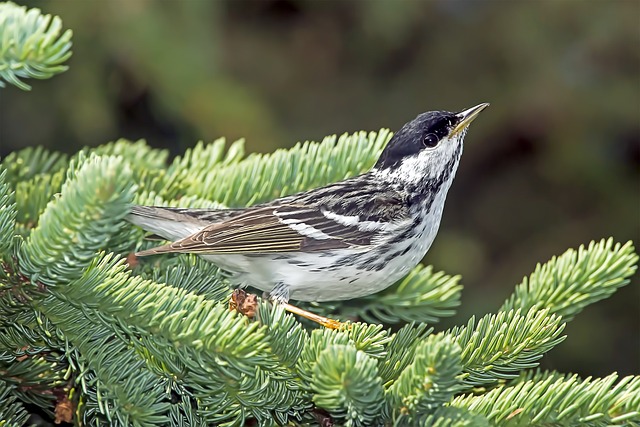
One of the most impressive marathon flyers is the tiny Blackpoll Warbler (Setophaga striata). This small songbird, weighing less than half an ounce (about 12 grams), makes one of the longest migrations of any North American bird.
- Fueling Up: Before its fall journey, the Blackpoll gorges on insects and berries, nearly doubling its body weight with fat—a process called hyperphagia.
- The Transoceanic Leap: From the Northeast coast of the U.S. and Canada, the Blackpoll launches a non-stop flight over the open Atlantic Ocean to its wintering grounds in South America (Venezuela, Brazil). This journey lasts between 72 and 88 hours and covers over 1,700 miles (2,700 kilometers). It flies at altitudes up to 20,000 feet, where the air is thin and cold, relying on its fat reserves for fuel. Losing that much weight over three days is equivalent to a human running four marathons a day for three days straight.
High-Altitude Flight: Bar-headed Goose

While not native to the U.S. but an example of what is possible, the Bar-headed Goose is one of the highest-flying birds, able to cross the Himalayas at altitudes where a human would instantly black out without supplemental oxygen (around 21,000 feet).
- Specialized Blood: North American migrants that fly at high altitudes, such as the Tundra Swan or Black-bellied Plover, have similar adaptations: highly efficient lungs and specialized hemoglobin that grabs and transports oxygen far more effectively than human blood, allowing them to utilize the thin, fast airflow of the upper atmosphere.
Biological Timekeeping: Perfecting the Calendar
Birds exhibit an internal, genetic calendar that dictates when they migrate, breed, and molt.
The Circannual Rhythm
This circannual rhythm is governed by the length of daylight (photoperiod), signaling the bird’s body to enter the state of zugunruhe, or migratory restlessness.
- Genetic Programming: Juvenile birds, particularly those that migrate alone (like many songbirds), follow a predetermined, genetically programmed flight plan. They know the direction and the minimum distance they must fly before they stop for the winter, a true testament to inherited instinct.
A Hidden World of Sensory Wonders
The more we study North America's birds, the more apparent it becomes that they live in a sensory world unrecognizable to us. They inhabit a planet marked by invisible magnetic lines, low-frequency sound waves, and minute shifts in pressure. Their abilities are not magical; they are the result of millions of years of evolutionary refinement, turning everyday challenges—like a 3,000-mile flight or an approaching thunderstorm—into achievable feats. When you next see a bird at your feeder or a hawk circling overhead, remember the invisible map and the internal supercomputer guiding its every move. They are, quite simply, the most amazing athletes and navigators on Earth.
