
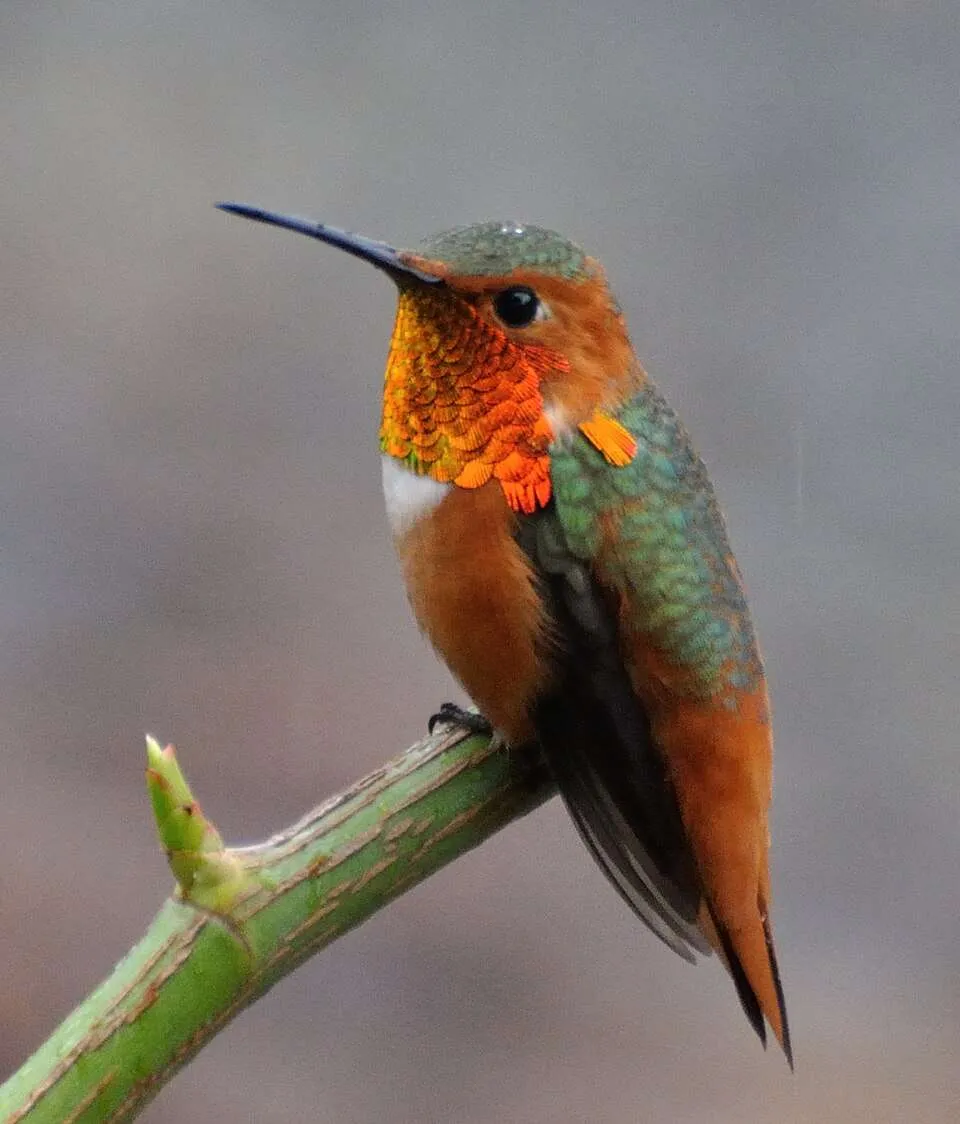
The coastline of California and southern Oregon is the domain of a tiny, intensely energetic marvel: the Allen's Hummingbird (Selasphorus sasin). Often overlooked by the casual observer due to its diminutive size and a close resemblance to its cousin, the Rufous Hummingbird, the Allen's is a species of remarkable endurance, aggressive territoriality, and striking beauty. Weighing a mere 0.07 to 0.15 ounces and measuring just over 3 inches in length, this bird lives a life characterized by constant motion, making it a favorite subject for both seasoned ornithologists and backyard bird enthusiasts.
The Iridescence of the Male
Identifying the Allen’s Hummingbird often starts with the dazzling male. He is a study in contrasting color:
Dorsal (Back and Head): The male typically sports a bronze-green back and crown. This feature is a key, though not entirely foolproof, differentiator from the Rufous Hummingbird, which has more rufous (rusty-red) on its back.
Ventral (Underparts): His flanks, rump, and tail are a deep, conspicuous cinnamon-rufous (rusty) color.
Gorget (Throat): His most eye-catching feature is the iridescent reddish-orange gorget (throat patch). This patch is not red pigment, but a structural color that shimmers and glows with fierce intensity as light hits the specialized feathers at the correct angle.
The female and immature Allen's Hummingbirds, in contrast, are generally bronze-green above with rufous coloration on the tail (which is tipped with white) and flanks, but they lack the brilliant iridescent gorget, having only a few specks of bronze or reddish-orange on a pale throat. Their subtle coloration and size make them exceptionally difficult to distinguish from the female Rufous Hummingbird in the field.

A Life on the Move: The Early Migrant
The Allen's Hummingbird is an extraordinary short-to-medium distance migrant. Most of the species (S. s. sasin) undertakes a twice-yearly journey between its breeding grounds and its wintering territory in the coastal scrub and oak-pine forests of south-central Mexico.
What sets this migration apart is its timing: the Allen's Hummingbird is one of North America’s earliest spring migrants.
Northbound Arrival: Individuals begin moving north from their wintering grounds as early as December, arriving on their coastal California and southern Oregon breeding grounds in late January or February. They arrive just as the cool, damp Pacific coastal environment begins to burst with life, exploiting the abundance of early-blooming nectar sources.
Fall Departure: Their breeding season is equally accelerated, with the southward migration beginning unusually early, sometimes by mid-May, and peaking in July and August. This early departure allows them to take advantage of flowering high-elevation habitats along the interior mountain ranges on their way south.
A separate, non-migratory subspecies (S. s. sedentarius) exists as a permanent resident on the Channel Islands off Southern California and has expanded its range to adjacent parts of the mainland, including the Palos Verdes Peninsula.

Aggression and Aerial Acrobats
The Allen's Hummingbird lives at a metabolic pace that demands constant foraging, driving its fiercely territorial nature. Both males and females will aggressively defend a rich patch of flowers or a feeder, chasing away not only other hummingbirds but also much larger birds, asserting their dominance with a high-pitched, excited chatter and high-speed darts.
The male's courtship display is one of nature's great aerial spectacles:
The Pendulum: He begins with a rapid, side-to-side flight in a wide, pendulum-like arc in front of the female, his wings making a distinctive, buzzing sound.
The High Dive: He then climbs skyward, sometimes up to 100 feet, before performing a steep, high-speed dive. As he pulls out of the dive near the female, he produces a sharp, metallic trill or squeal using specialized tail feathers (rectrices), concluding the dramatic maneuver.
Following mating, the male offers no parental care. The lone female builds a small, tidy cup-nest of plant down and spider silk, camouflaging the exterior with lichens and moss. She alone incubates the two tiny white eggs for about two to three weeks and feeds the nestlings until they fledge.

Conservation Concerns
While the Allen's Hummingbird has adapted well to suburban gardens—readily utilizing nectar from both native and introduced flowers (like eucalyptus) and sugar-water feeders—the species is facing significant conservation challenges.
Surveys have indicated a troubling decline in population over the last few decades, with some estimates suggesting a loss of over 75% of the migratory population. This decline is largely attributed to the destruction and fragmentation of the narrow strip of moist coastal scrub and chaparral that constitutes their primary breeding habitat, particularly in California.
Recognizing the fragility of this tiny flyer, the Allen's Hummingbird is a species that requires close monitoring and dedicated habitat protection to ensure its exhilarating aerial displays and intense, ruby-red glow continue to grace the West Coast for generations to come.
