
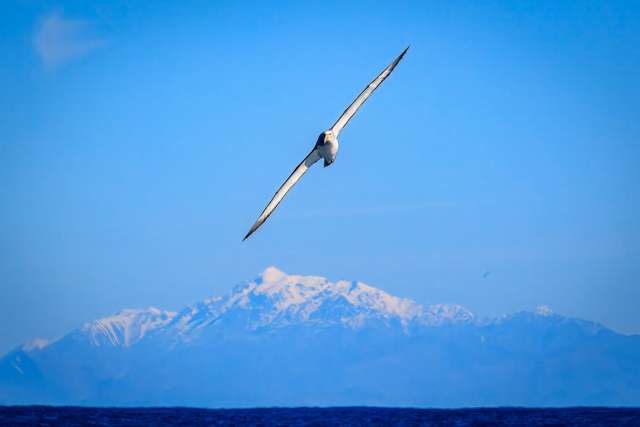
The incredible stamina and vast migratory range of the albatross are powered by the wind, but the execution of dynamic soaring relies on a crucial anatomical adaptation: the ability to passively lock the wing in the open position. This mechanism minimizes the energy cost of flight by turning the wing into a rigid, highly efficient aerofoil, dramatically reducing muscle fatigue.
The Shoulder Lock: A Biological Latch
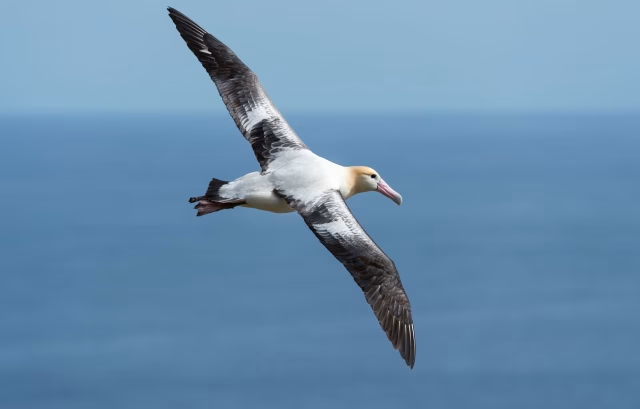
The key to the albatross's near-effortless gliding is the shoulder lock mechanism, also known as the tendon-locking mechanism or the "shoulder-humerus lock." This adaptation transforms the muscular task of holding the wing out into a structural one.
The Mechanism
Passive Tension: When the albatross fully extends its long, narrow wing, the bones and associated tendons within the shoulder and elbow joints align perfectly.
Toggle Joint: At the shoulder joint, there is a specialized bony structure that acts like a toggle or latch. When the wing is fully extended, the humerus (upper arm bone) and the scapula (shoulder blade) engage with one another.
Ligament and Tendon Lock: A specific set of tendons and ligaments becomes taut and locks the joint into position, requiring minimal to no muscle contraction to maintain the wing's rigidity.
The Result
This mechanism effectively removes the need for active muscle power to keep the wings outstretched against the forces of lift and drag. The muscles are only required for:
Take-off and Landing: When vigorous flapping is necessary.
Maneuvering: Tiny, precise adjustments during turns, where muscles are used for fine-tuning the angle of attack and banking.
By locking its wings, the albatross can hold its immense wingspan stable for hours, sometimes even days, while riding the air currents. This makes the muscular energy expenditure for cruising flight almost negligible.
Wing Anatomy: The Long, Narrow Design
The passive lock is only effective because of the overall structure of the albatross wing, which is the perfect design for low-speed, high-efficiency gliding.
High Aspect Ratio
Albatrosses possess a wing with a high aspect ratio.
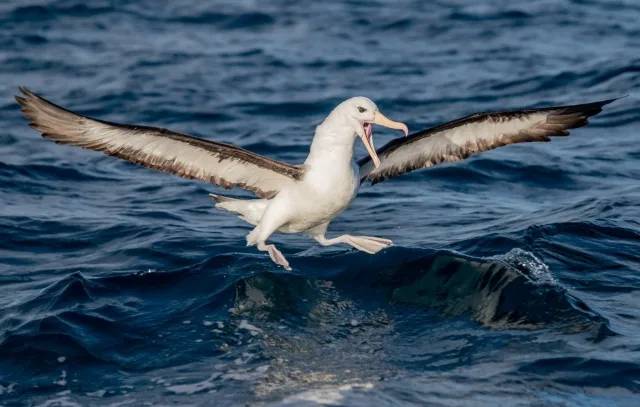
Aspect Ratio (AR) is the ratio of the wingspan squared to the wing area.
Albatrosses have extremely long, narrow wings, giving them one of the highest aspect ratios among all birds. For instance, the Wandering Albatross has the largest wingspan of any bird, reaching up to 11 feet.
This shape minimizes induced drag (the drag created as a byproduct of producing lift). Low induced drag is crucial for high-speed, long-distance soaring, allowing the bird to glide farther for every unit of altitude it loses.
The Giants of the North Pacific: Albatrosses of North America
Stiff Structure
The bone structure of the wing is relatively light but highly stiff. This rigidity is essential for the locking mechanism to bear the stress of flight without twisting or flexing excessively. The stiffness ensures that the wing remains a stable aerofoil, efficiently converting the wind’s kinetic energy into forward motion.
Dynamic Soaring and the Lock
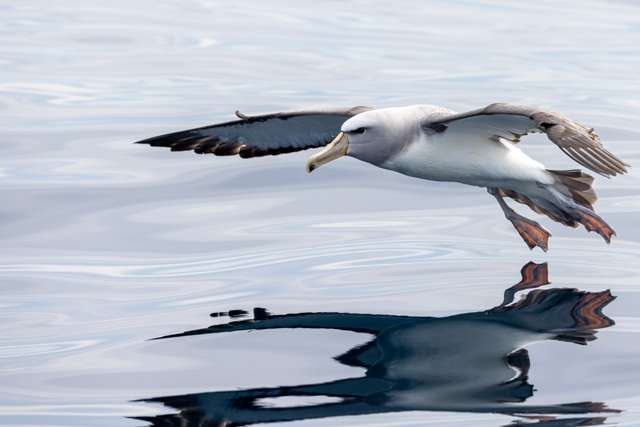
The wing lock and the wing shape are perfectly optimized for the dynamic soaring technique:
Gliding Efficiency: The high aspect ratio allows the albatross to move at high speeds horizontally and maintain lift while traversing the wind gradient.
Energy Conservation: During the long glides—which constitute the majority of the flight path—the locking mechanism is engaged, conserving muscle energy.
Precision: Muscles only exert full power during the sharp turns into and out of the wind shear, ensuring the precise control needed to navigate the narrow band of the wind gradient near the ocean surface.
In essence, the albatross is a living glider, carrying a biological design that allows it to exploit the physical laws of wind shear with unmatched efficiency, transforming the open ocean into a boundless, energy-rich aerial highway.
