
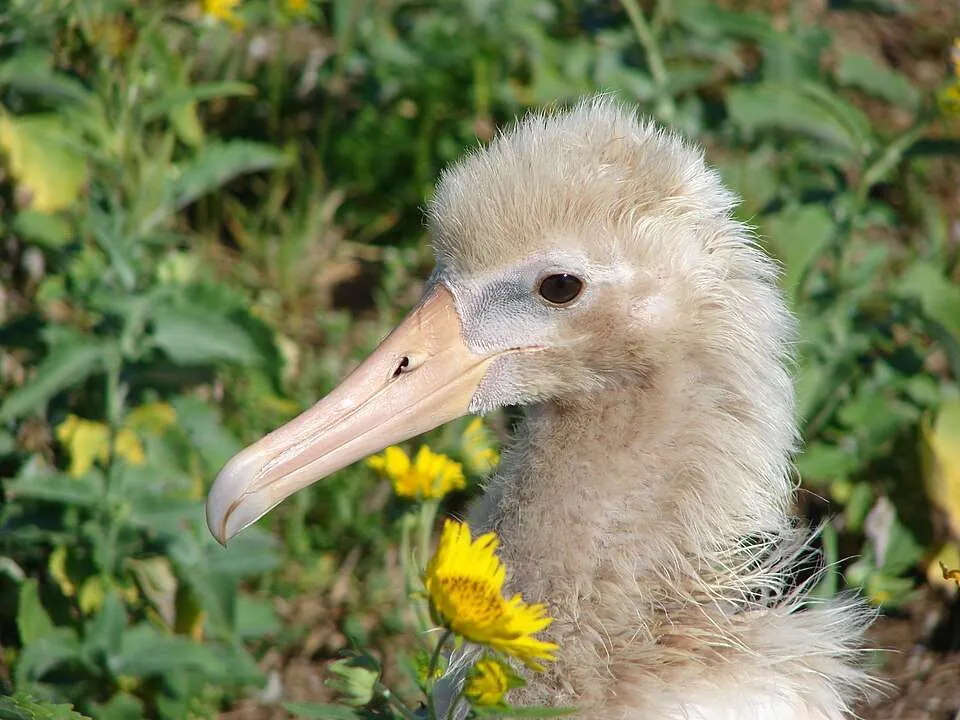
Few birds inspire the sense of oceanic wonder and sheer scale like the Albatross. With wingspans that can stretch over seven feet, these pelagic giants spend the vast majority of their lives soaring over the open sea, only returning to land to breed. Unlike their larger, more diverse cousins of the Southern Hemisphere, only a small number of albatross species regularly venture into the waters off North America, primarily along the Pacific Coast.
Of the three species of albatross found in the North Pacific, the waters bordering North America—from the shores of Baja California up to the Bering Sea in Alaska—are key foraging grounds. These birds undertake incredible journeys from their main breeding grounds in the distant Hawaiian and Japanese islands.
1. Black-footed Albatross (Phoebastria nigripes)
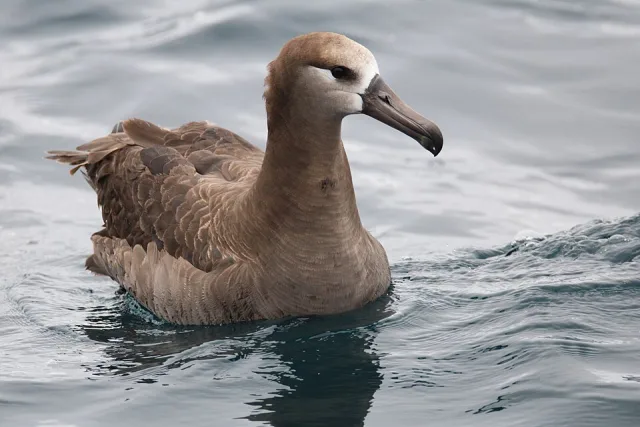
The Black-footed Albatross is, arguably, the most familiar albatross to North American birders, as it is the species most commonly and consistently observed relatively close to the coast.
Identification
This species is easily distinguished by its overall dark, sooty-brown plumage. Adults feature a small, whitish area around the base of the bill and under the eye, and a white rump area that is often visible in flight. The bill, legs, and feet are all dark. It is a medium-sized albatross, with a wingspan averaging around 6.5 feet.
Distribution in North America
Primary Range: The Black-footed Albatross is seen throughout the northeastern Pacific Ocean.
Where to See Them: They are common far offshore from California, Oregon, and Washington, and are regularly found off the coast of British Columbia in Canada.
Best Viewing: Pelagic birding trips—dedicated boat excursions far beyond the continental shelf break—are the most reliable way to observe this species. Their numbers peak in these waters during the summer months (June through August), when breeding adults make long foraging trips from their colonies to feed their chicks.
Conservation Status
The global population is concentrated on the Northwestern Hawaiian Islands (especially Midway Atoll and Laysan Island). The species is listed as Near Threatened due primarily to bycatch mortality in commercial fisheries and vulnerability to marine plastic pollution.
2. Laysan Albatross (Phoebastria immutabilis)
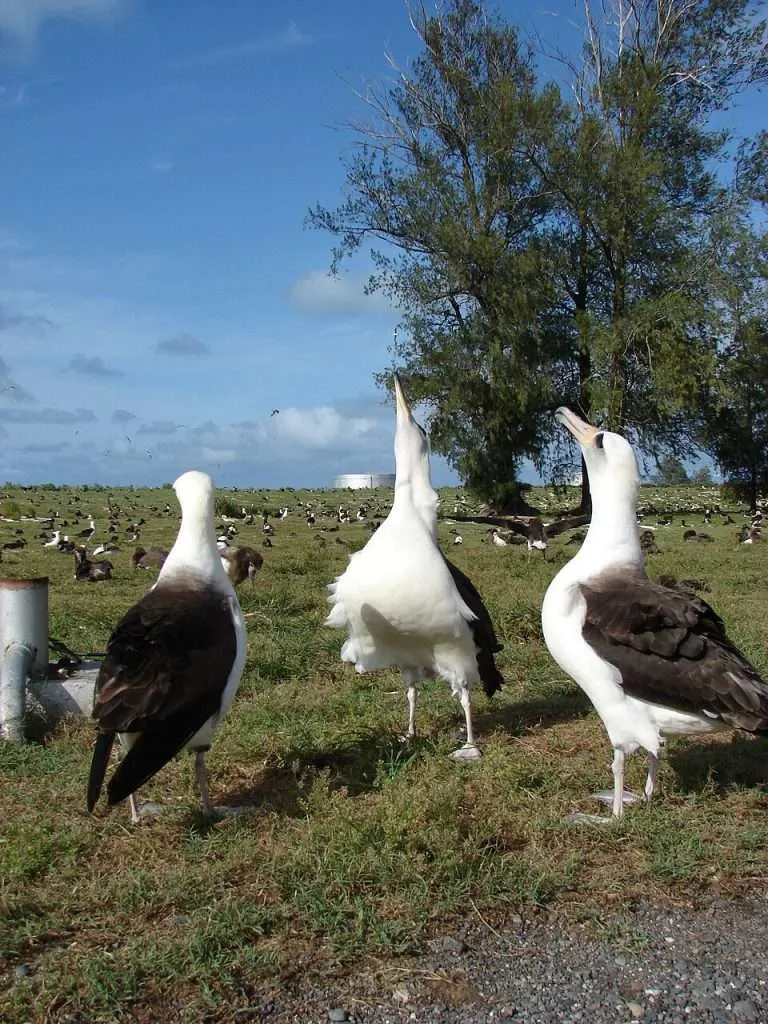
The Laysan Albatross contrasts sharply with its dark-feathered relative, possessing a striking, light-bodied appearance.
Identification
The Laysan Albatross has a white head and body with a contrasting dark back and upper wings (a classic "gull-like" appearance). It has a prominent dark smudge around the eye, giving it a masked look, and a large, pinkish bill with a dark tip. Its wingspan is similar to the Black-footed, reaching up to 6.7 feet.
Distribution in North America
Primary Range: Though a common North Pacific species (and the most numerous of the northern albatrosses globally), it is generally found farther offshore of the North American coast than the Black-footed.
Where to See Them: Sightings are most common off the coast of Alaska, particularly in the Bering Sea and the Aleutian Islands, where non-breeding birds gather to feed in the nutrient-rich waters. They are seen occasionally off the coasts of Washington, Oregon, and California, often in late winter and spring.
Note: Their main breeding colonies are overwhelmingly located in the Northwestern Hawaiian Islands, from which non-breeding and foraging birds disperse.
Conservation Status
Like the Black-footed, the Laysan Albatross is listed as Near Threatened. They face similar threats from plastic ingestion and fisheries bycatch, compounded by the threat of sea level rise to their low-lying island nesting grounds.
3. Short-tailed Albatross (Phoebastria albatrus)
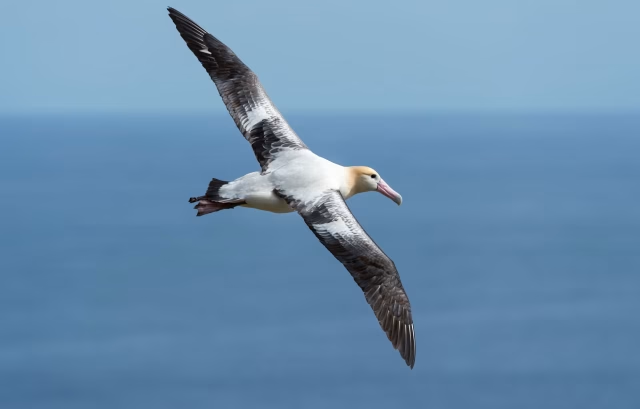
The Short-tailed Albatross is a spectacular bird, both for its appearance and its incredible conservation comeback from near-extinction.
Identification
Adults are large, with an impressive white body and neck, a golden-yellow wash on the head and nape, and black on the upper wings. The tail is white with a black terminal band. Its most distinctive feature is its massive, bright pink bill with a bluish tip. Juveniles, however, are uniformly dark, which can lead to confusion with the Black-footed, though the pink bill is a key differentiator. The Short-tailed has the largest wingspan of the three, reaching up to 7.5 feet (2.3 meters).
Distribution in North America
Primary Range: This endangered species ranges widely throughout the temperate and subarctic North Pacific.
Where to See Them: The highest concentrations in North American waters are found along the outer continental shelf of Alaska, specifically in the Aleutian Islands and the Gulf of Alaska. Small numbers are sighted annually down the coast of Washington, Oregon, and California, often as sub-adults ranging widely from their small breeding colonies off Japan and Midway Atoll.
Significance: Every sighting off the lower 48 states is significant, representing a success story for one of the most endangered seabirds on Earth.
Conservation Status
The Short-tailed Albatross was hunted to near-extinction in the early 20th century. Though its population is growing, it remains listed as Endangered under the U.S. Endangered Species Act. Conservation efforts, particularly the reduction of fishery bycatch, have been instrumental in its slow but steady recovery.
The Rarities: Vagrants
While the three species above are considered regular visitors to the eastern North Pacific, several other albatross species, typically from the Southern Ocean, are occasionally recorded as vagrants (accidental visitors) far from their normal range. The most notable of these extremely rare sightings include the Wandering Albatross and the Yellow-nosed Albatross (which is seen more commonly off the Atlantic coast). These sightings are exceptional and unpredictable, requiring incredible luck and often a high degree of skepticism until documented.
